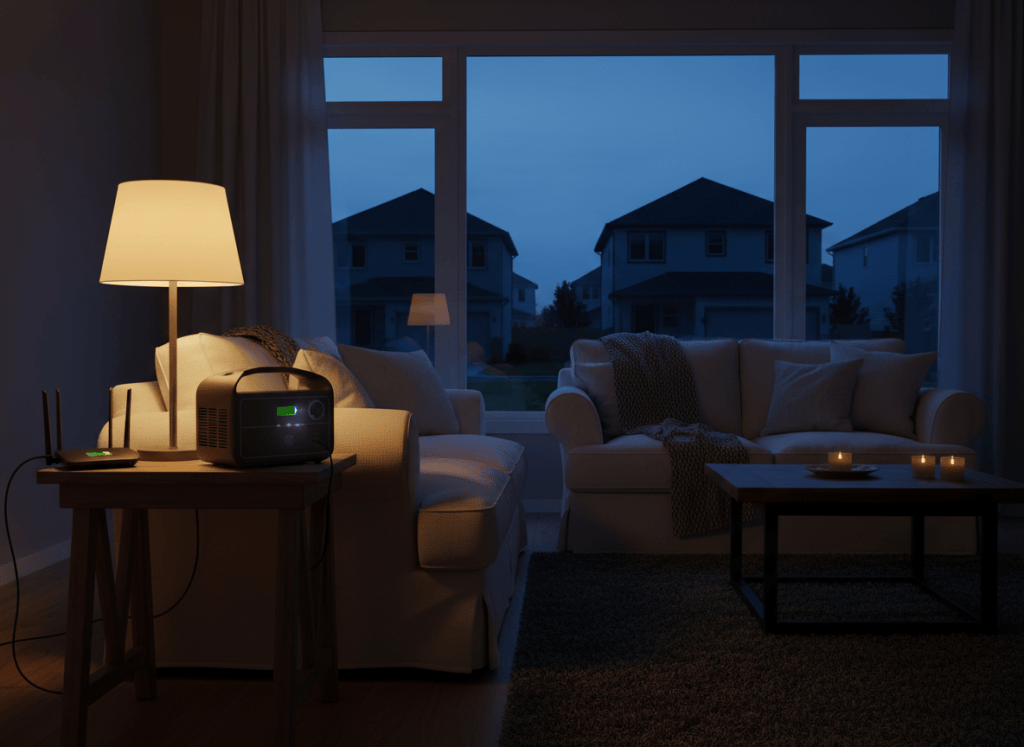
Quick answer: a portable power station is worth it if you lose power for many hours at a time (hurricane, winter storm or rural areas), if someone in your home uses a CPAP or other powered device, if you camp, road-trip or live in an RV, or if you work from home and can’t afford to go offline. It’s usually not worth it if outages where you live are rare and short and you’d only use it once or twice a year. The catch: U.S. outage averages hide the fact that a small share of homes suffer most of the long outages.
How we wrote this: outage figures come from the U.S. Energy Information Administration (EIA); runtimes are our calculated estimates with the math shown. Prices change constantly, so we compare value rather than quote prices. See How We Test.
What the official outage data says
| Measure (U.S., per customer) | Figure |
|---|---|
| Average total time without power, 2024 | About 11 hours |
| Share of 2024 outage hours caused by major events (mostly Hurricanes Beryl, Helene and Milton) | About 80% |
| Routine outages not caused by major events | About 2 hours per year, steady for over a decade |
| Average total time without power, 2022 | About 5.5 hours, across roughly 1.4 outages |
| South Carolina average, 2024 (Hurricane Helene) | About 53 hours |
| Arizona, the Dakotas and Massachusetts, 2024 | Under 2 hours |
The key insight: the everyday grid is reliable, about two hours of routine outages a year. What varies wildly is major events. In a quiet year you may barely notice an outage; in a hurricane year, your state’s average can jump to two days, and some homes wait much longer. After Hurricane Ian in 2022, some Florida customers were without power for over two weeks. A power station is insurance against those bad years, not the average one.
Is it worth it for you? Decision chart
| Your situation | Worth it? | Suggested size |
|---|---|---|
| Someone in the home uses a CPAP or another powered device at night | Yes, one of the best reasons to buy | 1 kWh or more |
| Hurricane, ice-storm or wildfire-shutoff area | Yes | 2 kWh or more, plus solar |
| Rural home with frequent long outages | Yes | 2 kWh or more |
| Remote worker who can’t lose internet | Yes, even a small unit keeps Wi-Fi and a laptop running for hours | 300 Wh–1 kWh |
| Camping, van life or RV trips several times a year | Yes, it pays off in everyday use | 300 Wh–2 kWh |
| Apartment or condo where a gas generator isn’t allowed or safe | Yes, if outages happen | 1 kWh |
| Rare, short outages and no camping | Probably not; a power bank and flashlights may be enough | Skip, or a small unit |
| You expect to run central AC or the whole house | No; you need a home battery system or standby generator | Not a portable unit |
The math: how much outage can you cover?
Capacity needed (Wh) = hours you want to cover × average watts ÷ 0.85
- Pick your essentials. A refrigerator, Wi-Fi, a lamp and phones average about 95 W together, including inverter overhead.
- Pick the hours. Example: the 2024 U.S. average of 11 hours.
- Calculate: 11 × 95 ÷ 0.85 ≈ 1,230 Wh.
In other words, a 1–1.5 kWh power station could have carried the average U.S. home’s essentials through its entire year of outages in 2024, even that bad hurricane year. For a South Carolina-style 53-hour year, you’d need around 5.9 kWh, or a 2 kWh unit plus solar recharging. For your own devices, use our sizing guide.
Where the value really comes from
- Food you don’t throw away. A refrigerator and freezer full of groceries is often the single biggest loss in a long outage. See how long a power station runs a refrigerator.
- Sleep and health equipment. For CPAP users, an outage means a night without therapy. See how many nights a power station runs a CPAP.
- Work and communication. Keeping Wi-Fi and a laptop online can save a workday and keeps you reachable in an emergency.
- Safety. Unlike a gas generator, it produces no carbon monoxide and can run indoors. Read solar vs gas generator.
- Everyday use. Camping, tailgating, road trips and backyard projects turn it from insurance into something you use every month.
- Longevity. Current LiFePO4 models are rated for about 4,000 cycles. Even weekly use would take decades to wear one out; see LiFePO4 vs lithium-ion.
Power station vs the alternatives
| Option | Best for | Indoor safe? | Main drawback |
|---|---|---|---|
| Phone power bank | Keeping phones alive for a day | Yes | Can’t run a fridge, router or CPAP for long |
| Computer UPS | A few minutes to shut down a desktop | Yes | Tiny battery; not for outages lasting hours |
| Portable power station | Fridge, CPAP, Wi-Fi and lights for hours to days; camping | Yes | Limited capacity; recharging needs sun, a car or grid power |
| Gas generator | Long outages and big loads | No, outdoors only | Noise, fuel, maintenance, carbon monoxide risk |
| Home battery or standby generator | Whole-home backup | Installed | Much higher cost; professional installation |
Torn between a portable power station and an installed home battery? See our full comparison: home battery backup vs portable power station.
Three real-world scenarios
1. A family in hurricane country
They lose power a couple of times a year, and every few years a storm knocks it out for days. Verdict: worth it. A 2 kWh unit keeps the fridge and essentials going for about 18 hours, and solar panels stretch that through a multi-day outage. See our hurricane outage checklist.
2. A renter in a reliable-grid state who never camps
Outages are rare and last an hour or two. Verdict: probably not worth it, unless someone uses a CPAP or works from home. A good power bank and a battery lantern cover most short outages.
3. A remote worker who camps on weekends
A 1 kWh unit keeps the router and laptop online for a full workday during outages (about 35 hours for a router alone), then goes camping on weekends. Verdict: worth it, because it gets used all year, not just in emergencies.
Working on a desktop instead of a laptop? Read power station vs UPS for a home office before you choose.
Common mistakes that make it “not worth it”
- Buying too small for a refrigerator, then being disappointed. A full-size fridge needs about 1 kWh for an overnight outage.
- Buying too big for occasional phone charging. You pay for capacity and weight you’ll never use.
- Letting it sit uncharged. A power station stored at 20% is worth little when the storm hits. Keep it plugged in as a UPS or top it up every few months.
- Expecting whole-house power. Central AC, electric stoves and 240 V well pumps are beyond portable units.
- Buying an old lithium-ion (NMC) clearance model. LiFePO4 lasts several times longer for a similar price.
If it’s worth it for you: where to start
| Need | Model to look at |
|---|---|
| Small, quiet, expandable starter (Wi-Fi, laptop, camping) | EcoFlow RIVER 3 Plus |
| Overnight fridge backup or CPAP, with room to grow | EcoFlow DELTA 3 Plus |
| Most power and fastest recharge in 1 kWh | Anker SOLIX C1000 Gen 2 |
| A full day of home backup | EcoFlow DELTA 3 Max Plus |
More options by need: best for home backup, best for CPAP and best for camping. Planning to buy during the holiday sales? Read what to look for in a power station before Black Friday first.
Frequently asked questions
How many years does a portable power station last?
The battery in current LiFePO4 models is rated for about 4,000 full cycles, so battery wear is rarely the limit for home and camping use. Electronics, ports and fans usually determine the real lifespan, which is why a solid warranty matters.
Is a power station better than a generator?
For indoor use, quiet nights and essentials like a fridge or CPAP, yes. For very long outages and big loads, a gas generator delivers more energy, but it must run outdoors and needs fuel and maintenance. Many households combine both.
Will a power station lower my electricity bill?
Not meaningfully for most people. Some models can charge when electricity is cheaper under time-of-use rates, but the savings are small. Buy one for backup and portability, not to save money on your bill.
Does it lose charge sitting in a closet?
Slowly, yes. Check it and top it up every few months, or keep it plugged in and use it as a UPS so it’s always full when the power goes out.
For each brand’s storage rules and the drain math, read how long a power station holds a charge in storage.
Can a power station run my whole house?
No. It covers essentials plugged into it directly. Whole-home backup needs a much larger battery system or a standby generator installed by a professional.
The bottom line
A portable power station is worth it when outages where you live are long or frequent, when someone depends on powered equipment, or when you’ll use it for camping and work too. If your grid is reliable and you’d only use it once a year, a power bank and a lantern are the smarter buy.
Sources
- U.S. Energy Information Administration, Hurricanes in 2024 led to the most hours without power in the United States in 10 years.
- U.S. Energy Information Administration, U.S. electricity customers averaged five and one-half hours of power interruptions in 2022.
- Utility Dive, coverage of EIA 2024 state outage data.

