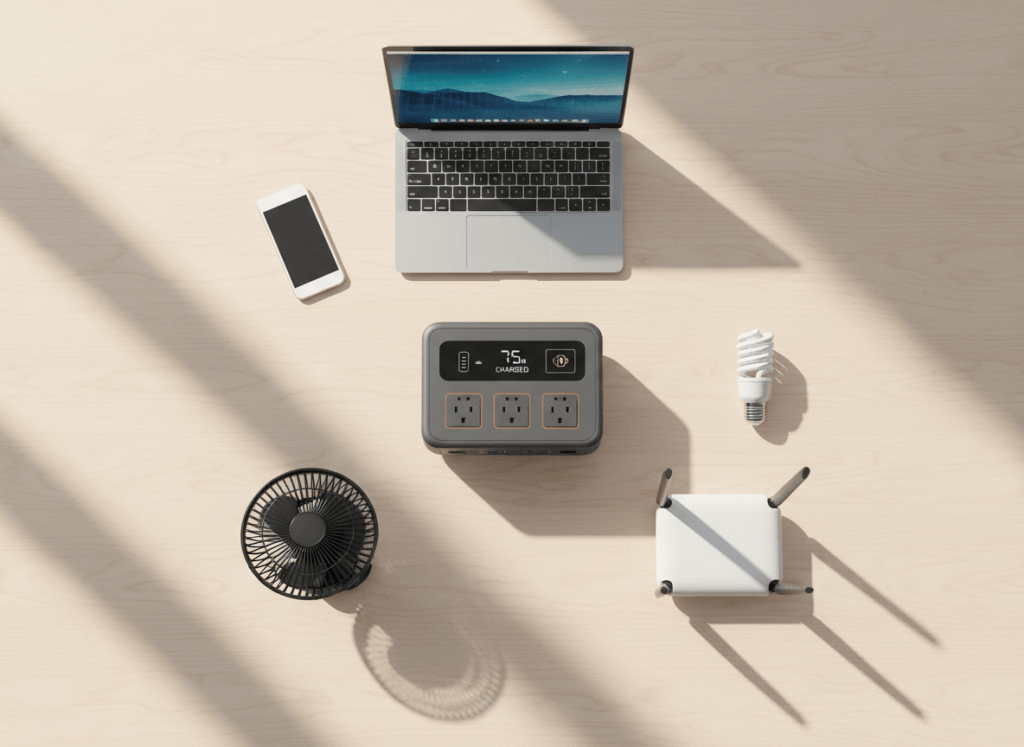
Quick answer: most people need about 500–1,000 Wh for camping, a CPAP or charging laptops and phones, and about 2,000–3,000 Wh to keep a refrigerator, Wi-Fi, lights and phones running through a full day without power. The right size for you comes from two numbers: how much energy your devices use (watt-hours) and how much power they draw at once (watts).
This guide walks you through both in four steps, with a wattage chart for common devices and three worked examples you can copy.
The wattages below are typical ranges for common U.S. appliances. Your devices may differ, so we show you how to check the label or measure. See How We Test.
Watts vs. watt-hours: the two numbers that matter
- Capacity (Wh) is the size of the fuel tank. It decides how long your devices run.
- Output
 is the size of the pipe. It decides what you can plug in at the same time. A big battery with a small inverter still can’t run a microwave.
You need to get both right. Most buying mistakes come from looking at only one of them.
Step 1: List what you want to power
Write down every device and how many hours a day you’ll use it. Be honest: the list is usually shorter during an outage than you think. Use this chart for typical power draws, or check the label on each device (watts, or volts × amps).
| Device | Typical running watts | Notes |
|---|---|---|
| Phone (charging) | 5–20 W | About 10–20 Wh per full charge |
| Wi-Fi router + modem | 10–20 W | Runs 24 hours a day |
| LED light bulb | 8–12 W | Per bulb |
| Laptop | 30–70 W | While charging and working |
| CPAP | 10–90 W | Depends mostly on the humidifier; see our CPAP guide |
| Box or pedestal fan | 30–75 W | Low settings use much less |
| LED TV (50-inch) | 60–120 W | Varies by brightness |
| Full-size refrigerator | 100–250 W running | Averages only 40–85 W over a day because the compressor cycles; see our refrigerator guide |
| Chest freezer | 60–120 W running | Very efficient if kept closed |
| Microwave | 1,000–1,500 W | Short bursts only |
| Coffee maker or electric kettle | 800–1,500 W | Short bursts only |
| Space heater | 750–1,500 W | Drains any portable battery fast |
Step 2: Add up your daily watt-hours
For each device, multiply watts by hours of use. Add the results. That’s how much energy you need per day.
Device Wh = watts × hours of use
For appliances that cycle on and off, like refrigerators, use the daily figure from the EnergyGuide label (kWh per year ÷ 365 × 1,000) instead of multiplying the running watts by 24.
Step 3: Convert to battery size, with a margin
A power station never delivers 100% of its rated capacity through the AC outlets; about 85% is a realistic planning figure. Then add a safety margin, because devices rarely behave exactly like the chart and batteries lose some capacity as they age.
Capacity needed = (daily Wh ÷ 0.85) × number of days × 1.2
If you’ll recharge every day with solar panels or a car, size for one day and let the recharging cover the rest. If you won’t be able to recharge, multiply by the number of days you need to cover.
Step 4: Check the output watts and surge
Add up the running watts of everything you might use at the same time. The power station’s continuous AC output must be higher than that total. If a fridge, freezer or pump is on your list, the surge rating must also cover its startup spike.
- Phones, lights, laptops and a CPAP only: 300–600 W of output is plenty.
- A full-size refrigerator: look for at least 1,000 W, with a higher surge rating.
- A microwave, coffee maker or kettle: you’ll need 1,500–2,000 W or more, and they will drain the battery quickly.
Three worked examples
Example 1: Power outage essentials for one day
| Device | Calculation | Daily Wh |
|---|---|---|
| Refrigerator (1.5 kWh/day label) | from the label | 1,500 Wh |
| Wi-Fi router + modem | 15 W × 24 h | 360 Wh |
| 4 LED bulbs | 40 W × 5 h | 200 Wh |
| 2 phones | 2 charges × 15 Wh | 30 Wh |
| Laptop | 50 W × 4 h | 200 Wh |
| Total | 2,290 Wh |
Capacity needed: 2,290 ÷ 0.85 × 1.2 = about 3,200 Wh for a full day with no recharging. Output: the fridge’s startup surge is the deciding factor, so choose at least 1,000 W of continuous output. If you can skip the laptop and run the fridge in cycles, a 2,000 Wh unit gets much closer.
Example 2: CPAP for one night
A CPAP with the humidifier on uses about 520 Wh per 8-hour night from the AC outlet, plus a phone charge (15 Wh). Capacity needed: 535 ÷ 0.85 × 1.2 = about 750 Wh. A unit of 750–1,000 Wh covers one night with margin; turning off the humidifier roughly halves the need.
Example 3: Weekend camping
Phones (4 charges, 60 Wh), camp lights (10 W × 5 h = 50 Wh) and a laptop (50 W × 2 h = 100 Wh) add up to about 210 Wh per day. For two days without recharging: 210 ÷ 0.85 × 2 × 1.2 = about 600 Wh. Add a 12 V compressor cooler and the number climbs quickly, so check its label; a small solar panel is often cheaper than a bigger battery.
Quick size guide by use
| What you want to do | Capacity | AC output |
|---|---|---|
| Phones, lights and a laptop on short trips | 250–500 Wh | 300–600 W |
| CPAP for one night, or a camping weekend | 500–1,000 Wh | 500–1,000 W |
| Refrigerator plus essentials through a short outage | 1,000–2,000 Wh | 1,000–2,000 W |
| Refrigerator plus essentials for a full day or more | 2,000–3,000+ Wh | 1,800–2,400+ W |
| Multi-day outages or bigger appliances | 3,000+ Wh, expandable, plus solar | 2,400+ W |
Three more things to consider before you buy
- Battery chemistry. LiFePO4 (lithium iron phosphate) batteries last for far more charge cycles than older lithium-ion designs and are now standard on most new models. For a unit you’ll keep for years, it’s worth it.
- Weight. Capacity is heavy. Units around 2,000 Wh often weigh 40 pounds or more, so think about who will carry it and where.
- Expandability. Some power stations accept add-on batteries. Buying a mid-size unit you can expand later can be smarter than paying for the biggest one today.
Frequently asked questions
Is a 1,000 Wh power station enough?
For camping, a CPAP or keeping phones, lights and a router running, yes. For a full-size refrigerator, it covers roughly 9 to 16 hours, which is enough for many short outages but not for a full day with everything else plugged in.
Can a power station run a space heater?
Technically yes, if its output is high enough, but not for long. A 1,500 W heater would empty a 1,000 Wh unit in well under an hour. Warm clothing and blankets are a far better use of your battery.
Is it better to buy a bigger power station or add solar panels?
For outages longer than a day, solar is usually the better value: it refills the battery every sunny day. For short outages or overnight use, a bigger battery is simpler because it works regardless of the weather.
The bottom line
List your devices, add up the watt-hours, add a 20% margin and check that the output watts cover everything you’ll run at once. For most households that points to 500–1,000 Wh for light use and 2,000–3,000 Wh if the refrigerator is on the list.


Leave a comment