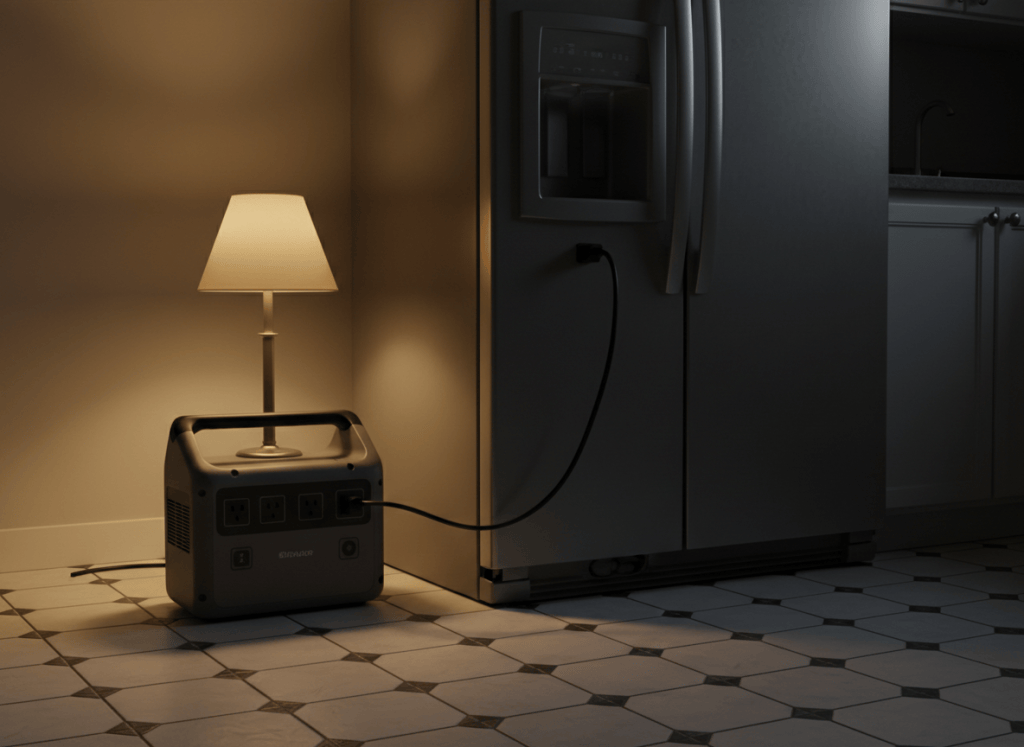
Quick verdict: the Anker SOLIX C2000 Gen 2 is one of the lightest 2 kWh power stations you can buy (41.7 lb), and its 9 W idle draw means more of its 2,048 Wh reaches your devices. It runs an average refrigerator for about 24 hours, delivers 2,400 W continuous (4,000 W peak), recharges fully in 58 minutes with AC and solar together, and has a TT-30 outlet for RVs. The trade-offs: 800 W of solar input and expansion to only about 4 kWh, where the EcoFlow DELTA 3 Max Plus offers 1,000 W and up to 10 kWh.
| Buy it if you… | Skip it if you… | Key numbers |
|---|---|---|
| Want a full day of fridge backup in a unit one adult can still move Own an RV with a 30 A (TT-30) plug Want a fast UPS for a home office | Need more than about 4 kWh of total storage Plan to rely mostly on solar with more than 800 W of panels Want something to carry to a campsite | 2,048 Wh · 2,400 W (4,000 W peak) ~24 h average fridge 58 min full charge (AC + solar) 41.7 lb · 5-year warranty |
How we reviewed it: this is an analysis of Anker’s official specifications, checked in September 2026, plus our own runtime calculations with the math shown. It is not a hands-on test. Charging times are Anker’s figures from its internal testing. Prices change daily, so compare the current price before you buy. See How We Test.
Pros and cons
| Pros | Cons |
|---|---|
| Very low 9 W idle draw, which stretches runtime on small loads | Solar input tops out at 800 W on a single XT-60i port |
| Light for its class: 41.7 lb, 7 lb less than the DELTA 3 Max Plus | Expands to about 4 kWh, not 10 kWh like some rivals |
| Full charge in 58 minutes with AC + solar; 88 minutes on AC alone | 2,400 W continuous is less than the 3,000 W of the DELTA 3 Max Plus |
| 2,400 W continuous, 4,000 W peak: handles a fridge start plus a microwave | The 800 W alternator charging needs Anker’s alternator charger, which isn’t in the box |
| Built-in TT-30 outlet for RVs, plus a bi-directional home inlet option | Only one USB-A port, and the small USB ports share 20 W |
| 10 ms UPS switchover for computers, routers and medical devices | At 41.7 lb it’s movable, not truly portable |
| LiFePO4 rated for 4,000 cycles to 80%, and a 5-year warranty | Won’t charge below freezing (32°F) |
Full specifications
| Specification | Anker SOLIX C2000 Gen 2 |
|---|---|
| Capacity | 2,048 Wh (51.2 V, 40 Ah) |
| Battery chemistry and cycles | LiFePO4 (LFP), 4,000 cycles to 80% capacity |
| AC output (peak) | 2,400 W continuous (4,000 W peak), 120 V pure sine wave |
| AC outlets | 5 household outlets (NEMA 5-20R) + 1 TT-30R RV outlet |
| USB-C | 2 × 140 W + 1 × 15 W |
| USB-A | 1 × 12 W (shares 20 W with the 15 W USB-C) |
| 12 V output | Car socket, 12 V 10 A (about 120 W) |
| Home connection | Bi-directional inlet box output, 15 A / 1,800 W (installed by an electrician) |
| AC charging | 1,800 W; 100% in 88 minutes |
| AC + solar charging | 2,600 W combined; 80% in 45 min, 100% in 58 min |
| Solar input | 800 W max, 11–60 V, 17 A max, XT-60i connector |
| Car charging | 100 W socket (about 23 h); 800 W with Anker’s alternator charger (about 3 h) |
| UPS switchover | 10 ms |
| Idle power draw | 9 W |
| Noise | 30 dB under 1,000 W (Anker figure) |
| Charging temperature | 32–104°F (0–40°C) |
| Operating (discharge) temperature | -4–104°F (-20–40°C) |
| Dimensions | 18.1 × 9.8 × 10.1 in (459 × 250 × 257 mm) |
| Weight | 41.7 lb (18.9 kg) |
| Expansion | One BP2000 Expansion Battery (Gen 2), 2,048 Wh, for about 4 kWh total |
| App and modes | Wi-Fi/Bluetooth app; Standard, Time-of-Use, Storm Guard and Fast Charging Plan modes |
| Warranty | 5 years |
Why the 9 W idle draw matters
Every power station burns some energy just keeping its inverter on, even with nothing plugged in. Anker rates the C2000 Gen 2 at 9 W and says it’s the first 2 kWh unit under 10 W. That matters most with small loads that run for many hours, like a router, a CPAP or an efficient fridge, because the idle draw is a big share of the total.
Two practical takeaways. First, our runtime estimates already add 10 W for the inverter, so the C2000 Gen 2 should land on or slightly above our numbers. Second, if you leave the AC outlets switched on with nothing plugged in, 9 W still empties the usable battery in about 8 days (1,741 Wh ÷ 9 W ≈ 193 h). Switch AC off when you store it, or keep it plugged into the wall.
Ports explained: what to plug in where
| Port | Best for |
|---|---|
| 5 AC outlets (20 A type) | Refrigerator, freezer, CPAP, TV, microwave, coffee maker, power tools. All five share the 2,400 W total. |
| TT-30R outlet | An RV’s 30 A shore-power cord, to run the RV’s 120 V circuits directly (still limited to 2,400 W) |
| 2 × USB-C 140 W | Laptops, tablets, camera batteries. More efficient than using the laptop’s AC charger. |
| USB-C 15 W and USB-A 12 W | Phones, earbuds, LED lanterns (20 W combined when both are used) |
| 12 V car socket | 12 V compressor coolers, tire inflators, 12 V fans |
| Bi-directional inlet | Feeding selected home circuits through an inlet box or transfer switch, installed by a licensed electrician |
| XT-60i and AC inputs | Solar panels (11–60 V) and wall charging; both can charge at once |
Charging options and times
| Method | Max input | 0–100% |
|---|---|---|
| AC + solar together | 2,600 W | 58 min (80% in 45 min) |
| Wall outlet (AC only) | 1,800 W | 88 min |
| Gas or inverter generator | 1,800 W | 88 min |
| Solar only | 800 W | About 3 h in ideal sun (Anker); about 3.4 peak-sun hours with 800 W of panels in real use (our estimate) |
| Alternator charger (sold separately) | 800 W | About 3 h of driving |
| Car socket | 100 W | About 23 h |
The headline 58-minute figure needs AC and solar at the same time. On a wall outlet alone, plan on about an hour and a half, which is still fast enough to top up between rolling blackouts. For solar sizing, see how many solar panels you need.
Runtime chart: 10 common appliances
Formula: hours = (Wh × 0.85) ÷ (appliance watts + 10 W inverter). Example: an average refrigerator uses about 1.5 kWh a day, or 62.5 W on average. 2,048 × 0.85 = 1,741 Wh usable; 62.5 + 10 = 72.5 W; 1,741 ÷ 72.5 ≈ 24 hours.
| Appliance (average draw) | C2000 Gen 2 (2,048 Wh) | With BP2000 Gen 2 (4,096 Wh) |
|---|---|---|
| Average refrigerator (1.5 kWh/day) | ~24 hours | ~48 hours |
| Efficient refrigerator (1.0 kWh/day) | ~34 hours | ~67 hours |
| CPAP, no humidifier (~320 Wh/night) | ~5.4 nights | ~10.9 nights |
| CPAP with humidifier (~520 Wh/night) | ~3.3 nights | ~6.7 nights |
| Wi-Fi router + modem (15 W) | ~70 hours | ~139 hours |
| Laptop via AC (50 W) | ~29 hours | ~58 hours |
| Box fan (50 W) | ~29 hours | ~58 hours |
| 50-inch LED TV (100 W) | ~16 hours | ~32 hours |
| Microwave (1,000 W) | ~1 h 40 min of cooking | ~3 h 25 min of cooking |
| Space heater (1,500 W) | ~70 minutes | ~2 h 20 min |
Anker quotes 15–32 hours for a dual-door fridge, which brackets our average and efficient estimates. For your own fridge, use our refrigerator runtime guide; for CPAP details, see how many nights a power station runs a CPAP.
Three real-world scenarios
1. A storm outage: fridge and essentials
Fridge, Wi-Fi, a lamp and phones average about 95 W. On its own, the C2000 Gen 2 lasts about 18 hours (1,741 ÷ 95); with the BP2000 Gen 2, about 37 hours. Add 400 W of panels and a 4-sun-hour day brings in about 1,200 Wh (400 × 0.75 × 4), against a daily need of 2,280 Wh (95 × 24), so the base unit lasts about 1.6 days. At the full 800 W of solar, the same day brings in about 2,400 Wh, enough to cover this load on sunny days, with the battery carrying you through the night.
2. A home office through a workday outage
A desktop PC (about 150 W), a monitor (30 W) and a router with modem (15 W) draw about 195 W, or 205 W with the inverter. The C2000 Gen 2 covers about 8.5 hours (1,741 ÷ 205), a full workday. Keep it plugged in between the wall and your desk: the 10 ms UPS switches over before most computers notice the outage.
Deciding between this and a regular desktop UPS? See power station vs UPS for a home office.
3. One night: fridge plus a CPAP with humidifier
Twelve hours of an average fridge (12 × 72.5 = 870 Wh) plus a CPAP with humidifier for 8 hours (about 520 Wh) adds up to about 1,390 Wh. That fits in the C2000 Gen 2’s 1,741 usable watt-hours with about 350 Wh (20%) to spare for phones and a lamp. A 1 kWh unit couldn’t cover both.
C2000 Gen 2 vs the competition
| Spec | Anker C2000 Gen 2 | EcoFlow DELTA 3 Max Plus | Anker C1000 Gen 2 | EcoFlow DELTA 3 Plus |
|---|---|---|---|---|
| Capacity | 2,048 Wh | 2,048 Wh | 1,024 Wh | 1,024 Wh |
| AC output (peak) | 2,400 W (4,000 W) | 3,000 W (6,000 W) | 2,000 W (3,000 W) | 1,800 W (3,600 W) |
| AC outlets | 5 + TT-30 | 4 (20 A) | 5 | 6 |
| Fastest charge | 58 min (AC + solar); 88 min AC | About 1,800 W AC input | About 49 min | 56 min |
| Max solar | 800 W | 1,000 W | 600 W | 1,000 W |
| UPS | 10 ms | Under 10 ms | 10 ms | Under 10 ms |
| Weight | 41.7 lb | 48.7 lb | 24.9 lb | 27.6 lb |
| Expandable | To about 4 kWh | 2–10 kWh | No | Up to 5 kWh |
| Warranty | 5 years | 3 + 2 years with registration | 5 years | 5 years |
| Our review | This page | Read | Read | Read |
Against the EcoFlow DELTA 3 Max Plus: same capacity. The Anker is 7 lb lighter, idles more efficiently and has a TT-30 outlet. The EcoFlow has more output, more solar input and can grow to 10 kWh. Against the 1 kWh models: the C2000 Gen 2 doubles runtime for about 14–17 extra pounds. If you’re torn between sizes, read 1 kWh or 2 kWh?
Who should buy it, and who shouldn’t
- Buy it if you want a full day of fridge backup, a fast UPS for a home office, or an RV hookup, and you care about weight. It’s a strong middle ground between 1 kWh units and heavy home-backup systems.
- Look at the EcoFlow DELTA 3 Max Plus if you want 3,000 W of output, more solar input or room to grow past 4 kWh.
- Look at the Anker C1000 Gen 2 if you mostly need overnight backup or camping power and want something you can carry with one hand.
- Skip portable units entirely if you expect to run central AC or the whole house; that needs a home battery system or a standby generator. Compare options in our best power stations for home backup.
Frequently asked questions
How long will the Anker SOLIX C2000 Gen 2 run a refrigerator?
About 24 hours for an average fridge using 1.5 kWh a day, and about 34 hours for an efficient one using 1.0 kWh a day, by our estimates. With the BP2000 Gen 2 expansion battery, those numbers roughly double.
Can the C2000 Gen 2 charge in cold weather?
Anker lists a charging range of 32–104°F (0–40°C), so it won’t charge below freezing. It can still power devices down to -4°F (-20°C). In a cold garage, bring it indoors to recharge.
Can I charge it with the USB-C ports?
No. Anker says the USB-C ports are output only. Charge it from a wall outlet, solar panels, a generator or your car.
Can it power an RV?
Yes, through the built-in TT-30 outlet, which accepts a standard 30 A RV plug. Total output is still limited to 2,400 W, so running the RV’s air conditioner together with other big loads may not work.
Is the C2000 Gen 2 worth waiting for Black Friday?
If you don’t need it for an upcoming storm, waiting can make sense, as long as you track the price history. Our Black Friday buying guide shows how to spot a real deal.
The bottom line
On paper, the Anker SOLIX C2000 Gen 2 is one of the most balanced 2 kWh power stations: light for its class, very efficient at idle, fast to recharge, with a 10 ms UPS, a TT-30 outlet and a 5-year warranty. Choose it for a full day of essential backup without a 50-pound box. Choose the EcoFlow DELTA 3 Max Plus instead if you need more output, more solar or a path to 10 kWh.
Sources
- Anker SOLIX, C2000 Gen 2 official product page and specifications.
- Anker SOLIX, C2000 Gen 2 overview page.
- ESS News, Anker Solix releases C2000 Gen 2 with lower idle power draw.
- Trusted Reviews, Anker SOLIX C2000 Gen 2 review (warranty).
- Renewable Outdoors (authorized Anker dealer), C2000 Gen 2 listing (warranty).
- EcoFlow, DELTA 3 Max Plus specifications and DELTA 3 Plus product page.
- ShopSolar (authorized dealer), Anker SOLIX C1000 Gen 2 listing (warranty).

