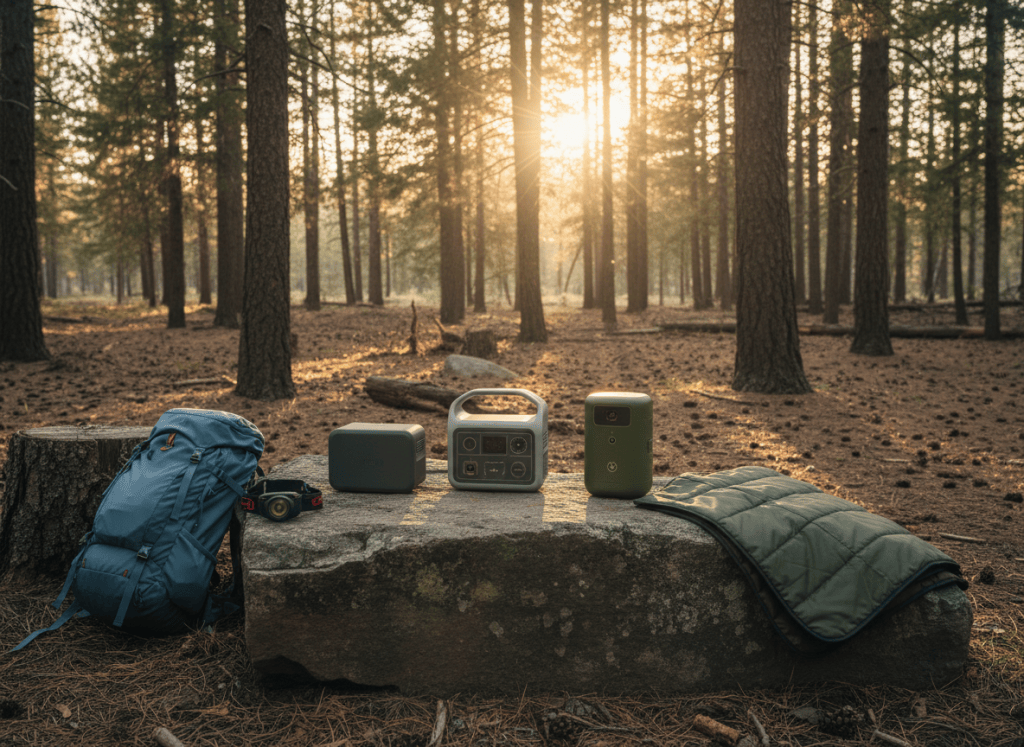
Our picks: the EcoFlow RIVER 3 Plus is the best small power station for most campers because it has twice the output of its rivals and can grow from 286 Wh to 858 Wh. The Anker SOLIX C300X offers the most outlets, a 10 ms UPS and a 5-year warranty. The Jackery Explorer 300 Plus is the lightest at 8.27 lb. If you car camp with a 12 V fridge or stay out for several days, step up to the BLUETTI Elite 100 V2 (1,024 Wh).
| Pick | Best for | Weight |
|---|---|---|
| EcoFlow RIVER 3 Plus | Best overall: most output, expandable | 10.4 lb |
| Anker SOLIX C300X | Most ports and longest warranty | About 9 lb |
| Jackery Explorer 300 Plus | Lightest; backpack-friendly | 8.27 lb |
| BLUETTI Elite 100 V2 | Car camping, 12 V fridges, multi-day trips | 25.3 lb |
How we chose: research-based picks from each manufacturer’s official specifications and our transparent runtime math, not hands-on tests. See How We Test.
What matters in a camping power station
- Weight versus capacity: around 300 Wh covers phones, lights and a laptop for a weekend at under 11 lb; 1 kWh units weigh about 25 lb.
- USB-C power: most camping gear charges by USB-C, which is more efficient than the AC outlet. Look for at least one 100 W port.
- A 12 V car outlet: for compressor coolers, tire inflators and CPAP DC converters.
- Solar input: the real key to staying out longer than a weekend.
- Quiet operation: it may sit inside your tent.
- LiFePO4 chemistry: thousands of cycles instead of hundreds; see LiFePO4 vs lithium-ion.
Our picks compared
| EcoFlow RIVER 3 Plus | Anker SOLIX C300X | Jackery Explorer 300 Plus | BLUETTI Elite 100 V2 | |
|---|---|---|---|---|
| Capacity | 286 Wh (to 858 Wh) | 288 Wh | 288 Wh | 1,024 Wh |
| Battery cycles | 3,000 to 80% | 3,000+ to 80% | 3,000 to 80% | 4,000+ to 80% |
| AC output (surge) | 600 W (1,200 W) | 300 W (600 W) | 300 W (600 W) | 1,800 W (3,600 W) |
| AC outlets | 3 | 3 | 1 | 4 |
| Best USB-C | 100 W | 140 W (×2) | 100 W (in/out) | 140 W |
| 12 V car outlet | Yes (126 W) | Yes (120 W) | Yes (12 V, 10 A) | Yes |
| Wall recharge | About 1 hour | Up to 330 W input | About 2 hours | 0–80% in about 45 min |
| Max solar | 220 W | 100 W | 100 W | 1,000 W |
| UPS | Under 10 ms | 10 ms | Bypass mode | 10 ms |
| Rated noise | Under 30 dB | 25 dB | Not a headline spec | 30 dB or less |
| Size | 9.2 × 9.1 × 5.7 in | 6.5 × 6.3 × 9.5 in | 9.1 × 6.1 × 6.6 in | 12.6 × 8.5 × 9.8 in |
| Weight | 10.4 lb | About 9 lb | 8.27 lb | 25.3 lb |
How long each one runs your camping gear
| Device | ~286–288 Wh units | RIVER 3 Plus + EB600 (858 Wh) | BLUETTI Elite 100 V2 (1,024 Wh) |
|---|---|---|---|
| Phone charges (~15 Wh each) | ~15 | ~45 | ~55 |
| Laptop (50 W, via AC) | ~4 hours | ~12 hours | ~14 hours |
| 12 V compressor cooler (~20 W average, via car outlet) | ~12 hours | ~1.5 days | ~1.8 days |
| String of camp lights (~10 W) | ~12 hours via AC | ~36 hours | ~43 hours |
| CPAP, humidifier off (via AC) | ~6 hours | ~2.3 nights | ~2.7 nights |
1. EcoFlow RIVER 3 Plus: best overall for camping
The RIVER 3 Plus gives you the most flexibility in a small package: 600 W of output, double the Anker and Jackery picks, plus quiet sub-30 dB operation, a one-hour wall recharge, up to 220 W of solar and a UPS under 10 ms. Stack EcoFlow’s extra battery underneath later and it grows to 858 Wh, enough for a 12 V cooler over a long weekend.
- Choose it if: you want room to grow and enough output for a small blender or electric blanket.
- Skip it if: every ounce counts; it’s the heaviest of the small picks.
Full details: EcoFlow RIVER 3 Plus review.
2. Anker SOLIX C300X: most ports and longest warranty
The C300X packs 8 ports into a compact, upright body: 3 AC outlets, 3 USB-C (including two 140 W), a USB-A port and a car socket, plus a built-in ambient light with an SOS mode. It has a 10 ms UPS, a rated noise level of 25 dB, a 288 Wh LiFePO4 battery rated for 3,000+ cycles to 80% and a 5-year warranty. Solar input tops out at 100 W, about 3.2 hours to refill with one 100 W panel in good sun.
- Choose it if: you charge lots of USB-C gear (laptops, cameras, drones) and value a long warranty.
- Skip it if: you need more than 300 W from the AC outlets.
3. Jackery Explorer 300 Plus: lightest option
At 8.27 lb and about the size of a lunchbox, the Explorer 300 Plus fits in a backpack. It has a 288 Wh LiFePO4 battery rated for 3,000 cycles to 80%, one 300 W AC outlet (600 W peak), a 100 W USB-C port that works for both charging and output, a second USB-C, a USB-A and a car port, plus app control. It charges from the wall in about 2 hours, or from a 100 W solar panel through USB-C.
- Choose it if: you hike to your campsite or have very limited space.
- Skip it if: you need more than one AC device at a time.
4. BLUETTI Elite 100 V2: best for car camping and longer trips
If you drive to your campsite, a 1 kWh unit opens up much more: running a 12 V fridge for nearly two days, boiling water with an electric kettle, or powering a CPAP for several nights. The Elite 100 V2 offers 1,024 Wh, 1,800 W of output (3,600 W surge), 11 ports, up to 1,000 W of solar input, a 10 ms UPS and a rated noise level of 30 dB or less, all at 25.3 lb in a relatively compact body. BLUETTI says it charges to 80% in about 45 minutes.
- Choose it if: you car camp, overland or live in a van.
- Skip it if: you need to carry it more than a short distance.
Compare it with its closest rival in BLUETTI vs EcoFlow.
How much power do you need for camping?
| Your camping style | Suggested capacity | Our pick |
|---|---|---|
| Phones, headlamps and a camera for a weekend | 250–300 Wh | Jackery 300 Plus or Anker C300X |
| Add a laptop, drone or CPAP | 300–800 Wh, or a small unit plus solar | RIVER 3 Plus (expandable) |
| A 12 V fridge, electric kettle or several days out | 1,000 Wh or more | BLUETTI Elite 100 V2 |
To size it exactly, use our power station sizing guide.
Pairing it with solar
| Power station | Suggested panel | Approximate refill in strong sun |
|---|---|---|
| Jackery 300 Plus / Anker C300X | One 100 W panel | About 3.5–4 hours |
| EcoFlow RIVER 3 Plus | One 200 W panel | About 2 hours |
| BLUETTI Elite 100 V2 | 200–400 W of panels | About 3.5–7 hours |
Camping tips to get more from your battery
- Charge by USB-C when you can: it skips the inverter and wastes less energy than plugging a charger into the AC outlet.
- Turn off the AC outlets when you aren’t using them; the inverter uses power just by being on.
- Keep it in the shade in summer and inside the tent or car on cold nights. Batteries shouldn’t be charged below 32°F.
- Top up while driving between campsites through the car outlet.
Frequently asked questions
Can a small power station run a coffee maker?
Usually not. Most drip coffee makers and kettles draw 800–1,500 W, beyond the 300–600 W small units provide. For hot drinks at camp, a 1 kWh unit like the BLUETTI Elite 100 V2 or a camp stove is the practical choice.
Can I take a camping power station on a plane?
No. U.S. airline rules don’t allow passengers to carry lithium batteries larger than 160 Wh, and all our picks are larger. Check with your airline before you fly.
Is it safe to use a power station inside a tent?
Yes, unlike a gas generator: it produces no fumes or carbon monoxide. Keep it dry, give it some airflow and don’t cover its vents with sleeping bags.
The bottom line
For most campers, a small LiFePO4 unit around 300 Wh is plenty. Pick the EcoFlow RIVER 3 Plus if you want room to grow, the Anker SOLIX C300X for ports and warranty, or the Jackery Explorer 300 Plus if every pound counts. For car camping with a fridge, go straight to the BLUETTI Elite 100 V2.
Sources
- EcoFlow, RIVER 3 Plus specifications (official).
- Anker, SOLIX C300X datasheet (PDF).
- Jackery, Explorer 300 Plus specifications (official).
- BLUETTI, Elite 100 V2 and Elite series buying guide (official).

