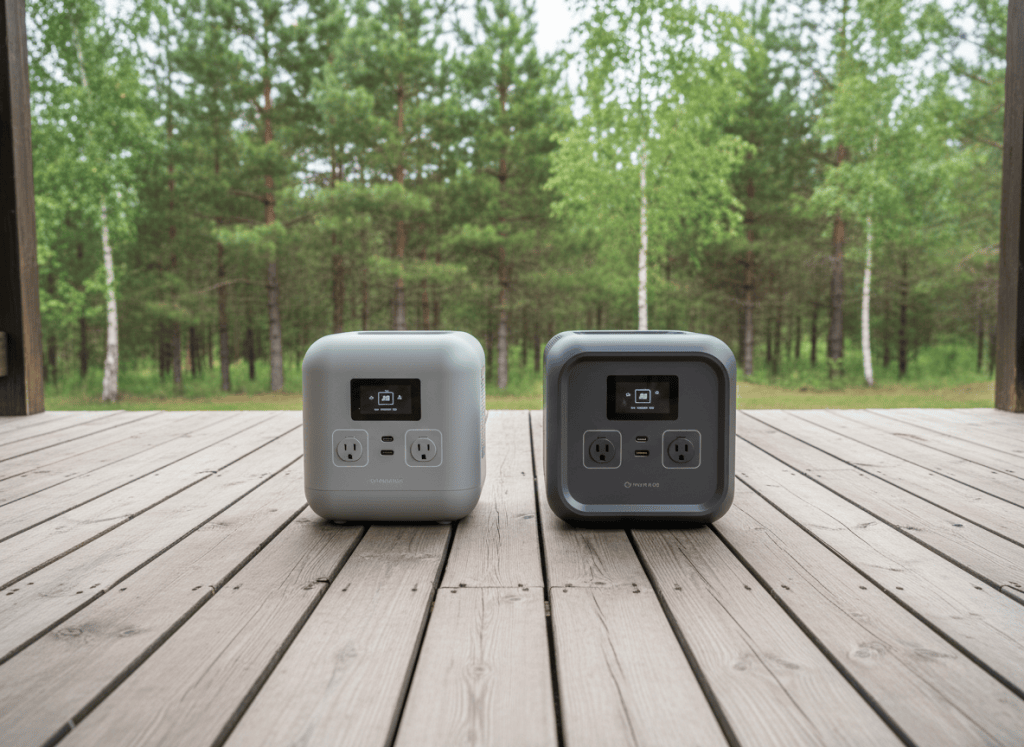
Quick verdict: the BLUETTI Elite 100 V2 and EcoFlow DELTA 3 Plus are closer than any other pair we’ve compared: both have 1,024 Wh LiFePO4 batteries rated for 4,000 cycles to 80%, 1,800 W of output with a 3,600 W surge, up to 1,000 W of solar input and UPS switching of about 10 ms. Choose EcoFlow if you want to expand to 5 kWh or need more AC outlets. Choose BLUETTI if you want a smaller, lighter, quieter unit to carry around.
| Category | Winner | Why |
|---|---|---|
| Expandability | EcoFlow | Up to 5 kWh vs limited |
| AC outlets | EcoFlow | 6 vs 4 |
| Full wall recharge | EcoFlow | 0–100% in 56 min |
| Warranty clarity | EcoFlow | 5 years listed on the product page |
| Size and weight | BLUETTI | 25.3 lb and a smaller footprint vs 27.6 lb |
| Quiet operation | BLUETTI | 30 dB or less in quiet mode |
| Fast top-up | BLUETTI | 0–80% in about 45 min |
| Capacity, output, solar, UPS | Tie | Same headline numbers |
How we compared: a specification comparison using each manufacturer’s official pages, not a hands-on test. Runtimes are our calculated estimates. See How We Test.
Full specs side by side
| Specification | BLUETTI Elite 100 V2 | EcoFlow DELTA 3 Plus |
|---|---|---|
| Capacity | 1,024 Wh | 1,024 Wh |
| Battery | LiFePO4, 4,000+ cycles to 80% | LiFePO4, 4,000 cycles to 80% |
| Expandable | Limited; not marketed as expandable like the DELTA 3 Plus | Yes, up to 5 kWh |
| AC output | 1,800 W (2,700 W Power Lifting, 3,600 W surge) | 1,800 W (2,200 W X-Boost, 3,600 W surge) |
| AC outlets | 4 | 6 |
| USB-C | 1 × 140 W, 1 × 100 W | 2 × 140 W |
| USB-A | 2 | 2 fast-charge (36 W max) |
| 12 V outputs | Car outlet + 2 DC5521 | Car outlet (126 W) + 2 DC5521 |
| Total output ports | 11 | 13 |
| Fast wall charging | 1,200 W; 0–80% in about 45 min | 1,500 W; 0–100% in 56 min |
| Max solar input | 1,000 W | 1,000 W (2 × 500 W) |
| UPS switchover | 10 ms | Under 10 ms |
| Rated noise | 30 dB or less (quiet mode) | Under 30 dB up to 600 W |
| Dimensions | 12.6 × 8.5 × 9.8 in | 15.7 × 8.0 × 11.2 in |
| Weight | 25.3 lb (11.5 kg) | 27.6 lb (12.5 kg) |
| Warranty | Check BLUETTI’s current listing | 5 years |
Runtime: identical
Same capacity means the same runtimes in our estimates: about 12 hours for an average refrigerator, about 9 hours for a fridge plus Wi-Fi, a lamp and phones, about 1.7 nights for a CPAP with the humidifier on and about 35 hours for a Wi-Fi router. See our refrigerator and CPAP guides for the math.
Where EcoFlow wins
- Expandability: add EcoFlow extra batteries up to 5 kWh, about two and a half days of refrigerator backup. That’s the single biggest difference between these two.
- More AC outlets: six versus four, useful when powering a fridge, router, lamp, fan and a TV at once without a power strip.
- Full recharge: 0–100% in 56 minutes from the wall.
- Smart features: storm warning alerts and time-of-use scheduling in the EcoFlow app.
Where BLUETTI wins
- Smaller and lighter: 2.3 lb lighter and noticeably shorter (9.8 vs 11.2 in), easier to tuck under a car seat or in a closet.
- Quiet by design: BLUETTI rates it at 30 dB or less in quiet mode, a plus next to a bed or in a tent.
- Power Lifting: runs resistive appliances like kettles and hair dryers up to 2,700 W at reduced power, higher than EcoFlow’s 2,200 W X-Boost.
- Fast top-up: to 80% in about 45 minutes, handy right before a storm.
Three scenarios: which wins?
| Scenario | Better choice | Why |
|---|---|---|
| Home backup in an area with long outages | EcoFlow | Expand to 5 kWh; more outlets |
| Car camping and van life | BLUETTI | Smaller, lighter, quiet; same solar input |
| CPAP in the bedroom | Either | Both quiet with ~10 ms UPS; see our CPAP picks |
Which should you buy?
| If you… | Choose |
|---|---|
| Want home backup you can expand later | EcoFlow DELTA 3 Plus |
| Need to run many AC devices at once | EcoFlow DELTA 3 Plus |
| Will carry it often or use it in a tent or van | BLUETTI Elite 100 V2 |
| Want the smallest 1 kWh box for a closet or car | BLUETTI Elite 100 V2 |
| Mainly need a CPAP, phones and lights | Either; pick the one on sale |
Also considering Anker or Jackery? See Anker SOLIX C1000 Gen 2 vs EcoFlow DELTA 3 Plus and EcoFlow vs Jackery. The BLUETTI is also our car camping pick in best power stations for camping.
Frequently asked questions
Is BLUETTI as reliable as EcoFlow?
Both are established brands, and both rate these models for 4,000 cycles to 80% capacity on LiFePO4 cells. How you store and charge the unit matters more than the logo on it.
What’s the difference between Power Lifting and X-Boost?
Both let the power station run resistive devices, like kettles or hair dryers, rated above its continuous output by lowering the voltage, so the device runs at reduced power. BLUETTI’s Power Lifting goes up to 2,700 W; EcoFlow’s X-Boost up to 2,200 W. Neither raises the true continuous output, which is 1,800 W on both.
Can both recharge fully from solar in a day?
Yes, with enough panels. Both accept 1,000 W; with real-world losses, that’s roughly 1.5 hours of strong sun from empty. See how many solar panels you need.
The bottom line
You can’t go far wrong with either. For home backup, EcoFlow’s expandability and extra outlets tip the balance. For carrying, camping and quiet nights, BLUETTI’s smaller, lighter, quieter design is the better fit.
Sources
- BLUETTI, Elite 100 V2, Elite 100 V2 vs AC180 and Elite series buying guide (official).
- EcoFlow, DELTA 3 Plus (official product page).
- StorageReview, EcoFlow DELTA 3 Plus Review (full specifications).

