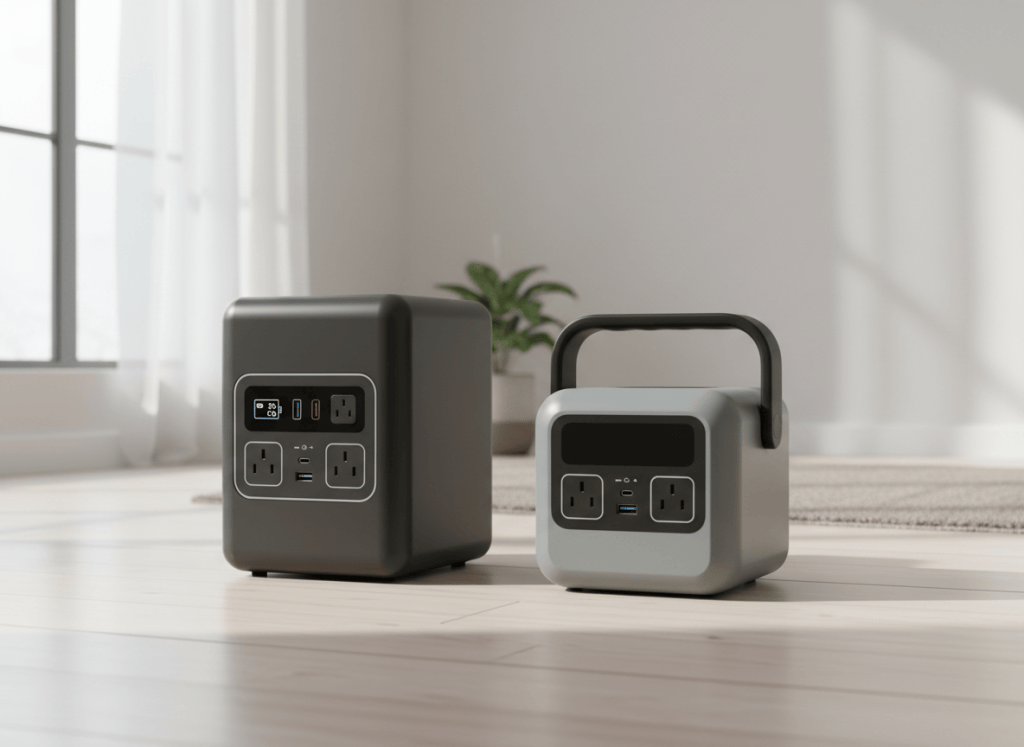
Quick verdict: for home backup, the EcoFlow DELTA 3 Plus is the stronger choice: more output, twice as many AC outlets, faster UPS switching, more solar input and a battery you can expand later. For camping and carrying around, the Jackery Explorer 1000 v2 is the better fit: it’s about 4 pounds lighter and holds slightly more energy. Both use long-life LiFePO4 batteries and charge from empty in about an hour.
EcoFlow and Jackery are the two best-known portable power station brands in the U.S., and their 1 kWh models are the ones most people end up choosing between. Here’s how they compare.
How we compared: this is a specification comparison based on each manufacturer’s official product pages, linked below, not a hands-on test. Runtime figures are our calculated estimates. See How We Test.
Specs side by side
| Specification | EcoFlow DELTA 3 Plus | Jackery Explorer 1000 v2 |
|---|---|---|
| Capacity | 1,024 Wh | 1,070 Wh |
| Battery chemistry | LiFePO4, 4,000 cycles to 80% | LiFePO4, 4,000 cycles to 70% |
| AC output | 1,800 W (2,200 W with X-Boost), 3,600 W surge | 1,500 W, 3,000 W surge |
| AC outlets | 6 | 3 |
| Fastest AC recharge (0–100%) | 56 minutes | About 1 hour (Emergency mode in the app) |
| Max solar input | 1,000 W (2 × 500 W) | 400 W |
| UPS switchover | Under 10 ms | 20 ms or less |
| Expandable capacity | Yes, up to 5 kWh with extra batteries | No extra battery port listed |
| Weight | 27.6 lb (12.5 kg) | 23.8 lb (10.8 kg) |
| Warranty | 5 years | 3 years + 2-year extension when bought from Jackery’s site |
Capacity and runtime: practically a tie
The Jackery holds about 4% more energy (1,070 Wh vs 1,024 Wh). In real use you won’t notice it: that’s roughly 30 extra minutes of refrigerator runtime. Using our refrigerator runtime formula, both run an average full-size fridge for about 11–13 hours, and both cover a CPAP for about 1.5 nights with the humidifier on.
One detail worth knowing: the two brands rate battery lifespan differently. EcoFlow quotes 4,000 cycles to 80% capacity, Jackery 4,000 cycles to 70%. Either way, that’s more than a decade of normal use.
Output: EcoFlow runs more at once
This is the biggest practical difference. The DELTA 3 Plus delivers 1,800 W continuous with six AC outlets, while the Explorer 1000 v2 delivers 1,500 W with three. During an outage, that means the EcoFlow can run a refrigerator, a router, lights and a microwave for a short time without you juggling plugs. EcoFlow’s X-Boost mode can also run some resistive devices rated up to 2,200 W at reduced power.
Both surge ratings (3,600 W and 3,000 W) comfortably cover a refrigerator’s startup spike.
Charging: both are fast, EcoFlow is better with solar
From a wall outlet, it’s a tie: EcoFlow quotes 56 minutes and Jackery about an hour in Emergency mode (Jackery’s standard mode takes longer and runs quieter). With solar, EcoFlow pulls ahead clearly: it accepts up to 1,000 W of panels versus 400 W for the Jackery. For multi-day outages where solar is your only recharge source, that difference matters a lot.
Home backup features: EcoFlow’s advantage
- UPS switchover. Both can sit plugged into the wall and take over when the power fails. EcoFlow quotes under 10 ms, Jackery 20 ms or less. Both are fast enough for most home electronics; if you’re protecting a desktop computer, the faster switchover gives more margin.
- Expandability. EcoFlow lets you add extra batteries to reach up to 5 kWh. The Explorer 1000 v2 is a fixed-capacity unit; Jackery’s expandable options are in its larger models.
Portability: Jackery’s advantage
At 23.8 lb, the Explorer 1000 v2 is about 4 pounds lighter than the DELTA 3 Plus, with a foldable handle. If you’ll carry it to a campsite, load it in a car every weekend or have a family member who needs to move it, that’s a real benefit.
Warranty and support
EcoFlow lists a 5-year warranty on the DELTA 3 Plus. Jackery offers 3 years plus a 2-year extension that applies when you buy from its official website, so where you buy matters. Keep your receipt and register your unit either way.
Which should you buy?
| If you… | Choose |
|---|---|
| Want home backup for a fridge and essentials | EcoFlow DELTA 3 Plus |
| Plan to rely on solar during long outages | EcoFlow DELTA 3 Plus |
| Might want more capacity later | EcoFlow DELTA 3 Plus |
| Will carry it often for camping or road trips | Jackery Explorer 1000 v2 |
| Mainly need a CPAP, phones and lights | Either; pick the one on sale |
Need more than 1 kWh? Both brands sell larger models. EcoFlow’s DELTA 3 Max Plus offers 2,048 Wh and 3,000 W of output, and the DELTA 3 Ultra Plus offers 3,072 Wh and 3,600 W. Not sure which size fits you? Start with our power station sizing guide.
Frequently asked questions
Is EcoFlow or Jackery more reliable?
Both are established brands with LiFePO4 batteries rated for thousands of cycles and multi-year warranties. The bigger reliability factor is how you use and store the unit: keep it between about 50% and 80% charged in storage and top it up every few months.
Can either one run a refrigerator?
Yes. Both have enough output and surge capacity for a typical full-size refrigerator and will run an average one for about 11–13 hours. See our refrigerator runtime guide for the math.
Do both work with a CPAP?
Yes. Both have pure sine wave AC output and a 12 V car-style port for a CPAP DC converter. Expect roughly 1.5 nights with the humidifier on and around 2.5 nights with it off. See our CPAP guide.
Sources
- EcoFlow, DELTA 3 Plus Portable Power Station (official product page).
- Jackery, Solar Generator 1000 v2 / Explorer 1000 v2 specifications (official product page).
- Jackery, Explorer 1000 v2 charging times and UPS (official product page).


Leave a comment