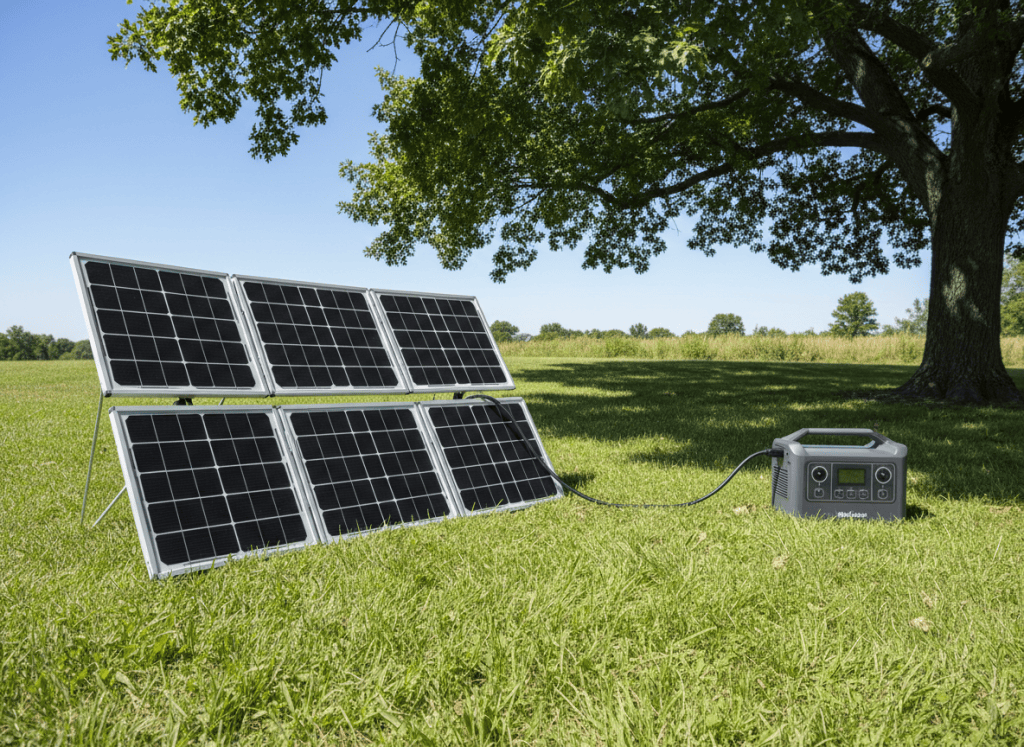
Quick answer: to charge a power station with solar panels, check its solar input limits (voltage and watts), choose panels that fit inside those limits, connect them with the right adapter cable, and aim them straight at the sun without shade. In good sun, expect to get roughly 70–80% of the panels’ rated watts in real use.
Specifications quoted here come from manufacturers’ official product pages. Charging-time figures are calculated estimates. See How We Test.
Step 1: Find your power station’s solar input limits
Look for the “solar input” or “DC input” line in your spec sheet. You need three numbers:
- Voltage range, for example 11–60 V. Your panels must stay inside this range.
- Maximum watts, for example 500 W per port. Extra panel watts beyond this are simply wasted.
- Connector type, such as XT60, Anderson or an 8 mm DC port. Most panels use MC4 connectors, so you’ll usually need an MC4-to-your-port adapter cable.
Two real examples: the EcoFlow DELTA 3 Plus has two solar ports, each accepting 11–60 V and up to 500 W. The Jackery Explorer 1000 v2 accepts up to 400 W of solar through its DC inputs. See our EcoFlow vs Jackery comparison for more.
Step 2: Match your panels to those limits
Every panel’s label lists its rated watts and its open-circuit voltage (Voc). Voc is the number that matters for safety: it’s the highest voltage the panel produces, and it rises in cold weather.
- Add up the panels’ rated watts: aim for about the power station’s maximum input, or somewhat more to make up for real-world losses.
- Make sure the combined Voc stays comfortably below the maximum input voltage, with room to spare for cold mornings.
Step 3: Wire multiple panels correctly
| Wiring | What happens | Best when |
|---|---|---|
| Series (positive of one panel to negative of the next) | Voltages add up; current stays the same | Your power station has a high voltage limit and you want better performance in low light |
| Parallel (using a Y-branch connector) | Currents add up; voltage stays the same | Series wiring would exceed the voltage limit, or you have partial shade |
Exceeding the maximum input voltage can damage your power station and void the warranty. When in doubt, use parallel, or follow the panel combinations your power station’s manufacturer lists as compatible.
Step 4: Place the panels for maximum sun
- Face the sun directly. In the U.S., that means facing roughly south, tilted toward the sun.
- Avoid shade. Even a shadow across part of one panel can cut its output dramatically.
- Re-aim every couple of hours if you can, following the sun across the sky.
- Keep them clean and cool. Dust lowers output, and panels work better when air can flow behind them.
- Keep the power station in the shade. Only the panels need sun; the power station charges best when it isn’t hot.
Step 5: Connect and check the input reading
Connect the panels to the adapter cable, then plug the cable into the power station’s solar port. The display or app should show incoming watts within a few seconds. If you see much less than expected, check for shade, the panel angle and loose connectors before assuming something is wrong.
How long does solar charging take?
Charging hours in full sun ≈ battery Wh ÷ (panel watts × 0.75)
| Battery | 200 W of panels | 400 W of panels | 800 W of panels |
|---|---|---|---|
| 500 Wh | ~3.3 hours | ~1.7 hours | ~0.8 hours* |
| 1,000 Wh | ~6.7 hours | ~3.3 hours | ~1.7 hours* |
| 2,000 Wh | ~13 hours | ~6.7 hours | ~3.3 hours* |
Because most places only get a few hours of strong sun per day, a 2,000 Wh unit with 200 W of panels may take two or three days to fill. To size your panels properly, see how many solar panels you need.
Frequently asked questions
Can I use solar panels from a different brand?
Usually yes, as long as the voltage stays within the power station’s input range and you have the right adapter cable. Using the same brand simply makes the connectors plug-and-play.
Can I use the power station while it charges from solar?
Most current models support pass-through charging, so you can run a fridge or a CPAP while the panels recharge the battery. Whatever you plug in reduces how fast the battery fills.
Do solar panels work on cloudy days?
Yes, but output can drop to a small fraction of the rated watts under heavy clouds. Plan your battery size for bad weather and treat sunny days as a bonus.
The bottom line
Check your input limits, keep the voltage safely below the maximum, point the panels at the sun without shade and expect about 70–80% of their rated power. Get those four things right and solar charging is simple.
Sources
- EcoFlow, DELTA 3 Plus specifications (official product page).
- Jackery, Explorer 1000 v2 specifications (official product page).


Leave a comment