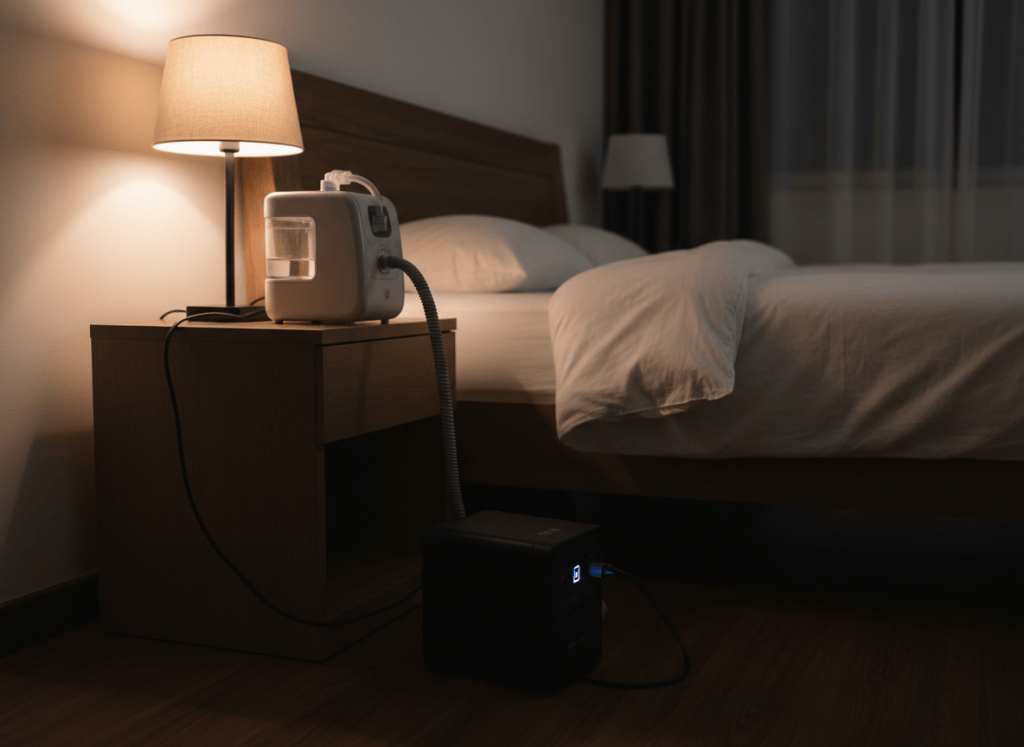
Quick answer: a 1,000 Wh portable power station runs a typical CPAP for about 2.5 nights with the humidifier off, about 1.5 nights with the humidifier on, and about 1 night with both the humidifier and a heated tube. The humidifier, not the machine itself, is what drains the battery.
This guide shows how many nights you can expect from each battery size, how to find your own machine’s real power use and how to build an outage plan you can trust.
How we got these numbers: the runtimes below are calculated estimates using conservative CPAP power figures and standard power station efficiency, with the math shown. Your machine, pressure and settings will change the result, so we also show you how to measure your own. See How We Test.
How much power does a CPAP use?
The blower that delivers your pressure uses surprisingly little power. The heated humidifier and heated tubing use most of it. For planning, we use these conservative figures for an 8-hour night:
| Your CPAP setup | Typical power draw | Planning figure | Energy per 8-hour night (on AC) |
|---|---|---|---|
| Humidifier and heated tube off | about 10–30 W | 30 W | ~320 Wh |
| Humidifier on | about 30–60 W | 55 W | ~520 Wh |
| Humidifier plus heated tube | about 50–90 W | 90 W | ~800 Wh |
Higher pressure settings, a leaky mask and a cold bedroom all push power use up. That’s why the planning figures sit at the high end of each range: it’s better to have battery left over in the morning than to run out at 3 a.m.
The power supply that came with your CPAP sets an upper limit. ResMed’s AirSense 11, for example, ships with a 65 W power supply, while the older AirSense 10 used a 90 W supply. Your machine rarely draws that much, but it’s a useful worst case.
CPAP runtime chart: nights per power station size
| Power station capacity | Humidifier off | Humidifier on | Humidifier + heated tube |
|---|---|---|---|
| 300 Wh | ~0.8 night (about 6 hours) | ~0.5 night | ~0.3 night |
| 500 Wh | ~1.3 nights | ~0.8 night | ~0.5 night |
| 1,000 Wh | ~2.7 nights | ~1.6 nights | ~1.1 nights |
| 2,000 Wh | ~5.3 nights | ~3.3 nights | ~2.1 nights |
| 3,000 Wh | ~8 nights | ~4.9 nights | ~3.2 nights |
The formula: nights = (power station Wh × 0.85) ÷ energy per night. Example: a 1,000 Wh unit gives about 850 usable Wh; with the humidifier on, that’s 850 ÷ 520 = about 1.6 nights.
How to find your CPAP’s real power use
- Measure it (best). Plug your CPAP into an inexpensive plug-in watt meter for one normal night with your usual settings. In the morning, the meter shows exactly how many Wh you used. That single number makes every calculation on this page personal.
- Check the manual. Your user guide lists power consumption, and manufacturers publish battery guides for their machines.
- Use the power supply rating as a ceiling. If you can’t measure, the watt rating on the power brick is a safe worst-case number.
Get more nights: run your CPAP on DC
Plugging your CPAP’s normal power brick into a power station’s AC outlet works, but it wastes energy: the power station converts battery DC to AC, and your power brick converts it straight back to DC. ResMed’s own battery guide strongly recommends powering its devices from a battery through a DC-to-DC converter rather than a DC-to-AC inverter.
- Most power stations have a 12 V car-style outlet. Your CPAP maker’s model-specific DC converter plugs into it.
- Skipping the inverter usually buys you meaningfully more runtime from the same battery.
- Only use the converter made for your exact model. A connector that fits is not proof that the voltage is right. Generic adapters can damage the machine and may affect your warranty.
Is it safe to turn off the humidifier during an outage?
Turning off the heated humidifier is the single most effective way to stretch your battery, often doubling your nights of backup. For most people, a few nights without humidification means dry mouth, a stuffy or dry nose, or some discomfort rather than a medical problem. Continuing therapy without humidity is generally far better than skipping CPAP altogether.
That said, your prescription and settings are your clinician’s decision. If you have a condition that makes humidification important for you, or if you use a BiPAP or another device with special settings, ask your doctor or equipment supplier before an outage, not during one.
A simple CPAP outage plan
- Know your number. Measure one night of use with a watt meter.
- Size for at least two nights. Outages after storms often last longer than the first estimate. Use the chart above for your setting.
- Keep the power station charged. Top it up every few months and before any storm warning.
- Test it once. Sleep one normal night with your CPAP running from the power station, so there are no surprises during a real outage.
- Have a recharge plan. Solar panels or a car outlet can refill the power station during the day for multi-day outages.
- Talk to your team. Tell your clinician and your equipment supplier you want a backup plan, and ask your electric utility whether it keeps a list of customers who depend on powered medical equipment.
Important: this guide is about CPAP machines used for sleep apnea. If you depend on a home ventilator, oxygen concentrator or any life-sustaining device, a portable power station is not a complete backup plan on its own. Work out a plan with your medical team and equipment supplier.
Frequently asked questions
Can a 300 Wh power station run a CPAP all night?
With the humidifier off, maybe. Our conservative estimate is about 6 hours from the AC outlet; running on DC and at lower pressure may get you through a full night. With the humidifier on, plan on a larger unit.
Do I need a pure sine wave power station for a CPAP?
Yes, if you use the AC outlet. CPAPs are sensitive electronics, and pure sine wave output is the safe choice. Nearly all current power stations from major brands provide it, but confirm on the spec sheet.
Can I charge the power station while my CPAP runs?
Most current models support pass-through charging, so they can power your CPAP while recharging from the wall, solar panels or a car. Check your model’s manual, and don’t rely on it until you’ve tried it.
Is a dedicated CPAP battery better than a power station?
A dedicated CPAP battery is smaller and ideal for travel, but usually covers about one night. A power station costs more and weighs more, yet it can cover several nights and also run a phone, lights or a refrigerator during an outage. See our guide on how long a power station runs a refrigerator.
The bottom line
For most CPAP users, a power station of about 1,000 Wh covers one to two and a half nights, and turning off the humidifier is the easiest way to stretch it. Measure your own machine for one night, size for at least two nights and test your setup before you need it.
This article is general information, not medical advice. Always follow your prescribing clinician’s instructions for your therapy and your manufacturer’s instructions for powering your device.
Sources
- ResMed, Battery Guide for ResMed devices (PDF).


Leave a comment