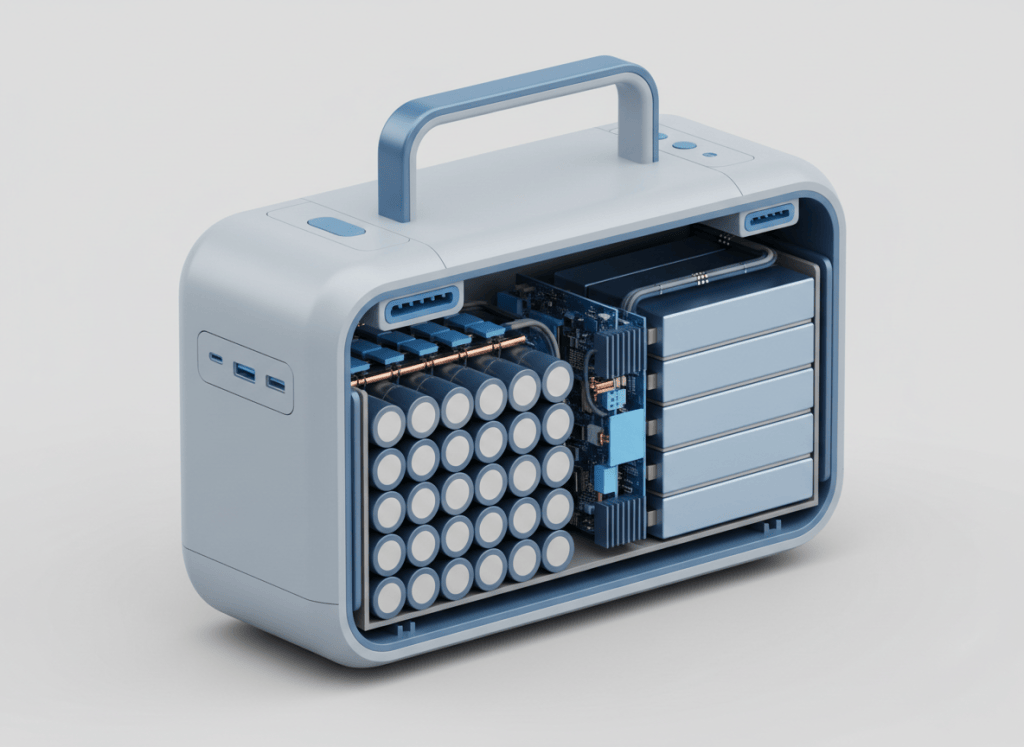
Quick answer: buy a LiFePO4 (lithium iron phosphate, also written LFP) power station unless low weight matters more to you than anything else. Current LiFePO4 models are rated for around 4,000 charge cycles, several times more than older lithium-ion (NMC) models, and the chemistry is more thermally stable. The trade-off is weight: NMC stores more energy per pound.
Cycle ratings quoted here come from manufacturers’ official specifications. See How We Test.
The two chemistries in one table
| LiFePO4 (LFP) | Lithium-ion (NMC) | |
|---|---|---|
| Typical rated cycle life | Around 3,000–4,000+ cycles on current models | Often around 500–1,000 cycles on older models |
| Thermal stability | Higher; more resistant to overheating | Lower |
| Weight for the same capacity | Heavier | Lighter |
| Where you find it | Most new power stations | Older and ultralight models |
| Best for | Home backup and frequent use over many years | Occasional use where every pound counts |
Cycle life: the biggest difference
A “cycle” is one full discharge and recharge. Manufacturers rate how many cycles a battery lasts before it drops to a set percentage of its original capacity. Two current LiFePO4 examples: the EcoFlow DELTA 3 Plus is rated for 4,000 cycles to 80% capacity, and the Jackery Explorer 1000 v2 for 4,000 cycles to 70%.
What that means in practice: even if you fully cycled a LiFePO4 power station every single day, 4,000 cycles would take more than ten years. For occasional camping and outages, the battery will likely outlast your interest in the product. With an older NMC unit rated for a few hundred cycles, daily use would wear it down within a couple of years.
When you compare brands, check what percentage each rating refers to: “4,000 cycles to 80%” is a stricter standard than “4,000 cycles to 70%.”
Safety
LiFePO4 is more chemically and thermally stable than NMC, which makes it less prone to overheating. That’s a big reason manufacturers switched to it for products people keep inside their homes, often in bedrooms and next to medical devices like a CPAP. Any quality power station also includes a battery management system that protects against overcharging, overheating and short circuits, whatever the chemistry.
Weight
NMC packs store more energy per pound, which is why the lightest power stations and many small battery packs still use it. For a 1 kWh-class unit, current LiFePO4 designs have narrowed the gap: the Jackery Explorer 1000 v2 weighs 23.8 lb and the EcoFlow DELTA 3 Plus 27.6 lb. If you’ll hike with it, weight matters; if it lives in a closet for outages, it barely does.
Cold weather
Neither chemistry likes charging in freezing temperatures. Manufacturers typically specify charging only above 32°F (0°C); the Explorer 1000 v2, for example, lists a charging range of 32–113°F. In winter, keep your power station indoors and bring it outside only to use it.
How to tell which battery a power station uses
- Look for “LiFePO4”, “LFP” or “lithium iron phosphate” on the spec sheet.
- Check the cycle rating: thousands of cycles almost always means LiFePO4; a few hundred usually means NMC.
- Be careful with older models and clearance deals: an older NMC version can look like a bargain next to its newer LiFePO4 replacement.
How to make any battery last longer
- Store it partly charged and top it up every few months.
- Keep it out of extreme heat, such as a hot car or direct summer sun.
- Use the standard charging mode for everyday charging and save the fastest mode for emergencies.
The bottom line
For almost everyone, LiFePO4 is the right choice: it lasts years longer, it’s more stable and the weight penalty has shrunk. Choose NMC only if you need the lightest possible unit and will use it occasionally. Next step: find the right capacity with our sizing guide.
Sources
- EcoFlow, DELTA 3 Plus specifications (official product page).
- Jackery, Explorer 1000 v2 specifications (official product page).


Leave a comment