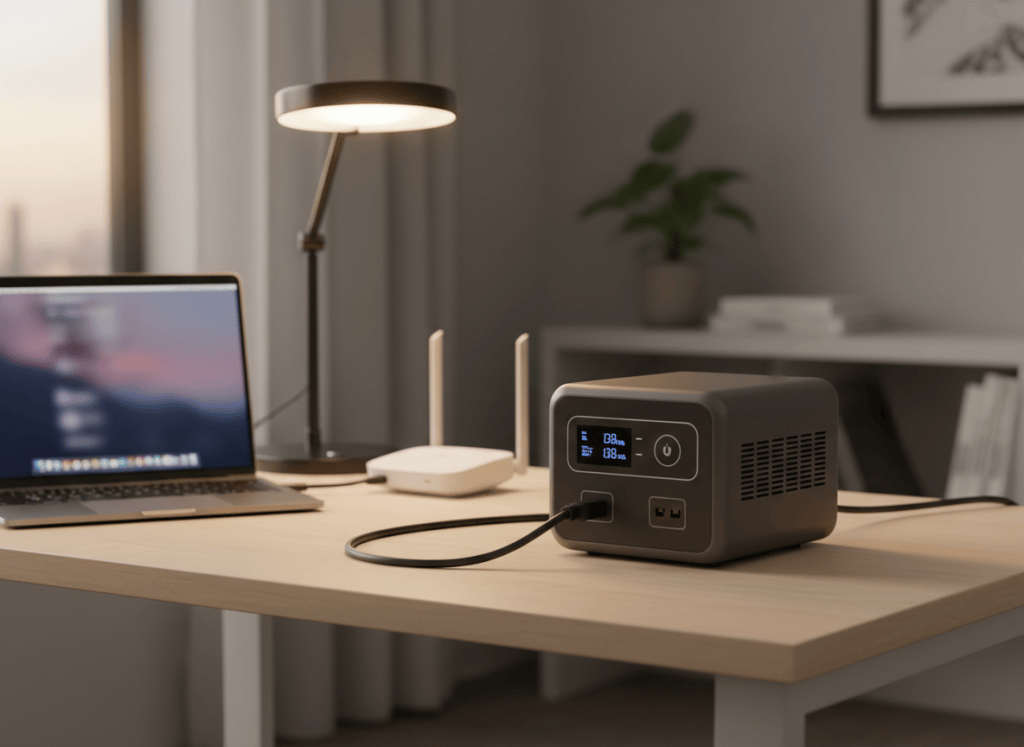
Verdict: the Anker SOLIX C1000 Gen 2 packs more power into a compact 1 kWh box than almost anything else in its class. It delivers 2,000 W from five AC outlets (3,000 W peak), recharges from empty in about 49 minutes with HyperFlash, switches to battery in 10 ms, stays around 20 dB under light loads and weighs 24.9 lb. It’s an outstanding all-rounder for home backup, CPAP and camping. Its trade-offs: it can’t be expanded, and it accepts less solar than the EcoFlow DELTA 3 Plus or BLUETTI Elite 100 V2.
| Best for | Home backup with bigger appliances, CPAP users, anyone who wants the fastest recharge |
| Not ideal for | Buyers who may need more capacity later; heavy solar users |
| Key numbers | 1,024 Wh · 2,000 W (3,000 W peak) · 10 ports · ~49-min recharge · 10 ms UPS · 24.9 lb |
How we reviewed it: a specification-based review using Anker’s official product pages and user guide plus our transparent runtime math. We have not tested this unit hands-on yet; we’ll add measured results when we do. See How We Test.
Pros and cons
| Pros | Cons |
|---|---|
| 2,000 W continuous output, the highest in our 1 kWh comparisons | Not expandable |
| About 49-minute full recharge with HyperFlash (1,600 W) | 600 W solar input, below the 1,000 W of some rivals |
| Two 140 W USB-C ports for laptops | HyperFlash must be switched on in the app |
| 10 ms UPS switchover | Five AC outlets, one fewer than the EcoFlow DELTA 3 Plus |
| Rated about 20 dB under 200 W loads | No built-in light |
| Compact: 15.1 × 8.2 × 9.6 in, 24.9 lb; LiFePO4 rated 4,000 cycles to 80% |
Full specifications
| Capacity | 1,024 Wh |
| Battery | LiFePO4, 4,000 cycles to 80% |
| AC output | 5 outlets, 120 V, 2,000 W rated, 3,000 W peak |
| USB-C | 2 × 140 W, 1 × 15 W |
| USB-A | 1 × 12 W (shares 20 W with the 15 W USB-C port) |
| 12 V car socket | 12 V, 10 A, 120 W |
| AC charging | 1,200 W standard; 1,600 W UltraFast (HyperFlash), about 49 minutes to full |
| Bypass (UPS) mode | Up to 1,800 W passed through; 10 ms switchover |
| Solar charging | XT60i input, 11–60 V, 600 W max; about 1.8 hours in ideal conditions |
| Noise | About 20 dB under 200 W (Anker rating) |
| Expandability | None |
| Charging temperature | 32–104°F (0–40°C) |
| Discharging temperature | −4–104°F (−20–40°C) |
| Dimensions | 15.12 × 8.19 × 9.61 in |
| Weight | 24.9 lb (11.3 kg) |
| In the box | AC charging cable, car charging cable, quick start guide |
All 10 ports, and what to plug into each
| Port | Best used for |
|---|---|
| 5 × AC outlets (2,000 W total) | Refrigerator, microwave or kettle in short bursts, TV, fans, lamps, CPAP power brick |
| 2 × USB-C 140 W | Laptops, including power-hungry models; tablets; more efficient than the AC outlet |
| 1 × USB-C 15 W | Phones, earbuds, small accessories |
| 1 × USB-A 12 W | Older phones, headlamps, gadgets |
| 1 × 12 V car socket (120 W) | 12 V compressor coolers, water pumps and your CPAP maker’s DC converter |
Charging: HyperFlash, solar and car
| Method | Max input | Time to full (from empty) |
|---|---|---|
| Wall, UltraFast (HyperFlash) mode | 1,600 W | About 49 minutes |
| Wall, standard mode | 1,200 W | Around an hour or a little more (our estimate) |
| Solar panels | 600 W (11–60 V) | About 1.8 hours in ideal sun; typically 2–3 hours in real conditions |
| Car socket | Low | Many hours; best for topping up while driving |
The 49-minute recharge is the C1000 Gen 2’s signature feature: when a storm is forecast, even a short window of grid power is enough to fill it. For long outages where solar is your main source, its 600 W input is solid but not class-leading. See how to charge a power station with solar.
What it can run, and for how long
| Device | Typical draw | Estimated runtime |
|---|---|---|
| Average full-size refrigerator | 1.5 kWh/day (~62 W average) | ~12 hours |
| Efficient ENERGY STAR refrigerator | 1.0 kWh/day (~42 W average) | ~16 hours |
| CPAP, humidifier off | ~30 W | ~2.7 nights |
| CPAP, humidifier on | ~55 W | ~1.7 nights |
| Wi-Fi router and modem | ~15 W | ~35 hours |
| Laptop (via AC) | ~50 W | ~14–15 hours |
| Box fan | ~50 W | ~14–15 hours |
| 50-inch LED TV | ~100 W | ~8 hours |
| Microwave | ~1,000 W | ~50 minutes of total cooking time |
| Space heater on high | ~1,500 W | ~35 minutes |
Three real-world scenarios
1. A storm is coming
Your battery sits at 30%. With HyperFlash on, less than an hour on the wall gets you to full. During the outage, a refrigerator, Wi-Fi, a lamp and phones (roughly 90–100 W together) run for about 9 hours.
2. Cooking during an outage
With 2,000 W of output, it can run a typical microwave or electric kettle while the fridge keeps going. Keep these high-watt uses short: 10 minutes of microwave use (about 170 Wh) costs roughly as much energy as two and a half to three hours of refrigerator time.
3. CPAP in the bedroom
Plugged into the wall with your CPAP plugged into it, the C1000 Gen 2 takes over within 10 ms if the power fails at 3 a.m. At CPAP-level loads it’s rated around 20 dB, quieter than a whisper. It’s our top pick in best power stations for CPAP.
How it compares with its main rivals
| Anker SOLIX C1000 Gen 2 | EcoFlow DELTA 3 Plus | Jackery Explorer 1000 v2 | BLUETTI Elite 100 V2 | |
|---|---|---|---|---|
| Capacity | 1,024 Wh | 1,024 Wh | 1,070 Wh | 1,024 Wh |
| AC output | 2,000 W | 1,800 W | 1,500 W | 1,800 W |
| AC outlets | 5 | 6 | 3 | 4 |
| Fastest wall recharge | ~49 min (full) | 56 min (full) | ~1 hour (full) | ~45 min (to 80%) |
| Max solar | 600 W | 1,000 W | 400 W | 1,000 W |
| UPS | 10 ms | Under 10 ms | 20 ms or less | 10 ms |
| Expandable | No | Yes, to 5 kWh | No | Limited |
| Weight | 24.9 lb | 27.6 lb | 23.8 lb | 25.3 lb |
Read the head-to-head in Anker SOLIX C1000 Gen 2 vs EcoFlow DELTA 3 Plus, or see the Jackery Explorer 1000 v2 review for a lighter alternative.
Frequently asked questions
Does it really recharge in 49 minutes?
That’s Anker’s figure with UltraFast (HyperFlash) mode enabled in the app, drawing up to 1,600 W from a standard outlet. In standard mode it charges at up to 1,200 W, which takes longer.
Can it run a refrigerator?
Yes. Its 2,000 W output and 3,000 W peak easily handle a refrigerator’s startup, and it runs an average one for about 12 hours.
Can I add an extra battery?
No. Anker made the Gen 2 fixed-capacity to keep it smaller and lighter. If expansion matters, look at the EcoFlow DELTA 3 Plus, which grows to 5 kWh.
Can I use it while it charges?
Yes. In bypass mode it passes up to 1,800 W from the wall to your devices while charging, and switches to battery in 10 ms if the grid fails.
Can I charge it in the cold?
Only above 32°F (0°C). It can supply power down to −4°F, but keep it indoors in winter and charge it at room temperature.
The bottom line
If you want the most output and the fastest recharge in a compact 1 kWh box, the Anker SOLIX C1000 Gen 2 is our pick. Choose the EcoFlow DELTA 3 Plus instead if you want to expand later or rely heavily on solar.
Sources
- Anker SOLIX, C1000 Gen 2 (official product page).
- Anker SOLIX Support, C1000 Gen 2 User Guide (A1763).
- Anker SOLIX, C1000 Gen 2 bundle page and box contents (official).

