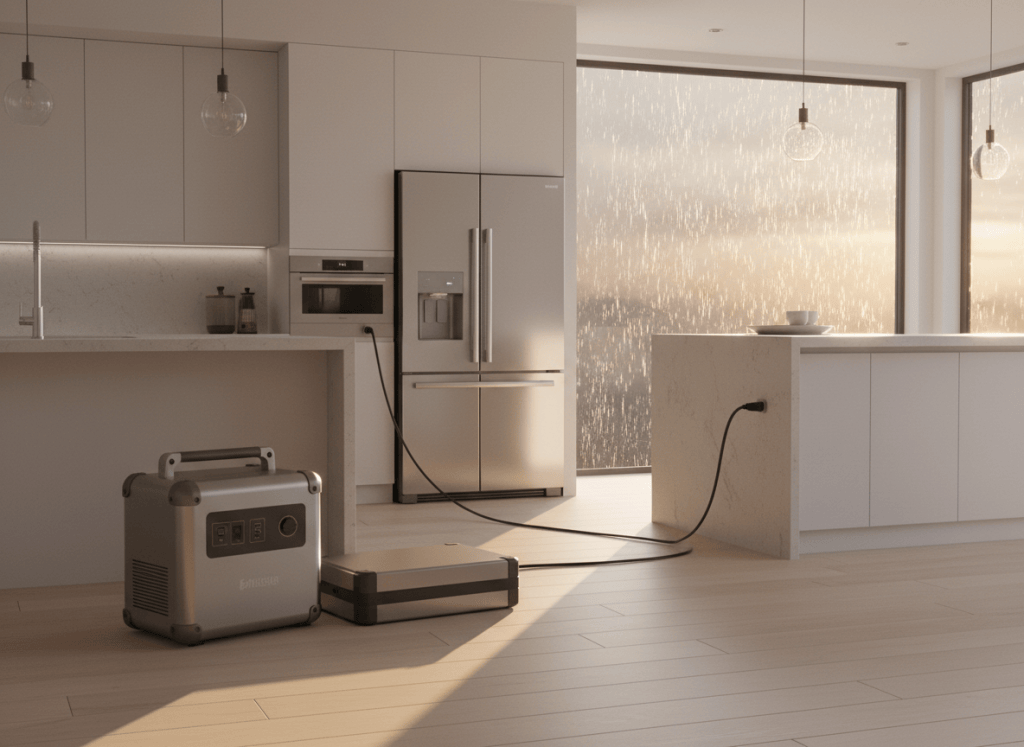
Verdict: the EcoFlow DELTA 3 Max Plus is one of the most capable 2 kWh power stations you can buy. It keeps an average refrigerator running for about a full day, delivers 3,000 W of output (6,000 W surge) for kitchen appliances, switches over in under 10 ms, accepts 1,000 W of solar and can grow to 10 kWh with extra batteries. It’s our pick for a full day of home backup in one box. The trade-offs: it weighs 48.7 lb, has only four AC outlets, and Anker’s C2000 Gen 2 is lighter and charges faster.
| Best for | A full day of home backup, running kitchen appliances during outages, RVs (30 A Anderson port), anyone planning to expand to 4–10 kWh |
| Not ideal for | Carrying often, camping far from the car, buyers who only need overnight backup (a 1 kWh unit is enough) |
| Key numbers | 2,048 Wh · 3,000 W (6,000 W surge) · 10 outlets · 1,800 W AC charging · 1,000 W solar · <10 ms UPS · 48.7 lb · expandable to 10 kWh |
How we reviewed it: a specification-based review using EcoFlow’s official specifications, an independent spec review and one independent hands-on measurement we cite by name. We have not tested this unit ourselves; runtimes are our calculated estimates with the math shown. See How We Test.
Pros and cons
| Pros | Cons |
|---|---|
| About 24 hours of average-refrigerator backup on one charge | Heavy: 48.7 lb, a two-hand lift |
| 3,000 W output (6,000 W surge); X-Boost runs resistive devices up to 3,800 W | Only 4 AC outlets |
| Expandable from 2 kWh to 10 kWh with several EcoFlow extra batteries | Anker’s C2000 Gen 2 is about 7 lb lighter and charges faster |
| 30 A Anderson port for RV and high-draw 12 V gear | Anderson and car outlets share a 378 W limit |
| UPS switchover under 10 ms | Extra batteries add significant weight and cost |
| 1,000 W solar input and 1,800 W wall charging | |
| 140 W USB-C for laptops |
Full specifications
| Capacity | 2,048 Wh (51.2 V, 40 Ah) |
| Battery chemistry | LFP (LiFePO4) |
| AC output | 120 V, 3,000 W total (6,000 W surge) |
| X-Boost | Runs resistive devices up to 3,800 W at reduced power |
| AC outlets | 4, each rated up to 20 A |
| USB-C | 1 × 140 W; 2 × 45 W (45 W total between them) |
| USB-A | 1 × 18 W |
| 12 V outputs | Car outlet (12.6 V, 10 A, 126 W) and Anderson port (12.6 V, 30 A); 378 W shared between them |
| Total outlets | 10 |
| AC charging | 100–120 V, 15 A (up to about 1,800 W); 0–80% in about 68 minutes per a retailer’s spec table |
| Solar charging | Up to 1,000 W |
| UPS switchover | Under 10 ms |
| Output priority | Yes; lets you choose which outputs stay on as the battery drains (set in the app) |
| Expansion | 2–10 kWh; one extra battery port (up to two extra batteries with EcoFlow’s expansion adapter) |
| Compatible extra batteries | DELTA 3 Max Plus, DELTA 3 Series, DELTA Pro 3 and DELTA 2 Max extra batteries |
| Charging temperature | 32–113°F (0–45°C) |
| Dimensions | 19.4 × 9.5 × 12.0 in (494 × 242 × 305 mm) |
| Weight | 48.7 lb (22.1 kg) |
| Warranty | 3 years + 2 years with registration |
Independent measurement: The Technology Man ran a constant 2,000 W load and got 1,898 Wh out of the 2,048 Wh battery, about 93%. That’s better than the 85% we use for our own planning, so our runtime estimates below are on the conservative side.
All 10 outlets, and what to plug into each
| Outlet | Best used for |
|---|---|
| 4 × AC outlets (3,000 W total) | Refrigerator, microwave, coffee maker or kettle, window air conditioner, sump pump (120 V), TV, lamps |
| 1 × USB-C 140 W | Laptops, including power-hungry models; more efficient than charging through the AC outlet |
| 2 × USB-C 45 W (shared) | Phones and tablets |
| 1 × USB-A 18 W | Older phones, headlamps and gadgets |
| 1 × 12 V car outlet (126 W) | 12 V coolers, tire inflators, your CPAP maker’s DC converter |
| 1 × Anderson port (30 A) | RV 12 V systems, 12 V fridges and water pumps, high-draw DC equipment |
How to charge it, and how long it takes
| Method | Max input | Time |
|---|---|---|
| Wall outlet (AC) | About 1,800 W | 0–80% in about 68 minutes (retailer figure); full in roughly 1.5 hours (our estimate) |
| Solar panels | 1,000 W | About 2.7 hours of strong sun with 1,000 W of panels (our estimate) |
| Gas generator | Through the AC input | Similar to the wall, if the generator can supply about 1,800 W cleanly |
What it can run, and for how long
The formula: hours ≈ (battery Wh × 0.85) ÷ (device watts + about 10 W of inverter overhead). Example for an average refrigerator: 2,048 × 0.85 = 1,741 Wh usable; 1,741 ÷ (62.5 + 10) ≈ 24 hours.
| Device | Typical draw | 2 kWh (alone) | 4 kWh (+1 extra battery) | 6 kWh (+2 extra batteries) |
|---|---|---|---|---|
| Average refrigerator | 1.5 kWh/day (~62 W avg) | ~24 hours | ~48 hours | ~72 hours |
| Efficient ENERGY STAR refrigerator | 1.0 kWh/day (~42 W avg) | ~33 hours | ~67 hours | ~100 hours |
| Fridge + Wi-Fi + lamp + phones | ~95 W total | ~18 hours | ~37 hours | ~55 hours |
| CPAP, humidifier off | ~320 Wh/night | ~5.4 nights | ~11 nights | ~16 nights |
| CPAP, humidifier on | ~520 Wh/night | ~3.3 nights | ~6.7 nights | ~10 nights |
| Wi-Fi router and modem | ~15 W | ~70 hours | ~139 hours | ~209 hours |
| Laptop or box fan | ~50 W | ~29 hours | ~58 hours | ~87 hours |
| 50-inch LED TV | ~100 W | ~16 hours | ~32 hours | ~47 hours |
| Window AC, 5,000 BTU (compressor running) | ~500 W | ~3.4 hours | ~6.8 hours | ~10 hours |
| Microwave | ~1,000 W | ~1 hr 45 min of cooking | ~3.5 hours | ~5 hours |
| Space heater on high | ~1,500 W | ~70 minutes | ~2.3 hours | ~3.5 hours |
Three real-world scenarios
1. A 24-hour winter storm outage
Refrigerator, Wi-Fi, a lamp and two phones average about 95 W together, so the Max Plus covers roughly 18 hours on its own. If the storm clears, 400 W of solar panels with about 5 hours of good sun put back roughly 1.5 kWh (400 × 5 × 0.75), enough to cover most of the next day. Skip the space heater: at 1,500 W it would empty the battery in about 70 minutes. An electric blanket is the efficient way to stay warm.
2. A summer outage with a small window AC
A 5,000 BTU window unit (about 500 W while the compressor runs), plus the fridge and Wi-Fi, adds up to roughly 590 W. That’s about 3 hours of continuous cooling, more in practice because the compressor cycles. The realistic plan: cool one bedroom for a few hours at night, then let the battery carry the fridge. With two extra batteries (6 kWh total), a full night of cooling becomes possible.
3. A weekend in an RV
Through the 30 A Anderson port: a 12 V fridge (about 480 Wh per day), LED lights (about 150 Wh) and a laptop (about 200 Wh) use roughly 830 Wh per day, so the Max Plus covers about two days without recharging. With its 1,000 W solar input on the roof or ground, it can keep up indefinitely in good sun. Remember that the Anderson and car outlets share 378 W.
Expansion: from 2 kWh to 10 kWh
The Max Plus has one extra battery port. EcoFlow says you can connect up to two extra batteries using its expansion adapter, and lists compatible batteries from four product lines: the DELTA 3 Max Plus extra battery (2,048 Wh), DELTA 3 Series, DELTA Pro 3 and DELTA 2 Max extra batteries. With two 2,048 Wh DELTA 3 Max Plus extra batteries you reach 6,144 Wh; EcoFlow lists a maximum of 10 kWh depending on which batteries you use. The DELTA 3 Max Plus extra battery weighs about 35 lb on its own, so a full stack is a stationary setup.
DELTA 3 Max vs DELTA 3 Max Plus: don’t mix them up
EcoFlow sells two 2,048 Wh models with almost the same name. They are not the same product:
| DELTA 3 Max | DELTA 3 Max Plus | |
|---|---|---|
| AC output (surge) | 2,400 W (4,800 W) | 3,000 W (6,000 W) |
| Total outlets | 9 | 10 |
| Best USB-C | 100 W | 140 W |
| 12 V output | Car outlet only (126 W) | Car outlet + 30 A Anderson port (378 W shared) |
| Expandable | No | Yes, 2–10 kWh |
| Output priority | No | Yes |
| Weight | About 44.8 lb (20.3 kg) | 48.7 lb (22.1 kg) |
If you might ever want more capacity or an RV-ready 12 V port, the Plus is worth it. If you know 2 kWh is enough forever and want to save weight, the plain Max is a reasonable alternative.
How it compares with its main rivals
| EcoFlow DELTA 3 Max Plus | Anker SOLIX C2000 Gen 2 | EcoFlow DELTA 3 Plus | EcoFlow DELTA 3 Ultra Plus | |
|---|---|---|---|---|
| Capacity | 2,048 Wh | 2,048 Wh | 1,024 Wh | 3,072 Wh |
| AC output (surge/peak) | 3,000 W (6,000 W) | 2,400 W (4,000 W) | 1,800 W (3,600 W) | 3,600 W (7,200 W) |
| AC outlets | 4 | 5 | 6 | 4 + one 30 A outlet |
| Fastest full recharge | ~1.5 h from the wall (est.) | 58 min (AC + solar together) | 56 min | About 1,800 W AC input |
| Max solar | 1,000 W | 800 W | 1,000 W | 1,600 W |
| Expandable to | 10 kWh | About 4 kWh | 5 kWh | 11 kWh |
| Weight | 48.7 lb | 41.7 lb | 27.6 lb | About 74.3 lb |
| Average fridge runtime (est.) | ~24 hours | ~24 hours | ~12 hours | ~36 hours |
Versus the Anker SOLIX C2000 Gen 2: the Anker is about 7 lb lighter, has one more AC outlet, reaches full charge in 58 minutes when combining wall and solar, and adds a TT-30 RV outlet. The EcoFlow answers with 600 W more output, 200 W more solar input and far more room to expand (10 kWh versus about 4 kWh). Choose the Anker for a lighter unit you’ll move around; choose the EcoFlow for maximum power and growth.
For the full breakdown of the Anker, including its 9 W idle draw, runtime chart and charging times, read our Anker SOLIX C2000 Gen 2 review.
Who should buy it, and who should skip it
| Buy it if you… | Skip it if you… |
|---|---|
| Want about a day of refrigerator backup without recharging | Only need overnight backup: see the DELTA 3 Plus |
| Want to use a microwave or kettle during outages | Need to carry it often |
| Have an RV or van with a 12 V system | Want the lightest 2 kWh unit: consider the Anker SOLIX C2000 Gen 2 |
| May expand to 4–10 kWh later | Face multi-day outages every year: start at 3 kWh with the DELTA 3 Ultra Plus |
Common mistakes to avoid
- Buying the plain DELTA 3 Max by accident. It looks the same but can’t be expanded and has less output. Check for “Plus” in the listing.
- Expecting whole-house power. It’s 120 V only: no central AC, electric range, dryer or 240 V well pump.
- Overloading the 12 V side. The Anderson port and car outlet share 378 W in total.
- Charging it in a cold garage. It only charges between 32°F and 113°F. Keep it indoors in winter.
- Never testing the UPS. Plug it into the wall, plug your devices into it, then unplug it from the wall once to confirm everything keeps running.
Frequently asked questions
How long will the DELTA 3 Max Plus run a refrigerator?
About 24 hours for an average fridge using 1.5 kWh per day, and about 33 hours for an efficient ENERGY STAR model, by our conservative estimate. With one extra battery, roughly double that.
Can it run a window air conditioner?
Yes. Its 3,000 W output handles the startup of a typical small window unit. A 5,000 BTU model running continuously would last about 3.4 hours; in real use the compressor cycles, so you’ll get more.
How many extra batteries can I add?
It has one extra battery port; EcoFlow says you can connect up to two extra batteries with its expansion adapter. EcoFlow lists a maximum total of 10 kWh, depending on the batteries you choose.
Can it run a well pump?
Only a 120 V pump within its output and surge limits. Many well pumps run on 240 V, which this unit can’t supply. Check the label on your pump.
Is 2 kWh the right size for me?
If you want a full day on the fridge or bigger appliances, yes. If overnight backup is enough, a 1 kWh unit costs less and weighs far less. See 1 kWh vs 2 kWh and our sizing guide.
The bottom line
The EcoFlow DELTA 3 Max Plus is a strong choice if you want a full day of home backup, real kitchen-appliance power and a clear path to 10 kWh. If weight matters more than maximum output and expansion, compare it with the Anker SOLIX C2000 Gen 2. For more picks by outage length, see our best power stations for home backup, and prepare with our hurricane outage checklist.
Sources
- EcoFlow, DELTA 3 Max series specifications (official).
- EcoFlow, DELTA 3 Max vs Max Plus comparison (official).
- EcoFlow, DELTA 3 Max Plus Smart Extra Battery (official).
- StorageReview, DELTA 3 Max Plus and Ultra Plus review.
- The Technology Man, EcoFlow DELTA 3 Max Plus review (independent capacity measurement).
- Anker SOLIX, C2000 Gen 2 (official) and ESS News, C2000 Gen 2 launch coverage.

