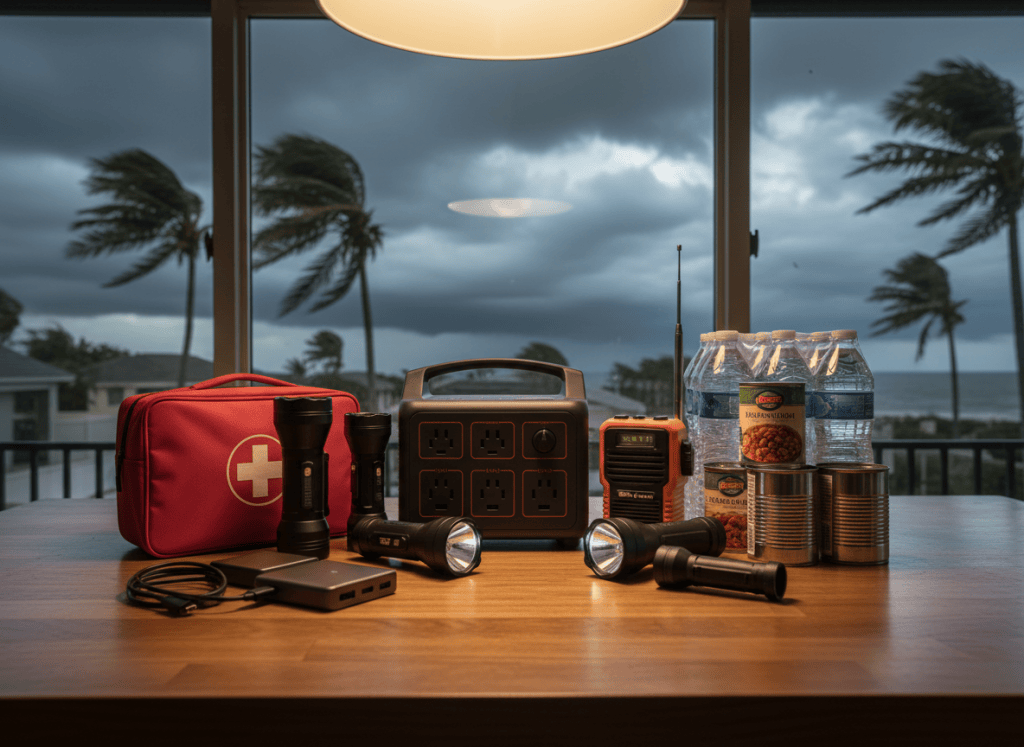
Hurricane outages can last days, and in the hardest-hit areas, weeks. The families who get through them best aren’t the ones with the most gear; they’re the ones who prepared a few simple things before the storm. Use this checklist in the days before landfall.
3–5 days before the storm
- Charge everything: your power station, power banks, phones, laptops, flashlights and any rechargeable medical devices.
- List your priority loads: refrigerator, medical devices, Wi-Fi, a few lights and a fan. Check that your backup power can handle them with our sizing guide.
- Refill prescriptions as early as your pharmacy allows, and keep a written list of your medications and doses.
- Test your backup setup: run your CPAP or fridge from the power station for an hour, so you find problems now instead of at 2 a.m.
- Stock basics: water, shelf-stable food, a first-aid kit, a battery or hand-crank weather radio, cash and a paper list of important phone numbers.
- Check your CO alarms and replace their batteries.
- If you have a gas generator: test-start it, store fuel safely in approved containers, and plan a spot outdoors at least 20 feet from doors, windows and vents.
24 hours before
- Freeze water: fill empty space in the freezer with jugs or bags of water. They keep food cold longer and become drinking water later.
- Turn the fridge and freezer colder and put appliance thermometers inside. The goal is 40°F or below in the fridge and 0°F or below in the freezer.
- Top up all batteries one last time, and fill your car’s tank or charge your EV.
- Move the power station to where you’ll use it, such as the kitchen or bedroom, before it gets dark and wet outside.
During the outage
- Keep the fridge and freezer closed. Without power, food stays safe about 4 hours in a closed refrigerator and about 48 hours in a full freezer (24 if half full).
- Power only what matters. Run the fridge in cycles and skip high-watt appliances like space heaters and coffee makers. See how long a power station runs a fridge.
- Use flashlights, not candles, to reduce fire risk.
- Unplug sensitive electronics from the wall so a power surge can’t damage them when the grid comes back.
- Never run a gas generator indoors, in a garage or near open windows. Carbon monoxide can kill in minutes. Read our generator safety guide.
- Recharge whenever you can: solar panels in daylight, your car while it’s running, or community charging stations.
After the storm
- Check food temperatures before eating. Throw out perishable food such as meat, poultry, seafood, eggs and leftovers that has been above 40°F for two hours or more. Never taste food to decide.
- Stay away from downed power lines and standing water near them, and report them to your utility.
- Check on neighbors, especially older adults and anyone who relies on medical equipment.
- Recharge and restock your power station and supplies as soon as power returns, so you’re ready for the next storm.
If someone in your home depends on medical equipment
A note from a physician: plan this part first, not last. Before hurricane season, talk to your clinician and equipment supplier about a backup plan, find out how long each device runs on battery, and ask your electric utility whether it keeps a list of customers who depend on powered medical equipment. Keep refrigerated medications like insulin in a cooler with ice if the fridge fails, and ask your pharmacist how long they stay safe at room temperature. If your home becomes too hot or too cold, or your devices can’t be powered, go to a shelter, a cooling or warming center, or a friend’s home with power.
For CPAP users specifically, see how many nights a power station runs a CPAP.
The bottom line
Charge everything, freeze water, know your priority loads and keep generators outside. Those four habits cover most of what goes wrong during a hurricane outage.
Sources
- American Red Cross, Power Outage Preparedness Checklist (PDF).
- Centers for Disease Control and Prevention, Keep Food Safe After a Disaster or Emergency.
- Centers for Disease Control and Prevention, Carbon Monoxide Poisoning Basics.


Leave a comment