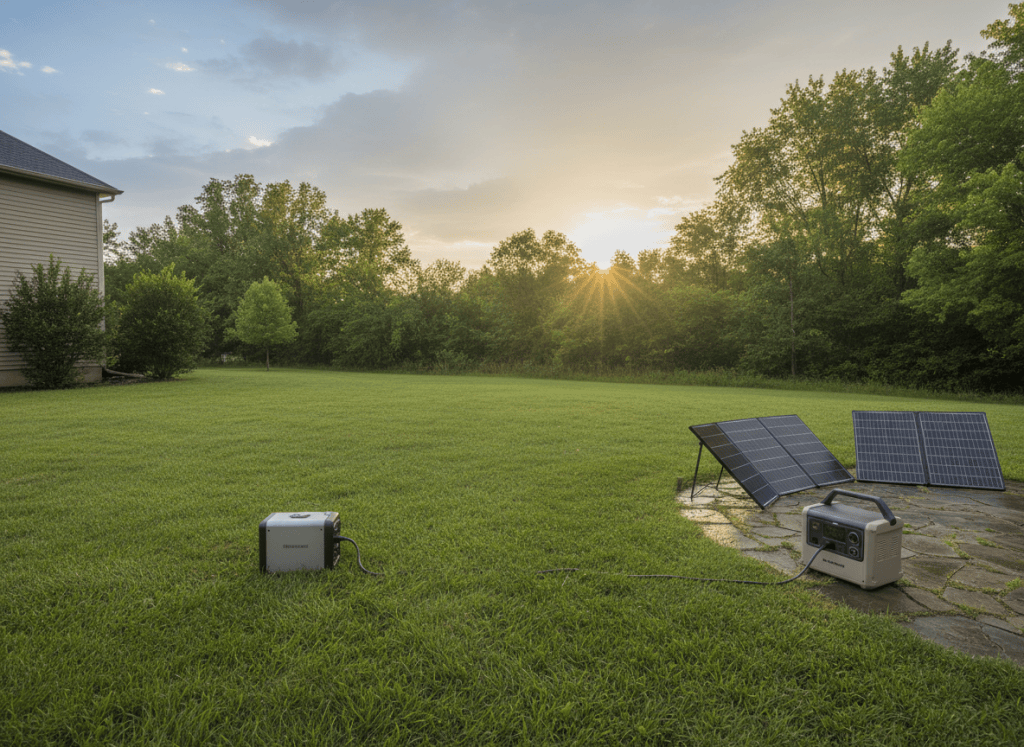
Quick answer: a gas generator gives you more power for less money and can run for days as long as you have fuel, but it’s loud, needs maintenance and must run outdoors because of carbon monoxide. A solar generator (a portable power station plus solar panels) is silent, safe to use indoors and needs no fuel, but it stores a limited amount of energy and recharges slowly on cloudy days. For a refrigerator, a CPAP and electronics in a house or apartment, solar is usually the better fit. For long outages with big loads like a well pump, gas still wins.
Prices and fuel figures in this article are approximate ranges and clearly labeled assumptions, not quotes. Check current prices before you buy. See How We Test.
The comparison at a glance
| Gas generator (portable inverter type) | Solar generator | |
|---|---|---|
| Typical upfront cost | Lower for the same output | Higher, especially for large capacity |
| Running cost | Fuel, oil and maintenance | Close to zero |
| Power output | High; can handle big motors | Moderate; limited by the inverter |
| How long it runs | As long as you have fuel | Until the battery empties; solar refills it by day |
| Noise | Noticeable engine noise | Near-silent (fan only) |
| Use indoors | Never (carbon monoxide) | Yes |
| Maintenance | Oil changes, fuel stabilizer, regular test runs | Keep it charged |
| Ready after months in storage | Only if fuel was stabilized or drained | Yes, if topped up every few months |
Safety: the difference that matters most
Every gas generator produces carbon monoxide (CO), a gas you can’t see or smell. It is one of the leading causes of preventable deaths after storms. U.S. safety agencies are unambiguous:
- Never run a generator inside your home, garage, basement, crawlspace or shed, even with doors and windows open.
- Run it outdoors, more than 20 feet from windows, doors and vents, with the exhaust pointed away from the house.
- Install battery-operated CO alarms, and turn the generator off and let it cool before refueling.
A note from a physician: early carbon monoxide poisoning often feels like the flu: headache, dizziness, weakness, nausea or confusion. If several people or pets in the home feel sick at the same time while a generator is running, get everyone into fresh air immediately and call 911.
A solar generator produces no exhaust, so it can sit next to your bed powering a CPAP or in your kitchen running the fridge. For apartments, condos and anyone without a safe outdoor spot 20 feet from the house, this alone often decides the question.
Cost example: a 3-day power outage
Let’s cover the same essentials from our sizing guide: a refrigerator, Wi-Fi, lights, phones and a laptop, about 2.3 kWh per day.
Gas generator
- Equipment: a portable inverter generator of about 2,000–3,500 W.
- Fuel (assumption): a small inverter generator at light load often burns roughly 0.1–0.2 gallons per hour. Running 12 hours a day for 3 days at 0.15 gal/h uses about 5.4 gallons, around $20 at $3.50 per gallon.
- The catch: you need to store that fuel safely beforehand, because gas stations often can’t pump during widespread outages. You also can’t run it overnight near bedrooms without noise and CO precautions.
Solar generator
- Equipment: a 2,000–3,000 Wh power station plus about 400–800 W of solar panels.
- Recharge (assumption): 400 W of panels with about 5 hours of good sun and typical real-world losses can put roughly 1.5 kWh per day back into the battery. 800 W roughly doubles that.
- The catch: on cloudy days, solar recharge can drop sharply. Cycling the refrigerator and skipping the laptop helps you stretch the stored energy.
The takeaway: over one outage, gas is cheaper to run. Over years, the solar generator’s near-zero running cost, zero maintenance and indoor safety close much of the gap, and it doubles as an everyday tool for camping, road trips and backup for your home office.
When a gas generator is the better choice
- You regularly face outages longer than 3–4 days.
- You need to run large loads: a well pump, a sump pump during heavy rain, a window air conditioner or power tools.
- You have a safe outdoor location at least 20 feet from the house and you’re comfortable storing fuel and doing basic engine maintenance.
When a solar generator is the better choice
- You live in an apartment, condo or anywhere a gas generator isn’t practical or allowed.
- Your priorities are a refrigerator, a CPAP, Wi-Fi, lights and phones.
- You want something that works silently at night and needs no maintenance between storms.
- You’ll also use it for camping, tailgating or van life.
The hybrid option many people choose
You don’t have to pick one. A common setup is a power station indoors for silent overnight power, recharged during the day by a small gas generator running safely outside, or by solar panels when the sun cooperates. You get indoor safety at night and nearly unlimited runtime during long outages.
Frequently asked questions
Can I run a gas generator in my garage with the door open?
No. U.S. safety agencies warn that carbon monoxide can build to deadly levels in a garage even with the door open. Run it outside only, more than 20 feet from any door, window or vent.
Can a solar generator power a whole house?
Not a typical portable one. It covers essentials such as a refrigerator, lights, Wi-Fi and medical devices. Whole-home backup requires much larger battery systems or a standby generator installed by an electrician.
Is a solar generator worth it if I live somewhere cloudy?
It can be, but size the battery for your outage without counting on solar, and treat the panels as a bonus. Many power stations can also recharge from a car or from a gas generator.
The bottom line
Choose gas for long outages and heavy loads, if you can run it safely outdoors. Choose solar for silent, indoor-safe power for the essentials, with no fuel to store. If you can, combine them. Either way, never run a gas generator indoors.
Sources
- Centers for Disease Control and Prevention, Carbon Monoxide Poisoning Basics.
- U.S. Consumer Product Safety Commission, Portable Generator Safety Alert (PDF).


Leave a comment