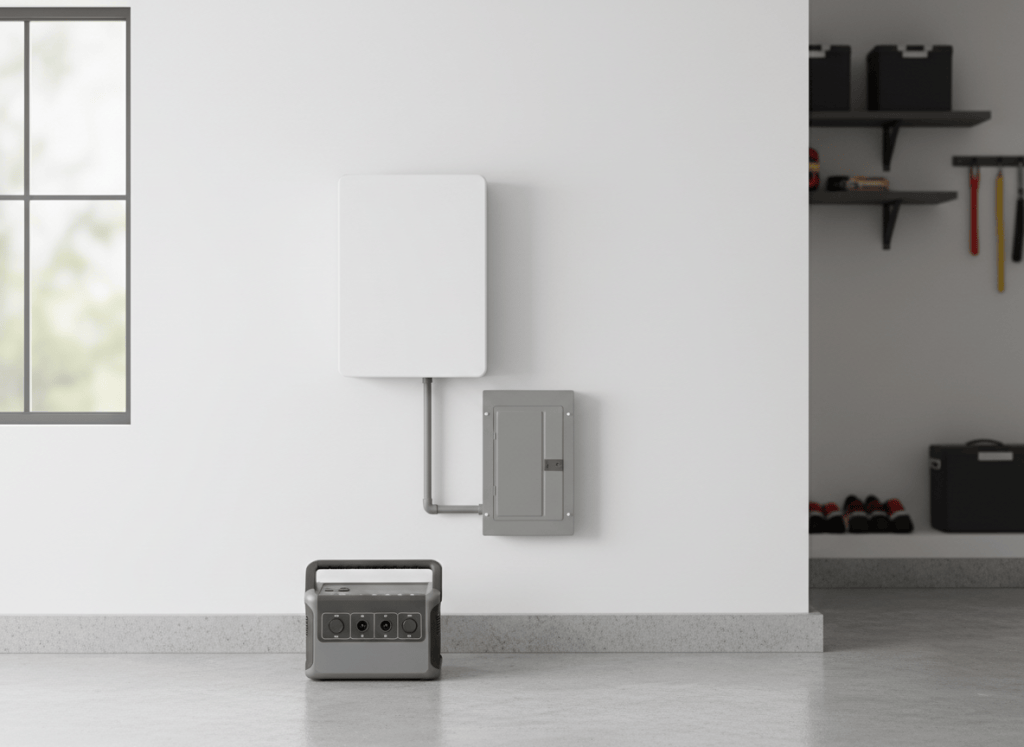
Quick answer: choose a home battery (like a Tesla Powerwall 3 or Enphase IQ Battery 5P) if you want your home’s circuits to switch over automatically, need 240 V appliances such as central AC or a well pump, or face long outages every year. Choose a portable power station if you need essentials (fridge, Wi-Fi, lights, phones, a CPAP) for hours to a couple of days, rent your home, or want something you can also take camping. Two facts shape the decision in 2026: most portable units are 120 V only, and the 30% federal tax credit for home batteries ended on December 31, 2025.
How we wrote this: specifications come from Tesla’s and Enphase’s official datasheets and from our verified power station data; household figures come from the U.S. Energy Information Administration (EIA); tax information comes from the IRS. Runtimes are our estimates with the math shown. We don’t quote prices because they vary widely by home and installer. This is general information, not tax or electrical advice. See How We Test.
The key differences at a glance
| Portable power station | Home battery backup | |
|---|---|---|
| What it powers | Devices plugged into it (or a few circuits through a transfer switch) | Your home’s circuits, through the electrical panel |
| Voltage | 120 V on most models, including every unit we’ve reviewed | 120/240 V split phase (Tesla Powerwall 3); 240 V (Enphase IQ Battery 5P) |
| Capacity | About 0.3–3 kWh per unit; some expand to 10–11 kWh | 5 kWh (Enphase 5P) to 13.5 kWh (Powerwall 3) per unit, stackable |
| Continuous output | About 0.3–3.6 kW | 3.84 kW (Enphase 5P) to 11.5 kW (Powerwall 3) per unit |
| When the grid fails | Plugged-in devices keep running if you use UPS mode; otherwise you move cords | Switches the home over automatically |
| Installation | None; plug and play | Licensed installer, permits and often panel work |
| Solar | Portable panels you set out yourself | Integrates with rooftop solar (Powerwall 3 accepts up to 20 kW DC) |
| Weight | About 8–75 lb; you can move it | About 174 lb (Enphase 5P installed) to 291 lb (Powerwall 3 installed); fixed |
| Warranty | Often 5 years on current models | 10 years (Powerwall 3); 15 years limited (Enphase 5P) |
| Relative cost | Lower; no installation | Several times higher, plus installation |
| Federal tax credit in 2026 | None | None for systems placed in service after Dec. 31, 2025 |
Why 240 V is the real dividing line
U.S. homes get split-phase power: 120 V for ordinary outlets and 240 V for big loads like central air conditioning, electric ranges and dryers, electric water heaters and many well pumps. Most portable power stations, including all the models we’ve reviewed, only supply 120 V. So no matter how big the battery, they can’t run a 240 V appliance. A home battery wired into your panel can, as long as it has enough power: the Powerwall 3 is rated to start motors up to 185 locked-rotor amps, which Tesla says covers the needs of most homes.
If everything you need during an outage plugs into a normal outlet, a portable power station can do the job. If the well pump or the central AC is non-negotiable, you’re shopping for a home battery (or a generator).
The math: how long each option lasts
Days of backup = usable kWh ÷ kWh you use per day
- Whole home: the EIA reports that an average U.S. home bought 10,791 kWh in 2022, about 899 kWh a month. Divided by 365, that’s about 29.6 kWh a day, or roughly 1,230 W on average.
- Essentials only: a refrigerator, Wi-Fi, a lamp and phones average about 95 W. 95 × 24 = 2.28 kWh a day, about 13 times less than the whole house.
- Usable capacity: for portable power stations we use 85% of the rated Wh (AC conversion and reserve). For home batteries we use the maker’s usable figure: 13.5 kWh for the Powerwall 3 and 5.0 kWh for the Enphase 5P.
- Example: one Powerwall 3 on essentials: 13.5 ÷ 2.28 ≈ 5.9 days. The same battery running an average whole home: 13.5 ÷ 29.6 × 24 ≈ 11 hours.
| System | Usable energy | Essentials only (95 W) | Average whole home (~1,230 W) |
|---|---|---|---|
| 2 kWh power station (e.g. EcoFlow DELTA 3 Max Plus) | ~1.7 kWh | ~18 hours | ~1.4 hours* |
| 3 kWh power station (EcoFlow DELTA 3 Ultra Plus) | ~2.6 kWh | ~27 hours | ~2.1 hours* |
| Portable expanded to 11 kWh (DELTA 3 Ultra Plus max) | ~9.4 kWh | ~4.1 days | ~7.6 hours* |
| Enphase IQ Battery 5P (one unit) | 5.0 kWh | ~2.2 days | ~4 hours |
| Tesla Powerwall 3 (one unit) | 13.5 kWh | ~5.9 days | ~11 hours |
| Two Powerwall 3 units | 27 kWh | ~11.8 days | ~22 hours |
The lesson: no battery runs a normal household for long. Home batteries win on convenience and 240 V power, but every system lasts far longer when you back up only the essentials. For your own numbers, use our sizing guide.
The 2026 tax-credit change
Until 2025, homeowners could claim the 30% Residential Clean Energy Credit on a home battery of 3 kWh or more, with or without solar. The IRS now states that the credit is not available for any property placed in service after December 31, 2025. Many articles online still mention the 30% credit, so check the date before you rely on it. Some states and utilities run their own battery programs; ask your utility or installer what applies where you live.
Without the credit, the price gap between an installed home battery and a large portable power station is wider than it was a year ago. That makes the middle option below more attractive for many homes.
The middle option: a power station plus a transfer switch
Some larger power stations can feed selected home circuits instead of just their own outlets. The EcoFlow DELTA 3 Ultra Plus lists connection through a manual transfer switch or an inlet box, and the Anker SOLIX C2000 Gen 2 has a bi-directional inlet output rated at 15 A (1,800 W). A licensed electrician installs the switch or inlet; then, during an outage, you connect the power station and flip the circuits you chose, such as the fridge, the furnace blower, lights and the router.
- What you gain: no extension cords, hard-wired items like a furnace blower or ceiling lights, and a battery you can still take camping.
- What you don’t get: 240 V loads (on 120 V units), a fully automatic switchover for the whole house, or rooftop-solar integration.
- Safety: never backfeed a panel through a regular outlet with a double-male cord. It can electrocute utility workers and start fires. Use a proper transfer switch or inlet installed by an electrician.
Three real-world scenarios
1. A renter with a few short outages a year
You can’t install anything in the panel, and outages last a few hours. A 1–2 kWh portable power station keeps the fridge, Wi-Fi and lights going overnight (about 18 hours of essentials on 2 kWh) and moves with you when you do. Choose: portable power station. Start with our best power stations for home backup.
2. A homeowner in hurricane country who wants the AC on
In 2024, EIA data show South Carolina customers averaged about 53 hours without power, mostly from Hurricane Helene. Central AC runs on 240 V, so a portable unit can’t help with it. One Powerwall 3 covers about 11 hours of average whole-home use, or nearly 6 days of essentials; paired with rooftop solar, it can recharge every sunny day. Choose: home battery, ideally with solar and a backup plan that limits AC to a few hours. See our hurricane outage checklist.
3. A homeowner who wants hard-wired backup on a tighter budget
Outages last a day or two, and the must-haves are the fridge, the gas furnace’s blower, lights and Wi-Fi, all 120 V. A 3 kWh power station through a transfer switch covers about 27 hours of essentials; expanded to 11 kWh, about 4 days. With 800 W of portable panels on a 4-sun-hour day (about 2.4 kWh), it can keep up with essentials on sunny days. Choose: power station plus transfer switch. To size the panels, see how many solar panels you need.
Decision guide: if you… choose…
| If you… | Choose |
|---|---|
| Rent, or can’t modify the electrical panel | Portable power station |
| Need backup for a few hours up to a day, for 120 V essentials | Portable power station (1–3 kWh) |
| Also want power for camping, RV trips or job sites | Portable power station |
| Want hard-wired circuits without a full installation budget | Power station + transfer switch or inlet |
| Need central AC, an electric range or a 240 V well pump during outages | Home battery (or a standby generator) |
| Want the house to switch over automatically with no action | Home battery |
| Already have rooftop solar and want it to work during outages | Home battery with a backup-capable system |
| Face multi-day outages every year | Home battery with solar, or a large expandable power station with solar |
Still weighing a gas generator? Read solar generator vs gas generator. Not sure you need backup at all? Start with is a portable power station worth it?
Common mistakes
- Expecting a portable unit to run 240 V appliances. Check the voltage on your AC, range, dryer and well pump labels first.
- Counting on the 30% federal credit. It doesn’t apply to home batteries placed in service after December 31, 2025.
- Assuming rooftop solar works in an outage. Most grid-tied solar systems shut down when the grid fails, for line-worker safety, unless they’re paired with a battery or backup-capable equipment.
- Buying on kWh alone. Output matters too. One Enphase 5P unit supplies 3.84 kW continuous, which may not start central AC by itself; installers size power (kW) and energy (kWh) separately.
- Backfeeding with a homemade cord. It’s dangerous and illegal in many places. Use a transfer switch or inlet installed by an electrician.
Frequently asked questions
Can a portable power station power my whole house?
Not in the usual sense. Most models supply only 120 V and a few kilowatt-hours, so they can’t run 240 V appliances, and an average home would drain even a 3 kWh unit in about two hours. They’re built for essentials, either plugged in directly or through a transfer switch.
Is there a tax credit for home batteries in 2026?
Not at the federal level for homeowners. The IRS says the Residential Clean Energy Credit isn’t available for property placed in service after December 31, 2025. Some states and utilities offer their own programs, so check locally.
Is a home battery worth it without solar?
It still provides automatic backup, and some utilities’ time-of-use rates let it save a little by charging when power is cheaper. But without solar it can’t recharge during a long outage, so its value depends on how long your outages last.
How long does a Tesla Powerwall 3 last in an outage?
By our estimate, about 11 hours at average U.S. household use, or close to 6 days if you run only a fridge, Wi-Fi, a lamp and phones. Heating, cooling and cooking shorten that sharply; solar recharging extends it.
Can I start with a power station and add a home battery later?
Yes. A power station isn’t wasted if you later install a home battery: it becomes your portable backup for camping, the garage or a second location. Many households use both.
The bottom line
If you need 240 V appliances, automatic whole-house switchover or solar that works through long outages, a home battery is the right tool. If your outage needs fit in normal outlets and a day or two of runtime, a portable power station does the job for far less, and a transfer switch closes much of the convenience gap. For specific models, compare the EcoFlow DELTA 3 Max Plus and the Anker SOLIX C2000 Gen 2.
Sources
- Tesla, Powerwall 3 Datasheet (U.S.).
- Enphase, IQ Battery 5P data sheet; installed weight from SunWatts spec sheet.
- IRS, Residential Clean Energy Credit and Instructions for Form 5695 (2025).
- U.S. Energy Information Administration, How much electricity does an American home use?
- U.S. Energy Information Administration, Hurricanes in 2024 led to the most hours without power in the United States in 10 years.
- EcoFlow, DELTA 3 Ultra Plus (official); home-connection options (manual transfer switch or inlet box, sold separately) as listed by authorized retailer Adorama.
- Anker SOLIX, C2000 Gen 2 (official specifications, bi-directional inlet output).

