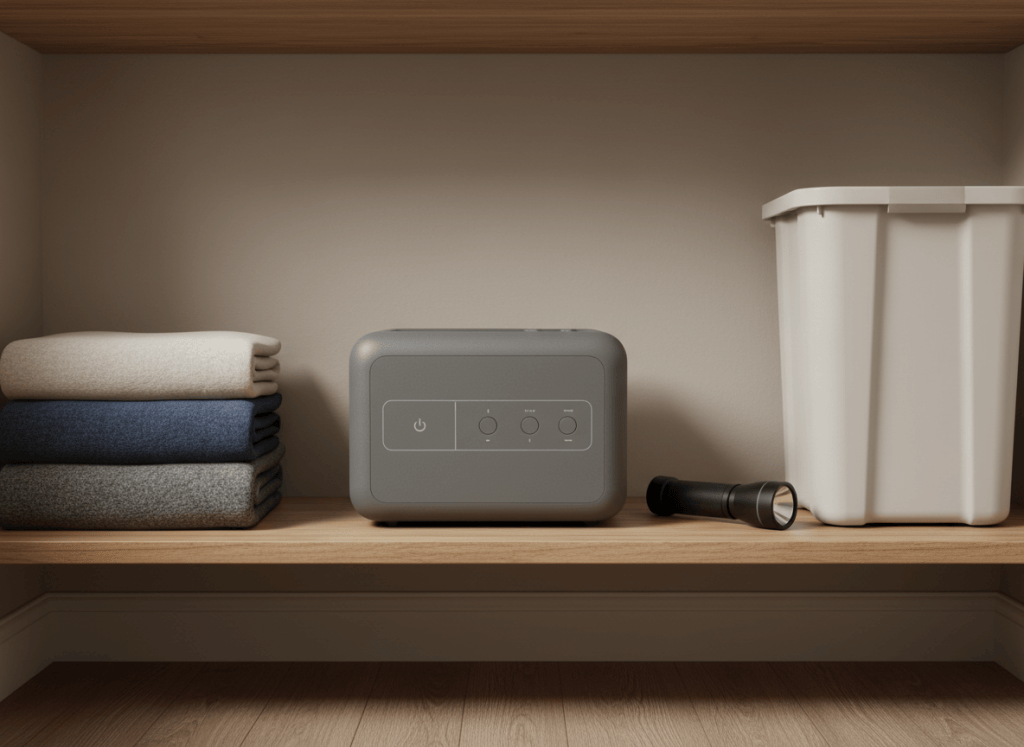
Quick answer: switched off, a current LiFePO4 power station loses charge slowly. Jackery, for example, says some of its v2 models lose 5% or less in six months. Left on with the AC outlets active, the inverter’s idle draw can empty it in days: about 8 days for a 2 kWh unit that idles at 9 W. The makers agree on the routine: turn it off, keep it cool and dry, and check it every three months. Never store it empty.
How we wrote this: storage rules come from EcoFlow’s, Anker’s and Jackery’s official FAQs, manuals and policies; self-discharge claims are the makers’ own figures, some quoted through authorized retailers. Drain times are our estimates with the math shown. We haven’t measured these units ourselves. See How We Test.
Off vs on: why it makes a huge difference
A power station loses charge two ways. Self-discharge is the slow loss inside the battery and electronics when the unit is off. Idle draw is the power the inverter uses just to keep the AC outlets live, even with nothing plugged in. The second is far bigger.
| State | What drains it | How long a full charge lasts |
|---|---|---|
| Switched off | Self-discharge only | Months; Jackery says some v2 models lose 5% or less in six months |
| On, AC outlets on, nothing plugged in | Inverter idle draw | Days; about 8 days for a 2,048 Wh unit at 9 W (Anker C2000 Gen 2) |
| Plugged into the wall (UPS mode) | Nothing; the wall keeps it topped up | Indefinitely, as long as the grid is on |
The drain math
Days until empty = (battery Wh × 0.85) ÷ idle watts ÷ 24
- Usable energy. A 2,048 Wh unit: 2,048 × 0.85 ≈ 1,741 Wh.
- Idle draw. Anker rates the C2000 Gen 2 at 9 W.
- Hours. 1,741 ÷ 9 ≈ 193 hours.
- Days. 193 ÷ 24 ≈ 8 days with the AC outlets on and nothing plugged in.
| Unit | Idle draw used | Empty after (AC left on) | Switched off (Jackery-style claim of ≤5% in 6 months) |
|---|---|---|---|
| ~286 Wh (small camping unit) | 10 W (our assumption) | About 1 day | About 14 Wh lost in 6 months |
| 1,024–1,070 Wh (1 kWh class) | 10 W (our assumption) | About 3.6 days | About 54 Wh lost in 6 months |
| 2,048 Wh (Anker C2000 Gen 2) | 9 W (Anker figure) | About 8 days | Not published by Anker |
The lesson: the off button matters more than anything else. Some units shut themselves off after hours of low use (Jackery lists auto shut-off on models like the Explorer 600 v2), but don’t count on it. Turn the unit off before you put it away.
What the makers recommend
| Brand | Official storage guidance |
|---|---|
| EcoFlow | Keep it at 68–86°F (20–30°C); don’t store it above 113°F (45°C) or below 14°F (−10°C) for long. For long-term storage, discharge to 30% and charge to 85% every three months. If it’s below 1% after use, recharge to 60% before storing. Leaving it idle with a very low battery can cause irreversible damage. |
| Anker SOLIX | Turn off all outputs, store it somewhere cool and dry, and check it regularly: if it’s below 30%, charge it to 100%, and fully charge it once every three months. Anker’s storage guide adds that 50–80% is the healthiest level between top-ups. |
| Jackery | To keep battery-cell warranty coverage, fully charge the unit within seven days of purchase and at least every six months after that. |
Notice the small disagreement: EcoFlow’s routine tops up to 85%, while Anker’s product FAQ says charge to 100% every three months. Both agree on the important parts: never let it sit near empty, keep it cool, and check it on a schedule. Follow your own brand’s manual.
A simple storage routine
- Charge it when it arrives. Jackery’s policy requires a full charge within seven days, and it’s a good habit for any brand. Test every outlet while you can still return it.
- Set the storage level. Follow your maker: EcoFlow and Anker both point to a partial charge between top-ups rather than sitting at 0% or 100% for months.
- Turn off the AC and DC outputs, then the unit.
- Store it indoors. A closet or basement shelf that stays at room temperature, not a hot attic, a car or a freezing garage.
- Put a reminder on your phone for every three months. Check the level and top it up as your manual says.
- Before storm season, charge it full or leave it plugged in as a UPS, so it’s ready the moment you need it.
Three real-world scenarios
1. A Black Friday gift that waits until Christmas
You buy a Jackery on November 27 and plan to wrap it for December 25. That’s four weeks, well past the seven days Jackery gives you to fully charge it for warranty purposes. What to do: unbox it, charge it fully in the first week, test it, turn it off and rewrap it. More tips in our Black Friday buying guide.
2. A hurricane backup that waits all season
From June through November, you want it ready at any moment. What to do: keep it plugged into the wall as a UPS for your router or fridge, or keep it full and check it monthly. After the season, bring it down to your maker’s storage level and switch to the three-month routine. See our hurricane outage checklist.
3. A camping unit stored over winter
It’s tempting to leave it in the garage until spring. In much of the U.S., garages drop below freezing, and many units can’t charge below 32°F; the Anker C2000 Gen 2, for example, lists 32–104°F for charging. EcoFlow says not to store its units below 14°F for long. What to do: store it indoors, off, at a partial charge, and check it every three months.
Common mistakes
- Leaving the AC outlets on. Idle draw can empty a unit in days, then it sits at 0%.
- Storing it empty after a trip. EcoFlow warns that long idle periods at very low charge can cause irreversible damage.
- Storing it in a hot attic or car. Heat speeds up battery aging; keep it at room temperature.
- Missing a warranty rule. Jackery’s battery-cell coverage depends on charging within seven days of purchase and every six months.
- Trusting the percentage after months off. Charge it and check it before the storm, not during it.
Frequently asked questions
How long will a fully charged power station last if I don’t use it?
Switched off, months: Jackery says some of its v2 models lose 5% or less in six months, and makers suggest checking every three months. Switched on with the AC active, only days, because the inverter keeps drawing power.
Should I store my power station at 100%?
For readiness during storm season, keeping it full or plugged in makes sense. For long off-season storage, EcoFlow and Anker both point to a partial charge between top-ups. Follow your maker’s manual.
Can I just leave it plugged in?
Models with a UPS mode are designed for it, and it’s the simplest way to keep one ready. See power station vs UPS for a home office.
What if it drained to 0% in storage?
Charge it as soon as possible and check that every outlet works. If it won’t charge or the capacity seems much lower, contact the maker; long periods at very low charge can damage the battery.
Does LiFePO4 hold a charge better than older batteries?
LiFePO4 is the chemistry in current models and is rated for thousands of cycles. For the full comparison, read LiFePO4 vs lithium-ion.
The bottom line
A power station switched off holds its charge for months; one left on can be empty in days. Turn it off, keep it indoors at a partial charge, check it every three months, and top it up before storm season. Idle draw is one reason a low figure like the Anker C2000 Gen 2‘s 9 W matters. Still deciding whether you need one? Read is a portable power station worth it?
Sources
- EcoFlow, DELTA 3 Ultra Plus & DELTA 3 Ultra FAQ (storage) and DELTA Pro user manual.
- Anker SOLIX, product FAQ on storage and maintenance and long-term storage guide; C2000 Gen 2 specifications (idle draw, charging temperature).
- Jackery, U.S. service policy (seven-day and six-month charging rule); Explorer 600 v2 self-discharge and auto shut-off claims as listed by Costco.

