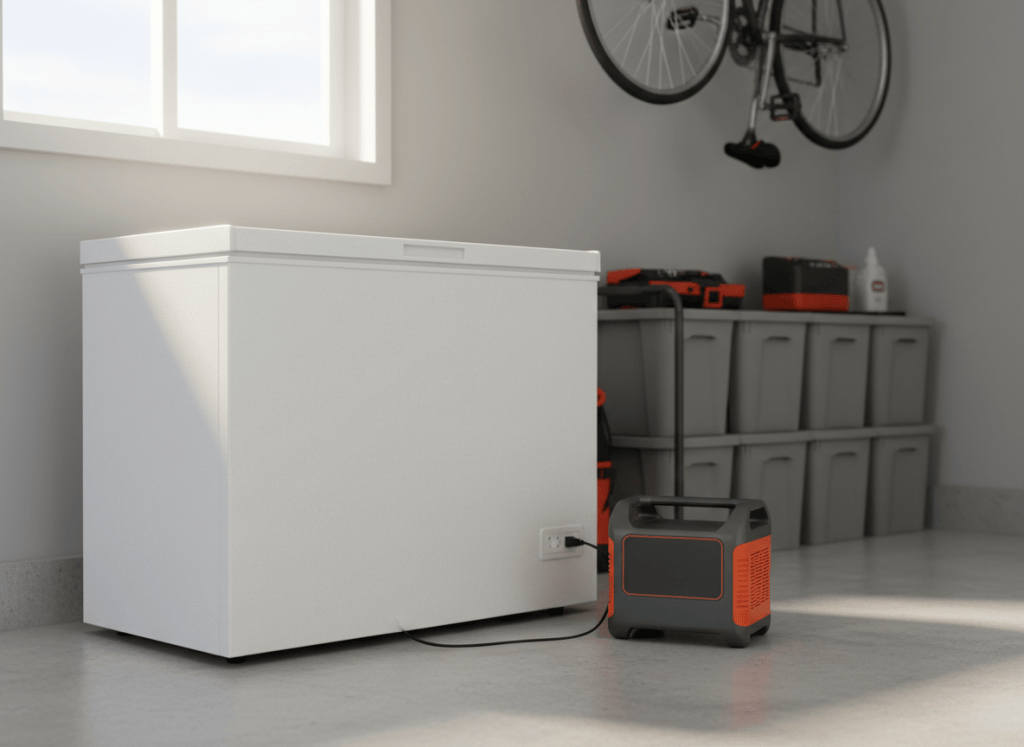
Quick answer: yes. A typical 5–7 cu ft chest freezer uses only about 25–30 W on average, so a 1 kWh power station runs it for roughly 22–25 hours, a 2 kWh unit for about two days and a 3 kWh unit for close to three. The 1 kWh-class models we cover are rated for 3,000 W or more of peak output, a wide margin for the compressor’s start-up. The biggest hidden cost is the inverter itself, which can add a quarter or more to what a small freezer uses.
How we worked this out: freezer energy use comes from real EnergyGuide labels published by the makers or their retailers; power station specs from official pages; runtimes are our own estimates with the math shown. We haven’t tested these combinations hands-on. See How We Test.
How much power does a chest freezer use?
New freezers sold in the U.S. carry a yellow EnergyGuide label showing the model’s estimated yearly use in kWh. Divide by 8,760 (hours in a year) to get its average watts. Four real labels:
| Chest freezer (label) | Size | kWh per year | Average watts | Per day (with ~10 W inverter) |
|---|---|---|---|---|
| Midea MRC05M5CWW | 5.1 cu ft | 218 | ~25 W | ~840 Wh |
| GE FCM7ST | 7.0 cu ft | 250 | ~28.5 W | ~925 Wh |
| Whirlpool WZC3115D | 14.8 cu ft | 297 | ~34 W | ~1,050 Wh |
| Danby DCFM171A1WDB | 17.1 cu ft | 326 | ~37 W | ~1,130 Wh |
Notice how little a bigger freezer adds: tripling the size (5.1 to 17.1 cu ft) raises energy use by only about 50%. Chest freezers are well insulated, which makes them one of the easiest appliances to back up.
The formula, step by step
Hours = (battery Wh × 0.85) ÷ (freezer average watts + 10 W inverter)
- Average watts: 250 kWh/year ÷ 8,760 h ≈ 28.5 W (GE 7 cu ft).
- Add the inverter: 28.5 + 10 = 38.5 W.
- Usable battery: a 1,024 Wh station × 0.85 ≈ 870 Wh.
- Runtime: 870 ÷ 38.5 ≈ 22.6 hours.
| Freezer | ~300 Wh station | 1 kWh station | 2 kWh station | 3 kWh station |
|---|---|---|---|---|
| 5.1 cu ft (218 kWh/yr) | ~7 h | ~25 h | ~50 h | ~75 h |
| 7.0 cu ft (250 kWh/yr) | ~6.4 h | ~22.6 h | ~45 h | ~68 h |
| 14.8 cu ft (297 kWh/yr) | ~5.6 h | ~20 h | ~40 h | ~60 h |
| 17.1 cu ft (326 kWh/yr) | ~5.2 h | ~18.4 h | ~37 h | ~55 h |
The inverter trap: why small loads cost more than you think
A power station’s inverter uses power just to keep the AC outlets on. We use about 10 W in our math. For a fridge averaging 62.5 W, that’s a small add-on. For a 7 cu ft freezer averaging 28.5 W, it’s about 26% of the total, roughly 240 Wh a day. That’s why a low idle draw matters for freezers: Anker lists 9 W for the SOLIX C2000 Gen 2, for example. Check your unit’s figure if the maker publishes it.
Starting surge: which stations can start a freezer?
A compressor briefly draws more than its running power when it starts. Every 1 kWh-class station we cover is rated for at least 1,500 W continuous and 3,000 W peak, leaving a wide margin for a household chest freezer. Small 300 Wh-class units (300–600 W output) may or may not start one; check the freezer’s label amps and the station maker’s guidance before relying on it.
Three real-world scenarios
1. An overnight outage, freezer only
A 7 cu ft garage freezer needs about 38.5 W through the inverter. A 1 kWh station covers about 22 hours, enough for a typical overnight outage with plenty to spare. Plug it in through the station as a UPS and it switches over by itself.
2. Fridge and freezer during a hurricane outage
An average fridge (62.5 W) plus a 7 cu ft freezer (28.5 W) on one station, with a single 10 W inverter overhead, is about 101 W, or 2,425 Wh a day. A 2 kWh station lasts about 17 hours; a 3 kWh station about 26 hours. To keep up with solar: 2,425 ÷ (4 sun hours × 0.75) ≈ 810 W of panels. See our EcoFlow DELTA 3 Ultra Plus review, which accepts 1,600 W of solar.
3. A week without power, freezer on solar
The same 7 cu ft freezer uses about 925 Wh a day through the inverter. 400 W of panels produce roughly 300 W × 4 sun hours = 1,200 Wh on a clear day, more than the freezer needs. A 2 kWh station stores two days of buffer for cloudy stretches. More in how many solar panels you need.
How to set it up
- Find the kWh/year on the EnergyGuide label or the model’s online listing.
- Plug the freezer straight into an AC outlet on the station, or use a short, heavy-duty cord.
- Leave the station plugged into the wall so it acts as a UPS and stays full until the outage.
- Keep the lid closed. Every opening lets cold air out and makes the compressor run longer.
- Add solar if outages can last more than a day or two.
For food-safety guidance during outages, follow FoodSafety.gov.
Common mistakes
- Using the nameplate amps. The label’s amps show the maximum draw, not the average. Use kWh per year.
- Ignoring the inverter. With a freezer, it can be a quarter of the total.
- Trusting the label in a hot garage. Labels use a standard test; summer garage heat makes the compressor work harder.
- Running fridge and freezer on 1 kWh. Together they need about 2.4 kWh a day; 1 kWh lasts well under half a day.
- Using a thin extension cord. It can overheat and cause voltage drop at start-up.
Which power station should you pick?
| If you need… | Good fit | 7 cu ft freezer alone (est.) |
|---|---|---|
| Freezer through an overnight outage | EcoFlow DELTA 3 Plus or Anker SOLIX C1000 Gen 2 (1 kWh) | ~22.6 h |
| Freezer for two days, or fridge + freezer for most of a day | Anker SOLIX C2000 Gen 2 (9 W idle) or EcoFlow DELTA 3 Max Plus (2 kWh) | ~45 h |
| Fridge + freezer for multi-day outages with solar | EcoFlow DELTA 3 Ultra Plus (3 kWh, 1,600 W solar) | ~68 h |
Planning around the refrigerator too? See our best power stations for a refrigerator.
Frequently asked questions
Can a 500 Wh power station run a chest freezer?
For about 11 hours with a 7 cu ft freezer, by our formula, if the station can start the compressor. Check the station’s output and surge ratings against the freezer’s label.
Does a chest freezer use less power than a refrigerator?
Usually, yes. The chest freezers above use 218–326 kWh a year, while a typical full-size refrigerator uses around 550–630 kWh. Compare the EnergyGuide labels of your own appliances.
Do I need a pure sine wave power station?
All the models we recommend provide pure sine wave AC, which compressors and electronic controls are designed for.
Can I run the freezer from the 12 V port?
Only if it’s a 12 V freezer built for vehicles. Household chest freezers run on 120 V AC and must use the AC outlets.
How long does the station take to recharge afterward?
About an hour from the wall for current 1 kWh units; see how long it takes to charge a power station.
The bottom line
A chest freezer is an easy load: about 25–37 W on average for sizes from 5 to 17 cu ft. A 1 kWh station covers about a day, 2 kWh about two, and a few hundred watts of solar can keep it going indefinitely. Not sure what size fits your whole outage list? Use our sizing guide or the hurricane outage checklist.
Sources
- EnergyGuide labels: Midea MRC05M5CWW (official), GE FCM7ST, Whirlpool WZC3115D and Danby DCFM171A1WDB (retailer-hosted labels).
- Anker SOLIX, C2000 Gen 2 (idle draw, official).
- Power station specifications: see our linked reviews and their official sources.
- FoodSafety.gov for food-safety guidance.

