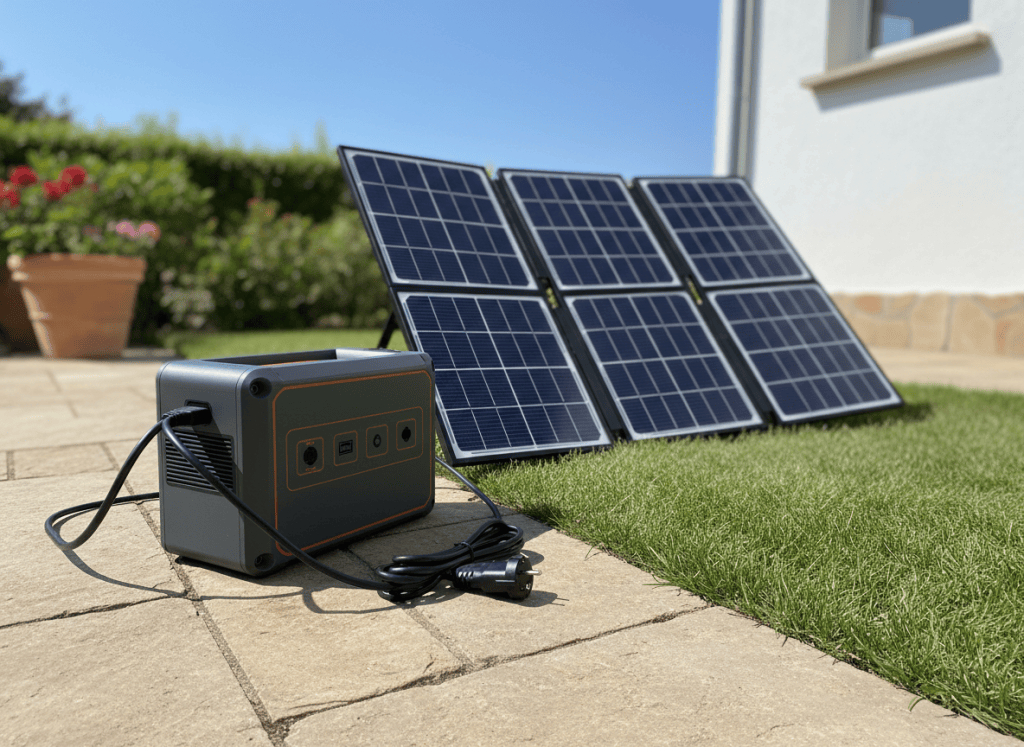
Quick answer: from a wall outlet, most current 1–2 kWh power stations charge fully in about 1 to 1.5 hours. With solar, a 1 kWh unit needs about 3.5 hours of full sun with 400 W of panels, or roughly two sunny days with a single 200 W panel. From a car’s 12 V outlet, expect 10–20+ hours; an 800 W alternator charger cuts that to 1–3 hours of driving.
How we worked this out: charging times come from official manufacturer specifications (and one independent review where noted); solar, car and cloudy-day figures are our own estimates using the formulas below. We haven’t tested these units hands-on. See How We Test. For what each input spec means, see power station specs explained.
| Charging method | 1 kWh station | 2 kWh station |
|---|---|---|
| Wall outlet (fast mode) | ~50–60 min | ~1–1.5 h (model-dependent) |
| Solar, 400 W of panels | ~3.5 h of full sun | ~7 h of full sun |
| Solar, 200 W panel | ~7 h (about 2 sunny days) | ~14 h (about 3–4 sunny days) |
| Car 12 V outlet (~100 W) | ~10–12 h | ~20–23 h |
| 800 W alternator charger | ~1.3–1.8 h of driving | ~3 h of driving |
The formula
Charging hours ≈ battery Wh ÷ real charging watts
The hard part is the “real charging watts”. Here is how to estimate it for each method:
- Wall: use the maker’s listed time; fast modes already account for everything.
- Solar: panel rating × 0.75 (panels rarely produce their full rating), capped at the station’s maximum solar input.
- Car outlet: 12 V × 10 A = 120 W at most; plan on about 100 W.
- Alternator charger: use the charger’s rating (for example 800 W) and the maker’s time.
Worked example: a 1,024 Wh station with two 200 W panels in strong sun.
- Panel rating: 2 × 200 W = 400 W.
- Real output: 400 × 0.75 = 300 W (below the station’s solar limit, so no cap).
- 1,024 ÷ 300 ≈ 3.4 hours of full sun.
- With about 4 peak-sun hours per day, that’s one sunny day.
Wall charging times by model
| Model | Capacity | Fastest wall charge (maker) | Notes |
|---|---|---|---|
| Anker SOLIX C1000 Gen 2 | 1,024 Wh | Full in 49 min (1,600 W UltraFast) | 1,200 W standard; fast mode set in the app |
| EcoFlow DELTA 3 Plus | 1,024 Wh | Full in 56 min (1,500 W) | |
| Jackery Explorer 1000 v2 | 1,070 Wh | ~1 h (Emergency mode) | ~1.6 h in standard mode |
| Anker SOLIX C2000 Gen 2 | 2,048 Wh | Up to 1,800 W AC input | Anker lists 100% in 58 min with AC and solar together |
| EcoFlow DELTA 3 Max Plus | 2,048 Wh | About 1,800 W AC input | Limited by a standard 15 A outlet |
| EcoFlow DELTA 3 Ultra Plus | 3,072 Wh | About 1,800 W AC input | EcoFlow lists 0–80% in 48 min with solar + generator together |
A standard U.S. outlet on a 15 A circuit supplies about 1,800 W, which is why 2 and 3 kWh units can’t charge as fast from the wall alone as their size might suggest. Adding solar at the same time is the only way to go faster.
The 3 kWh class shows this best: see all six charging methods compared in our EcoFlow DELTA 3 Ultra Plus review.
Solar charging: hours and days
| Panels (rated) | Real output (~75%) | 1 kWh: full-sun hours | 1 kWh: sunny days (4 h) | 2 kWh: full-sun hours | 2 kWh: sunny days (4 h) |
|---|---|---|---|---|---|
| 100 W | ~75 W | ~13.7 h | ~3.5 | ~27 h | ~7 |
| 200 W | ~150 W | ~6.8 h | ~1.7 | ~13.7 h | ~3.5 |
| 400 W | ~300 W | ~3.4 h | ~0.9 | ~6.8 h | ~1.7 |
| 800 W | ~600 W | ~1.7 h* | Under half a day | ~3.4 h* | ~0.9 |
Clouds can cut output by half or more, and winter sun is weaker. Check your local peak-sun hours before relying on solar alone. More in how many solar panels do you need and how to charge a power station with solar panels.
Car and alternator charging
A car’s 12 V outlet is usually limited to about 10 A, or roughly 100–120 W. That’s why makers list long times: Jackery about 12 hours for the Explorer 1000 v2, and Anker about 23 hours for the 2 kWh C2000 Gen 2. Run the engine while charging this way so you don’t drain the car’s starting battery.
An alternator charger is wired to the vehicle battery and delivers far more power. EcoFlow lists its 800 W charger filling a DELTA 3 Plus in about 1.3 hours; Anker lists about 1.8 hours for the C1000 Gen 2 with its alternator bundle and about 3 hours for the C2000 Gen 2. See our van life and RV picks.
Three real-world scenarios
1. A storm is coming and you have an hour
Fast wall charging is the whole game here. A C1000 Gen 2 (49 min) or DELTA 3 Plus (56 min) goes from empty to full within the hour; a Jackery 1000 v2 in Emergency mode gets close. Better still: keep the station plugged in as a UPS so it’s always full. See our hurricane power outage checklist.
2. A three-day camping trip with one 200 W panel
The panel produces about 150 W, so roughly 600 Wh on a 4-sun-hour day. If you use about 600 Wh a day (a 12 V fridge, lights and phones), the panel keeps a 1 kWh station roughly level, but a cloudy day leaves you short. Start full and budget carefully.
3. A road trip: car outlet vs alternator
Four hours of driving through a car outlet adds about 400 Wh, less than half a 1 kWh battery. The same four hours with an 800 W alternator charger would fill it more than twice over, which is why full-time van dwellers install one.
Common mistakes
- Counting the panel’s full rating. A “200 W” panel usually delivers closer to 150 W in real use.
- Buying more panels than the input accepts. Extra watts above the station’s solar limit are wasted in full sun.
- Exceeding the input voltage. Wiring panels in series raises the voltage; stay under the station’s maximum (for example, 60 V on the Anker C1000 Gen 2).
- Charging in the cold. Most units won’t charge below 32°F. Bring it inside first.
- Waiting for the forecast. Keep it topped up; don’t count on a fast charge in the last hour before a storm.
Which power stations charge fastest?
For wall charging, the Anker SOLIX C1000 Gen 2 (49 min) and EcoFlow DELTA 3 Plus (56 min) lead the 1 kWh class. For solar-heavy use, the DELTA 3 Plus and DELTA 3 Max Plus accept 1,000 W. Comparing the two biggest 1 kWh names? See Jackery vs Anker SOLIX.
Frequently asked questions
Can I use a power station while it’s charging?
Most current models support pass-through charging, so devices keep running while the battery charges. Charging will be slower because part of the incoming power goes to your devices. Check your model’s manual for limits.
Does fast charging wear out the battery?
Makers design their fast modes for regular use, and LFP batteries are rated for thousands of cycles. If you’re not in a hurry, many units let you choose a slower or quieter charging mode in the app.
Can I charge a power station with a gas generator?
Generally yes, through the regular AC input. An inverter generator gives cleaner power. Always run the generator outdoors, far from windows and doors. See solar vs gas generator.
Why does charging slow down near 100%?
Battery management systems usually reduce the charging rate near full to balance the cells and protect them, so the last few percent often take longer than the rest.
How long does a charge last in storage?
Switched off, it loses charge slowly; left on with the AC outlets active, it can drain in days. Top it up every few months. See how long a power station holds its charge in storage.
The bottom line
From the wall, about an hour is now normal for 1 kWh units. Solar depends on panel size and sun: 400 W of panels refills 1 kWh in about one sunny day. The car outlet is a trickle; an alternator charger is the fast option on the road. Not sure what size you need? Use our sizing guide.
Sources
- Anker SOLIX, C1000 Gen 2, C1000 Gen 2 alternator charger bundle and C2000 Gen 2 (official).
- EcoFlow, DELTA 3 Plus, 800 W Alternator Charger, DELTA 3 Max Plus specifications and DELTA 3 Ultra Plus specifications (official).
- Jackery Explorer 1000 v2 specifications as published by TechRadar and a retailer listing.

