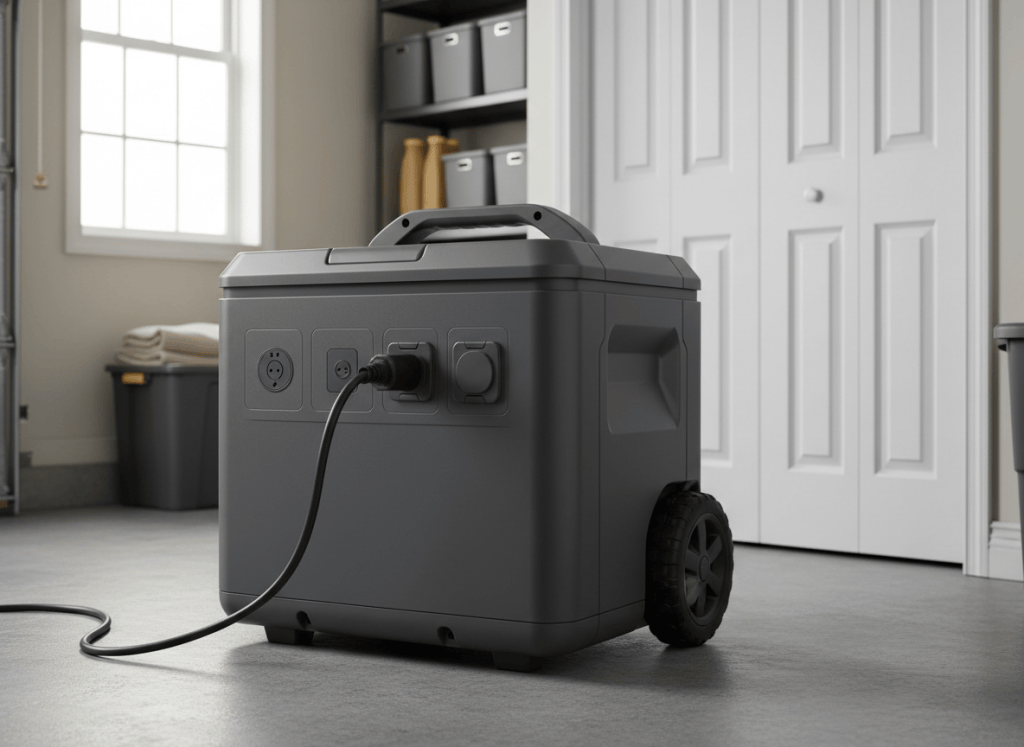
Quick verdict: the EcoFlow DELTA 3 Ultra Plus is a 3,072 Wh, 3,600 W power station built for multi-day home outages and RVs. It runs an average refrigerator for about 36 hours on its own, takes up to 1,600 W of solar, charges from a generator at up to 3,200 W and expands to 11 kWh. The catch is size: at 74.3 lb it’s a unit you park, not carry, and from a normal wall outlet it takes about 2 hours to fill.
| Buy it if | Outages in your area last a day or more, you want solar or generator backup, or you have an RV with a 30 A plug |
| Skip it if | Your outages are short, you need to carry it, or 1–2 kWh covers your needs |
| Key numbers | 3,072 Wh · 3,600 W (7,200 W surge) · 1,600 W solar · 3–11 kWh · 74.3 lb |
| Average fridge (est.) | ~36 hours |
How we reviewed it: an analysis of EcoFlow’s official specifications and FAQ, with dimensions and weight from a retailer listing, plus our own runtime math. We haven’t tested this unit hands-on. See How We Test. Prices change often; compare current listings.
Pros and cons
| Pros | Cons |
|---|---|
| 3,600 W output, 7,200 W surge; X-Boost runs resistive devices up to 4,600 W | Heavy: 74.3 lb |
| TT-30 / 30 A outlet plus a 30 A Anderson port for RVs | Wall charging is capped at about 1,800 W (~2 h to full) |
| 1,600 W of solar input across two ports | Only four standard AC outlets |
| Expands from 3 to 11 kWh | Extra batteries, generator and alternator charger cost extra |
| Six charging methods, including 3,200 W from EcoFlow’s smart generator | Large footprint (about 24 × 13 × 16 in) |
| 10 ms UPS switchover; charges at up to 113°F | |
| 5-year warranty (with app registration) |
Full specifications
| Specification | EcoFlow DELTA 3 Ultra Plus |
|---|---|
| Capacity | 3,072 Wh |
| Chemistry and lifespan | LFP; EcoFlow rates it for 10+ years of use |
| AC output | 3,600 W continuous, 7,200 W surge; X-Boost up to 4,600 W |
| AC outlets | 4 × 20 A outlets + 1 × 30 A (TT-30R) |
| USB-C | 1 × 140 W + 2 × 45 W (shared) |
| USB-A | 1 × 18 W |
| 12 V output | Anderson 30 A (378 W, shared) + car socket 126 W |
| Wall (AC) charging | 1,800 W; 0–80% in ~90 min, 0–100% in ~120 min |
| Solar input | 1,600 W (2 × 800 W, 11–60 V, 18 A per port); 0–80% in 101 min |
| Generator charging | Up to 3,200 W with EcoFlow Smart Generator 4000; 0–80% in 53 min |
| Alternator charging | 1,000 W with Alternator Charger Plus 1000; 0–80% in 142 min |
| Fastest combined charge | Solar + generator (3,960 W): 0–80% in 48 min |
| UPS | 10 ms switchover |
| Noise | About 25 dB (EcoFlow) |
| Charging temperature | 32–113°F |
| Discharging temperature | 14–113°F |
| Dimensions | About 24.1 × 12.9 × 15.6 in |
| Weight | 74.3 lb |
| Expansion | 3–11 kWh (up to 11 kWh with two DELTA Pro 3 Extra Batteries) |
| App and smart features | Wi-Fi and Bluetooth; Smart Output Priority, Storm Guard, generator auto start/stop |
| Warranty | 3 years + 2 more with app registration (5 total) |
Ports: what to plug in where
| Port | Use it for |
|---|---|
| 20 A AC outlets (×4) | Refrigerator, freezer, microwave, coffee maker, window AC, CPAP power supply, TV |
| 30 A TT-30 outlet | An RV’s 30 A shore cord, feeding the RV’s 120 V outlets and lights |
| USB-C 140 W | Laptops (more efficient than using the laptop’s AC charger) |
| USB-C 45 W (×2) | Phones and tablets |
| Anderson 30 A / car socket | 12 V fridges, tire inflators, RV 12 V gear |
EcoFlow also offers two ways to connect it to a home’s circuits, a manual transfer switch or an inlet box. Either one must be installed by a licensed electrician; never backfeed power through a wall outlet.
Six ways to charge it
| Method | Input | 0–80% (EcoFlow) |
|---|---|---|
| Wall outlet | 1,800 W | ~90 min (full in ~2 h) |
| Solar | 1,600 W | 101 min in ideal sun |
| Smart generator | 3,200 W | 53 min |
| Alternator (Charger Plus 1000) | 1,000 W | 142 min |
| Solar + alternator | 2,600 W | 60 min |
| Solar + generator | 3,960 W | 48 min |
The solar input is the standout for long outages. In real use, panels produce about 75% of their rating, so 1,600 W of panels gives roughly 1,200 W and about 4,800 Wh on a 4-sun-hour day, more than the battery holds. EcoFlow’s Storm Guard mode can also top the battery up automatically when a severe-weather alert is issued. More on charging in how long it takes to charge a power station.
How long does it run your devices?
Hours = (3,072 Wh × 0.85) ÷ (device watts + 10 W inverter). Usable energy: 3,072 × 0.85 ≈ 2,611 Wh. Example, an average refrigerator (62.5 W average): 2,611 ÷ 72.5 ≈ 36 hours. Backing up a chest freezer too? It adds only about 25–37 W on average; see can a portable power station run a chest freezer.
| Device | Estimated runtime |
|---|---|
| Average refrigerator (1.5 kWh/day) | ~36 hours |
| Efficient refrigerator (1.0 kWh/day) | ~50 hours |
| Fridge + Wi-Fi + lamp + phones (~95 W) | ~27.5 hours |
| CPAP, no humidifier (~320 Wh/night) | ~8 nights |
| CPAP with humidifier (~520 Wh/night) | ~5 nights |
| CPAP, humidifier + heated hose (~800 Wh/night) | ~3.3 nights |
| Wi-Fi router (~15 W) | ~104 hours |
| Laptop via AC (~60 W) | ~37 hours |
| Box fan (~30 W) | ~65 hours |
| 50-inch TV (~50 W) | ~43 hours |
| 5,000 BTU window AC (~440 W) | ~5.8 hours at full compressor |
| Microwave or space heater (~1,500 W) | ~1.7 hours of use |
Three real-world scenarios
1. A three-day outage after a hurricane
Fridge, Wi-Fi, a lamp and phones use about 95 W, or 2,280 Wh a day. The battery alone covers about 27 hours. Add 800 W of panels (about 600 W real): on a 4-sun-hour day they produce about 2,400 Wh, enough to match daily use. With sunny days, it can keep the essentials running indefinitely. See our hurricane power outage checklist.
2. A travel trailer without hookups
Plug the trailer’s 30 A cord into the TT-30 outlet and its 120 V outlets and lights run from the battery. Keep total loads under 3,600 W. A 12,000 BTU window-style AC drawing about 990 W would drain it in roughly 2.6 hours at full compressor, so treat air conditioning as a short-term luxury unless you have solar or a generator. See can a power station run a window AC and our van life and RV picks.
3. A week-long outage with a generator
Pair it with EcoFlow’s Smart Generator and use generator auto start/stop: the generator runs only when the battery gets low, charging at up to 3,200 W (0–80% in 53 minutes), while the battery covers the quiet hours. Always run any generator outdoors, far from windows and doors. Compare approaches in solar vs gas generator.
DELTA 3 Ultra Plus vs rivals
| DELTA 3 Ultra Plus | DELTA 3 Ultra | DELTA 3 Max Plus | Anker SOLIX C2000 Gen 2 | |
|---|---|---|---|---|
| Capacity | 3,072 Wh | 3,072 Wh | 2,048 Wh | 2,048 Wh |
| AC output (surge) | 3,600 W (7,200 W) | 3,600 W (7,200 W) | 3,000 W (6,000 W) | 2,400 W (4,000 W) |
| Solar input | 1,600 W | 800 W | 1,000 W | 800 W |
| Wall charging | 1,800 W | 1,800 W | About 1,800 W | 1,800 W |
| Generator charging | 3,200 W | 1,800 W | — | — |
| Alternator charging | 1,000 W | 720 W | 800 W (with adapter) | 800 W |
| Expandable | 3–11 kWh | No | 2–10 kWh | Up to ~4 kWh |
| RV outlet | TT-30 + Anderson | No Anderson port | Anderson 30 A | TT-30 |
| Weight | 74.3 lb | Check listing | 48.7 lb | 41.7 lb |
| Average fridge alone | ~36 h | ~36 h | ~24 h | ~24 h |
The non-Plus DELTA 3 Ultra has the same battery and output but half the solar input, slower generator and alternator charging and no expansion. If you’ll never add panels or batteries, it’s the simpler choice; otherwise the Plus is the one to get. If 2 kWh is enough, the DELTA 3 Max Plus and Anker SOLIX C2000 Gen 2 are much easier to move.
Who should buy it, and who shouldn’t
| Buy it if you… | Look elsewhere if you… |
|---|---|
| Live where outages last a day or longer (hurricanes, ice storms, rural lines) | Mostly face outages of a few hours: a 1 kWh unit is enough |
| Want to add solar, a generator or extra batteries | Need to carry it up stairs or into a car |
| Have an RV or trailer with a 30 A plug | Want a lighter 2 kWh unit with an RV outlet: see the C2000 Gen 2 |
| Run heavier appliances alongside the fridge | Need 240 V appliances like central AC or a 240 V well pump |
Common mistakes with a big power station
- Expecting a fast wall charge. A standard outlet limits it to about 1,800 W, so a full charge takes about 2 hours. Charge before the storm, or use Storm Guard.
- Buying more capacity than your outages need. Check your area’s typical outage length first.
- Running heat or AC for hours. A space heater or window AC can use more than a day of fridge energy in a couple of hours.
- Backfeeding the house. Use a transfer switch or inlet box installed by an electrician.
Frequently asked questions
What’s the difference between the DELTA 3 Ultra and Ultra Plus?
Same 3,072 Wh battery and 3,600 W output. The Plus adds expansion to 11 kWh, 1,600 W of solar (vs 800 W), 3,200 W generator charging (vs 1,800 W), 1,000 W alternator charging (vs 720 W) and an Anderson port.
Can it power my whole house?
It can power selected 120 V circuits through a professionally installed transfer switch or inlet box, and Smart Output Priority lets you choose which stay on. It won’t run 240 V loads like central air. Compare it with installed systems in home battery backup vs portable power station.
How long will it run a refrigerator?
About 36 hours for an average fridge on the battery alone, by our estimate, and indefinitely with enough solar. See best power stations for a refrigerator.
Can I use it while it charges?
Yes. EcoFlow says it runs devices while connected to AC, a car outlet or solar; charging is slower because some power goes to your devices.
Is it quiet enough for a bedroom?
EcoFlow rates it at about 25 dB, very quiet. Fans may run harder under heavy loads or fast charging.
The bottom line
The DELTA 3 Ultra Plus is the most capable single-box pick we’ve analyzed for long outages: 3 kWh to start, 11 kWh if you need it, and enough solar and generator input to keep going for days. If your outages are short or you need to move it often, a 1–2 kWh unit is the better buy. More options in our best power stations for home backup.
Sources
- EcoFlow, DELTA 3 Ultra Plus product page and DELTA 3 Ultra Plus overview (official).
- EcoFlow, DELTA 3 Ultra Plus & DELTA 3 Ultra FAQ (charging times and methods) and DELTA 3 Ultra product page (official).
- Adorama, DELTA 3 Ultra Plus listing (dimensions and weight).
- Rival specifications: our reviews of the DELTA 3 Max Plus and Anker SOLIX C2000 Gen 2 and their official sources.

