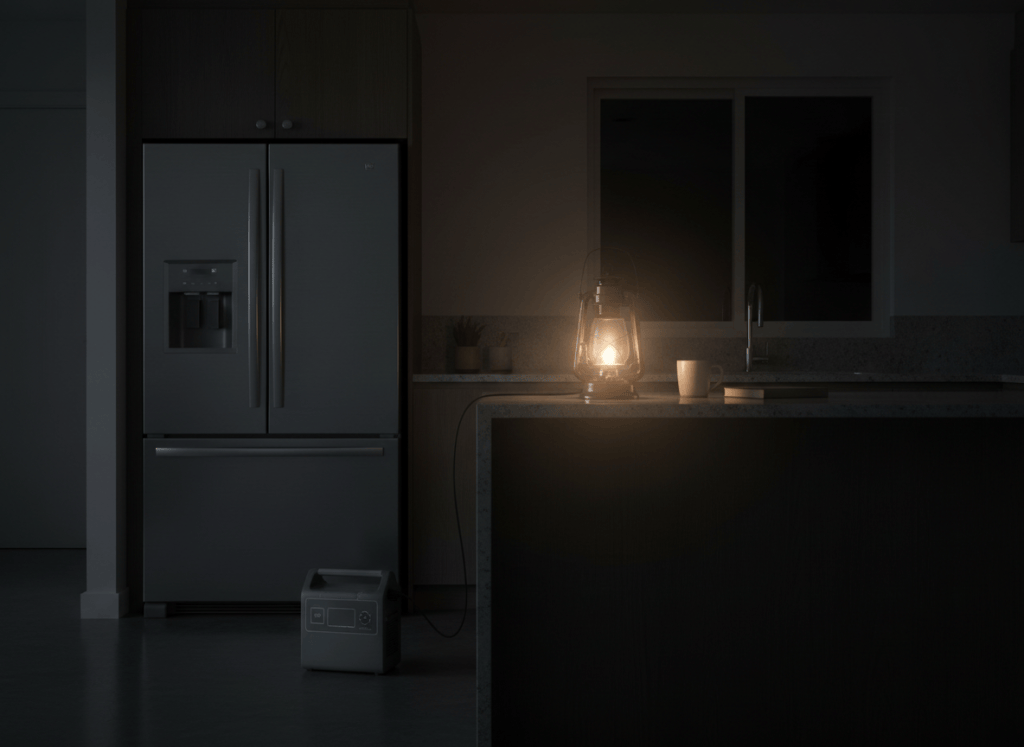
Our picks: to keep a full-size refrigerator running for about a day, the EcoFlow DELTA 3 Max Plus (2 kWh) is the best choice: plenty of surge for the compressor, automatic switchover and room to expand. The Anker SOLIX C2000 Gen 2 offers the same 2 kWh in a lighter box. For overnight outages, a 1 kWh unit is enough: the EcoFlow DELTA 3 Plus if you might expand later, the Anker SOLIX C1000 Gen 2 for the fastest recharge. For multi-day outages, the EcoFlow DELTA 3 Ultra Plus (3 kWh).
| Pick | Best for | Average fridge alone (est.) |
|---|---|---|
| EcoFlow DELTA 3 Max Plus | Best overall: a full day | ~24 hours |
| Anker SOLIX C2000 Gen 2 | Lightest 2 kWh | ~24 hours |
| EcoFlow DELTA 3 Plus | Overnight, expandable to 5 kWh | ~12 hours |
| Anker SOLIX C1000 Gen 2 | Overnight, fastest recharge | ~12 hours |
| EcoFlow DELTA 3 Ultra Plus | Multi-day outages | ~36 hours |
How we chose: a research-based comparison of official manufacturer specifications and our transparent runtime math, not hands-on tests. See How We Test. Prices change often; compare current listings.
Step 1: find how much energy your fridge uses
New refrigerators sold in the U.S. carry a yellow EnergyGuide label showing the model’s estimated yearly electricity use in kWh. Divide that number by 365 to get kWh per day. No label? Look up the model number online, or measure it for 24 hours with a plug-in energy meter.
| Fridge type | Example label | Per day | Average watts (+10 W inverter) |
|---|---|---|---|
| Compact / mini fridge (3.4 cu ft) | 259 kWh/year | ~0.71 kWh | ~30 W (~40 W) |
| Average full-size fridge | ~548 kWh/year | ~1.5 kWh | ~62.5 W (~72.5 W) |
| Large side-by-side with ice dispenser (23 cu ft) | 630 kWh/year | ~1.7 kWh | ~72 W (~82 W) |
Step 2: the runtime formula
Hours = (battery Wh × 0.85) ÷ (fridge average watts + 10 W)
Worked example, large side-by-side fridge (630 kWh/year) on a 2,048 Wh station:
- 630 ÷ 365 = 1.73 kWh per day → 1,730 Wh ÷ 24 h ≈ 72 W on average.
- Add 10 W for the inverter: 82 W.
- Usable energy: 2,048 × 0.85 ≈ 1,741 Wh.
- 1,741 ÷ 82 ≈ 21 hours.
| Station capacity | Mini fridge | Average fridge | Large side-by-side | Fridge + Wi-Fi, lamp, phones (~95 W) |
|---|---|---|---|---|
| 1,024 Wh | ~22 h | ~12 h | ~10.5 h | ~9 h |
| 2,048 Wh | ~44 h | ~24 h | ~21 h | ~18 h |
| 3,072 Wh | ~66 h | ~36 h | ~32 h | ~27.5 h |
More detail, including how to stretch runtime: how long can a power station run a refrigerator.
What matters in a power station for a fridge
- Capacity (Wh): decides how many hours. Match it to your typical outage.
- Surge (peak watts): a compressor briefly draws several times its running power when it starts. Every pick here is rated for at least 3,000 W peak, far above what a household fridge needs to start.
- UPS / automatic switchover: leave the fridge plugged into the station and the station into the wall; it takes over the moment the grid fails, even while you sleep.
- Pure sine wave AC: all picks provide it, which compressors and control boards need.
- Solar input and expansion: for outages longer than the battery lasts.
Our picks compared
| DELTA 3 Max Plus | C2000 Gen 2 | DELTA 3 Plus | C1000 Gen 2 | DELTA 3 Ultra Plus | |
|---|---|---|---|---|---|
| Capacity | 2,048 Wh | 2,048 Wh | 1,024 Wh | 1,024 Wh | 3,072 Wh |
| Chemistry | LFP | LFP | LFP | LFP | LFP |
| AC output | 3,000 W | 2,400 W | 1,800 W | 2,000 W | 3,600 W |
| Peak / surge | 6,000 W | 4,000 W | 3,600 W | 3,000 W | 7,200 W |
| UPS switchover | Under 10 ms | 10 ms | Under 10 ms | 10 ms | Under 10 ms |
| Fastest wall charge | About 1,800 W | 1,800 W | Full in 56 min | Full in 49 min | About 1,800 W (15 A outlet) |
| Solar input | 1,000 W | 800 W | 1,000 W | 600 W | 1,600 W |
| Expandable | 2–10 kWh | Up to ~4 kWh | Up to 5 kWh | No | 3–11 kWh |
| Charging temperature | 32–113°F | 32–104°F | See manual | 32–104°F | 32–113°F |
| Weight | 48.7 lb | 41.7 lb | 27.6 lb | 24.9 lb | 74.3 lb |
| Average fridge alone | ~24 h | ~24 h | ~12 h | ~12 h | ~36 h |
1. EcoFlow DELTA 3 Max Plus: best overall for a refrigerator
With 2,048 Wh, the Max Plus runs an average fridge for about a day, or a fridge plus Wi-Fi, a lamp and phones for about 18 hours. Its 3,000 W output (6,000 W surge) means you can also run a microwave or coffee maker without unplugging the fridge. It switches over in under 10 ms, accepts 1,000 W of solar and expands up to 10 kWh with extra batteries.
| Pros | Cons |
|---|---|
| A full day for an average fridge | Heavy at 48.7 lb |
| Runs kitchen appliances alongside the fridge | Only four AC outlets |
| Expands to 10 kWh | Larger footprint |
| Charges at up to 113°F (hot garages) |
Choose it if outages in your area often last a day. Skip it if you have to carry it up and down stairs. Full details: EcoFlow DELTA 3 Max Plus review.
2. Anker SOLIX C2000 Gen 2: lightest 2 kWh
Same capacity as the Max Plus at 41.7 lb, with Anker listing a low 9 W idle draw, which matters when a fridge runs for 24 hours. Output is 2,400 W (4,000 W peak), it switches over in 10 ms, accepts 800 W of solar and expands to about 4 kWh. It charges only between 32°F and 104°F, so it’s less suited to a hot garage.
| Pros | Cons |
|---|---|
| 2 kWh at 41.7 lb | Less output than the Max Plus |
| 9 W idle draw listed by Anker | Expansion only to about 4 kWh |
| TT-30 RV outlet as a bonus | Charging stops above 104°F |
Choose it if you want a full day of fridge backup you can still move easily. Full details: Anker SOLIX C2000 Gen 2 review.
3. EcoFlow DELTA 3 Plus: best 1 kWh that can grow
For outages that usually end by morning, 1 kWh covers an average fridge for about 12 hours. The DELTA 3 Plus recharges from the wall in 56 minutes, takes 1,000 W of solar and, unlike most 1 kWh units, expands to 5 kWh if you later want a full day or more.
| Pros | Cons |
|---|---|
| Expands to 5 kWh | 1 kWh alone won’t last a full day |
| 1,000 W solar input | 1,800 W limits running a kettle with the fridge |
| Six AC outlets | Heaviest 1 kWh pick (27.6 lb) |
Full details: EcoFlow DELTA 3 Plus review.
4. Anker SOLIX C1000 Gen 2: fastest recharge in 1 kWh
The C1000 Gen 2 refills from the wall in 49 minutes, useful when power flickers on and off during a storm. It has 2,000 W of output, enough to run a kettle with the fridge on, and weighs 24.9 lb. It can’t be expanded and accepts 600 W of solar.
| Pros | Cons |
|---|---|
| Full recharge in 49 minutes | Not expandable |
| 2,000 W output | 600 W solar input |
| Lightest pick (24.9 lb) | Charging stops above 104°F |
Full details: Anker SOLIX C1000 Gen 2 review. Comparing it with Jackery? See Jackery vs Anker SOLIX.
5. EcoFlow DELTA 3 Ultra Plus: best for multi-day outages
At 3,072 Wh, the Ultra Plus runs an average fridge for about a day and a half on its own, and it expands up to 11 kWh. It accepts 1,600 W of solar through two inputs, so a large array can refill most of a day’s fridge use in a few hours of good sun. It has 3,600 W of output (7,200 W surge) and a sub-10 ms switchover. At 74.3 lb, it’s meant to stay in one place.
| Pros | Cons |
|---|---|
| About 36 hours for an average fridge | Very heavy (74.3 lb) |
| 1,600 W solar input | More capacity than short outages need |
| Expands to 11 kWh |
Full details: EcoFlow DELTA 3 Ultra Plus review.
Other alternative: the Jackery Explorer 1000 v2 (1,070 Wh) runs an average fridge for about 12.5 hours, but its 1,500 W output leaves little room for anything else.
Three real-world scenarios
1. An overnight summer storm outage
Power goes out at 8 p.m. and returns at 7 a.m.: 11 hours. An average fridge plus Wi-Fi and a lamp (~95 W) needs about 1,045 Wh, just over what a 1 kWh station delivers usably (~870 Wh). Drop the lamp and router at bedtime and the fridge alone (~72.5 W) needs about 800 Wh: a 1 kWh unit covers it. Want the TV on too? See can a power station run a TV, Wi-Fi and game console.
2. A two-day outage after a hurricane
An average fridge uses about 1,740 Wh a day through the inverter. To keep up with solar, divide by 5 sun hours × 75% panel output: 1,740 ÷ 3.75 ≈ 464 W, so plan on about 500 W of panels. A 2 kWh station bridges the nights. See our hurricane power outage checklist and how many solar panels you need.
How fast each method refills the battery between outages: how long does it take to charge a power station.
3. A mini fridge in a garage, office or dorm
A compact fridge rated 259 kWh/year uses about 30 W on average. Even a 1 kWh station runs it for about 22 hours, and a 2 kWh station for almost two days.
Common mistakes
- Using the nameplate watts. The label’s amps or watts describe the maximum, not the average. Use the EnergyGuide kWh/year figure.
- Forgetting the inverter. Running AC costs about 10 W extra, around 240 Wh a day.
- Opening the door often. Each opening lets cold air out and makes the compressor run longer.
- Using a thin extension cord. Plug the fridge directly into the station, or use a heavy-duty cord rated for the load.
- Backfeeding through a wall outlet. Never do it; to power home circuits, have an electrician install a transfer switch.
Frequently asked questions
What size power station do I need for a refrigerator?
About 1 kWh for an overnight outage and about 2 kWh for a full day with an average fridge. For longer outages, add solar panels or choose 3 kWh or more. Use our sizing guide for your exact devices.
Can a 500 Wh power station run a fridge?
Yes, for a few hours, if its output and surge cover the compressor start. With an average fridge, 500 Wh gives roughly 6 hours by our formula; a mini fridge, about 11 hours.
Can I leave my fridge plugged into the power station all the time?
Yes. All our picks support UPS-style use: the station passes grid power through and switches to battery automatically when the power fails.
Can it run a fridge and a freezer together?
Yes, if you add both loads. An average fridge plus a 7 cu ft chest freezer uses about 2.4 kWh a day through the inverter, so plan on 2–3 kWh or solar. Output is not the problem; capacity is. Freezer-only runtimes by size: can a portable power station run a chest freezer.
Is a power station better than a gas generator for a fridge?
It’s silent, fume-free and can run indoors, but it holds limited energy. For week-long outages, a generator or a large solar setup goes further. Compare them in solar vs gas generator.
The bottom line
Check your fridge’s EnergyGuide label, then match capacity to your outages: 1 kWh for overnight (DELTA 3 Plus or C1000 Gen 2), 2 kWh for a full day (DELTA 3 Max Plus or C2000 Gen 2) and 3 kWh plus solar for multi-day outages (DELTA 3 Ultra Plus). For more home options, see our best power stations for home backup.
Sources
- U.S. DOE Building America Solution Center, EnergyGuide label example (630 kWh/year).
- Compact refrigerator EnergyGuide label, 3.4 cu ft (259 kWh/year).
- EcoFlow, DELTA 3 Plus, DELTA 3 Max Plus specifications and DELTA 3 Ultra Plus specifications (official); Ultra Plus weight from Adorama.
- Anker SOLIX, C2000 Gen 2, C1000 Gen 2 and C1000 Gen 2 basic specifications (official).

