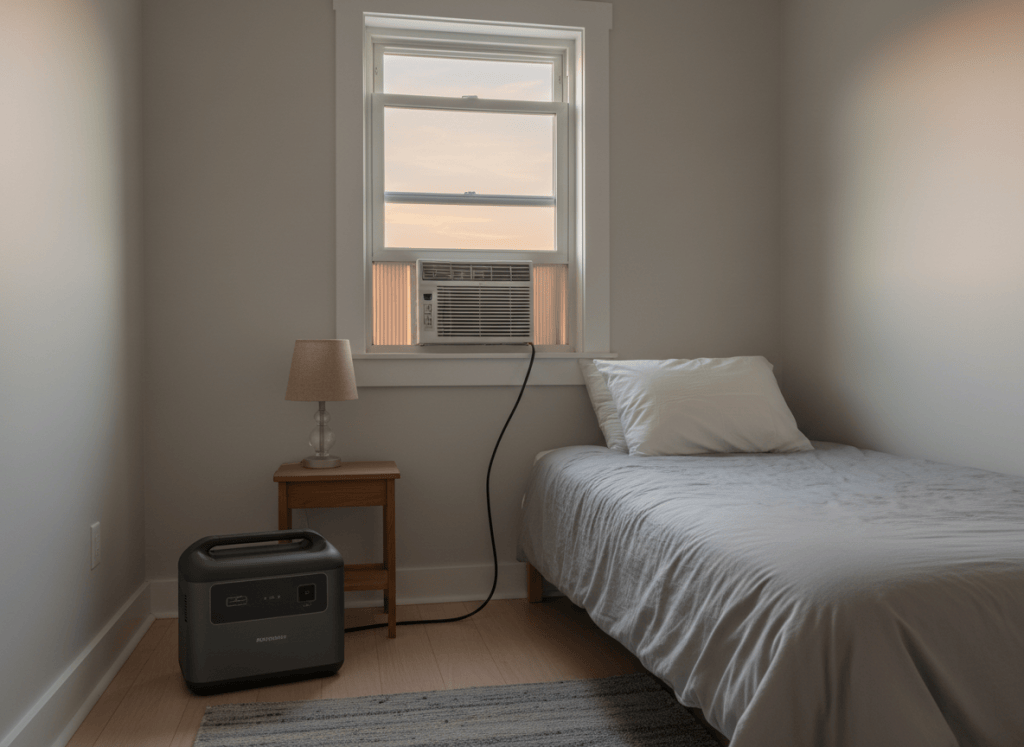
Quick answer: yes, most 1 kWh and larger power stations can run a 115 V window air conditioner, but only for a few hours. A 5,000 BTU unit like the LG LW5016 is rated at 440 W; a 12,000 BTU unit like the LG LW1216ER at 990 W. On a 2 kWh station, that’s roughly 4–6 hours for the small unit and 2–3 hours for the big one. The small one with solar panels in strong sun is the combination that can actually last through a day.
How we wrote this: AC ratings come from LG’s spec sheet and retailers’ published specifications; power station ratings from each maker’s official pages. Runtimes are our estimates, with the math shown. We haven’t run these air conditioners on these units ourselves. See How We Test.
How many watts does a window AC use?
Look for “cooling watts” or “rated amps” on the label or spec sheet. If you only find the BTU rating and the EER (energy efficiency ratio), you can estimate: watts ≈ BTU ÷ EER. An 8,000 BTU unit with an EER of 12 draws about 670 W.
| Model | Size | Type | Cooling watts | Rated amps | EER |
|---|---|---|---|---|---|
| LG LW5016 | 5,000 BTU (150 sq ft) | Standard | 440 W | 4.1 A | 11.2 |
| Midea U-shaped MAW08V1QWT | 8,000 BTU (350 sq ft) | Inverter | Up to 710 W | 8.78 A | 15 |
| LG LW1216ER | 12,000 BTU (550 sq ft) | Standard | 990 W | 9.3 A | 12.1 |
The Midea is a special case. As an inverter model, it changes compressor speed instead of switching fully on and off. The 710 W is its maximum; at its rated EER of 15, 8,000 BTU works out to about 533 W, and it can run slower once the room is cool.
The start surge
A standard window AC switches its compressor on and off. Every time it kicks on, the compressor motor draws a short burst of current well above its running current. For scale, Micro-Air, which makes soft-start kits for RV air conditioners, says 16,000 BTU RV rooftop compressors are rated around 50–60 A at start, far more than a 2,000 W generator’s peak of about 16.7 A. Window AC makers rarely publish this number; if your unit’s nameplate lists “LRA” (locked rotor amps), that’s the one to check.
In practice: a 5,000–6,000 BTU unit is the easiest to start; a 12,000 BTU standard unit is the riskiest. Inverter models change speed instead of slamming on at full power, which generally makes them easier on a power station. If a station can’t handle the start, it shuts off its output to protect itself, so test at home first.
Which power stations can run one?
| Power station | Continuous / peak | 5,000 BTU (440 W) | 8,000 BTU inverter (≤710 W) | 12,000 BTU (990 W) |
|---|---|---|---|---|
| EcoFlow RIVER 3 Plus (286 Wh) | 600 W / 1,200 W | Not practical: about 30 minutes | No | No |
| Jackery Explorer 1000 v2 (1,070 Wh) | 1,500 W / 3,000 W | Yes | Yes | Runs; test the start |
| Anker SOLIX C1000 Gen 2 (1,024 Wh) | 2,000 W / 3,000 W | Yes | Yes | Runs; test the start |
| EcoFlow DELTA 3 Plus (1,024 Wh) | 1,800 W / 3,600 W | Yes | Yes | Likely; test the start |
| Anker SOLIX C2000 Gen 2 (2,048 Wh) | 2,400 W / 4,000 W | Yes | Yes | Likely |
| EcoFlow DELTA 3 Max Plus (2,048 Wh) | 3,000 W / 6,000 W | Yes | Yes | Yes, most margin |
How long will it run? The math
A standard AC’s compressor cycles on and off as the room reaches the set temperature. On a hot night, it may run most of the time; in a mild evening, much less. So we use the share of time the compressor runs.
Average watts = cooling watts × share of time running + 10 W inverter
Hours = (battery Wh × 0.85) ÷ average watts
- Cooling watts. LG LW5016: 440 W.
- Share of time running. Example: the compressor runs 60% of the time. 440 × 0.6 = 264 W.
- Add the inverter. 264 + 10 = 274 W on average.
- Usable energy. 2,048 Wh × 0.85 ≈ 1,741 Wh.
- Divide. 1,741 ÷ 274 ≈ 6.4 hours.
| Air conditioner and use | Average draw | 1 kWh (1,024 Wh) | 2 kWh (2,048 Wh) | 3 kWh (3,072 Wh) |
|---|---|---|---|---|
| 5,000 BTU, compressor always on | ~450 W | ~1.9 h | ~3.9 h | ~5.8 h |
| 5,000 BTU, compressor on 60% of the time | ~274 W | ~3.2 h | ~6.4 h | ~9.5 h |
| 8,000 BTU inverter at rated efficiency (~533 W) | ~543 W | ~1.6 h | ~3.2 h | ~4.8 h |
| 8,000 BTU inverter at maximum (710 W) | ~720 W | ~1.2 h | ~2.4 h | ~3.6 h |
| 12,000 BTU, compressor always on | ~1,000 W | ~0.9 h | ~1.7 h | ~2.6 h |
| 12,000 BTU, compressor on 60% of the time | ~604 W | ~1.4 h | ~2.9 h | ~4.3 h |
Compare that with a refrigerator, which averages about 62.5 W: the same 2 kWh unit runs a fridge for about a day. Air conditioning is one of the most expensive things you can ask a battery to do. For the other big one, see can a power station run a space heater.
Can solar keep a window AC running?
During strong midday sun, yes for a small unit. Panels deliver about 75% of their rating in real use, so 800 W of panels make about 600 W in good sun. That covers a 5,000 BTU AC (440 W running) with some left over to charge the battery, as long as your station accepts that much solar input (the DELTA 3 Plus and DELTA 3 Max Plus take up to 1,000 W). Clouds, mornings and evenings drop the output fast, and at night you’re back on the battery. A 12,000 BTU unit needs more than 1,300 W of panels just to break even in full sun. See how many solar panels you need.
How to get the most hours
- Cool one small room, not the house. Close the door and cover sunny windows.
- Pick the smallest AC that does the job. A 5,000 BTU unit in a bedroom beats a 12,000 BTU unit running half the time for battery life and start surge.
- Set the thermostat a few degrees higher than usual so the compressor cycles off more often.
- Pre-cool on grid or solar power, then switch to the battery once the room is cool.
- Use fan-only mode or a separate fan when you don’t need the compressor; a fan draws a small fraction of an AC’s power.
- Test at home first: let the AC start and cycle a few times on battery before you rely on it.
Three real-world scenarios
1. Summer outage, one bedroom, 2 kWh station
A 5,000 BTU unit cycling 60% of the time averages about 274 W, so a 2 kWh station lasts about 6.4 hours: a good part of a night. If the fridge also needs power, the two together average about 336 W (274 + 62.5), and the battery lasts about 5 hours. That’s the real trade-off in a summer outage. See how long a power station runs a refrigerator.
2. Camping or RV with a small AC and a 1 kWh station
Running a 5,000 BTU unit nonstop, a 1 kWh station lasts about 2 hours. It’s enough to cool the space before bed, not for the whole night. For real overnight cooling off-grid, you need 2–3 kWh or shore power. Our 1 kWh vs 2 kWh guide explains the jump.
3. Home office on a sunny afternoon
A 5,000 BTU AC plus a laptop setup (about 60–100 W) draws around 500–550 W while the compressor runs. With 800 W of panels producing about 600 W in strong sun, the solar covers most of it and the battery fills the gaps. Once the sun drops, a 2 kWh station gives you a few more hours.
Common mistakes
- Expecting all-night cooling from 1 kWh. With the compressor running most of the time, even a small AC empties it in about 2–3 hours.
- Buying a bigger AC than the room needs. More BTU means more watts and a harder start.
- Trying a 230 V unit. Some larger window ACs use a 208/230 V plug; portable power stations like these supply 120 V only.
- Using a thin extension cord. Plug the AC straight into the station.
- Not testing the start. The first time you find out the station can’t start your AC shouldn’t be during an outage.
Frequently asked questions
What size power station do I need for a window AC?
For a 5,000–8,000 BTU unit, a 1 kWh station runs it for 1–3 hours and a 2 kWh station for about 3–6 hours, based on our estimates. For a 12,000 BTU unit, pick a station with at least 1,800 W continuous and plenty of surge, and expect only 1–3 hours from 1–2 kWh.
Can a 1,000 W power station run a window AC?
A 5,000 BTU unit drawing about 440 W fits within 1,000 W of continuous output, but its start surge also has to fit under the station’s peak rating. A 12,000 BTU unit at 990 W is too close to a 1,000 W limit to be reliable.
Is an inverter window AC better for a power station?
Generally yes. It changes speed instead of cycling fully on and off, so it avoids repeated hard starts and can run at lower power once the room is cool. Its maximum draw can still be high, so check the spec sheet.
Will my AC turn back on by itself after the power goes out?
Some models, like the LG LW1216ER, have an auto-restart feature that turns the unit back on after an outage. If the AC is plugged into a power station running in UPS mode, it keeps running through the outage and doesn’t need to restart. See power station vs UPS.
Can a power station run central air conditioning?
No. Central AC usually runs on 240 V and draws far more power than these portable units supply. For that, you need an installed home battery or a standby generator; compare them in home battery backup vs portable power station.
The bottom line
A portable power station can run a window AC for a few hours, not a few days. Your best setup is a small 5,000–8,000 BTU unit, ideally an inverter model, in one closed room, on a 2 kWh station, with solar panels for daytime. For more options, see best power stations for home backup or size your whole list with what size power station do I need.
Sources
- LG, LW1216ER spec sheet (watts, amps, EER, auto restart).
- LG LW5016 specifications as published by eComfort and DS Home Appliances.
- Midea MAW08V1QWT specifications as published by AJ Madison; product page at Midea.
- Micro-Air, EasyStart installation FAQs (compressor starting current).
- EcoFlow, DELTA 3 Plus specifications; Anker SOLIX, C2000 Gen 2 specifications. Other models: see our linked reviews and their sources.

