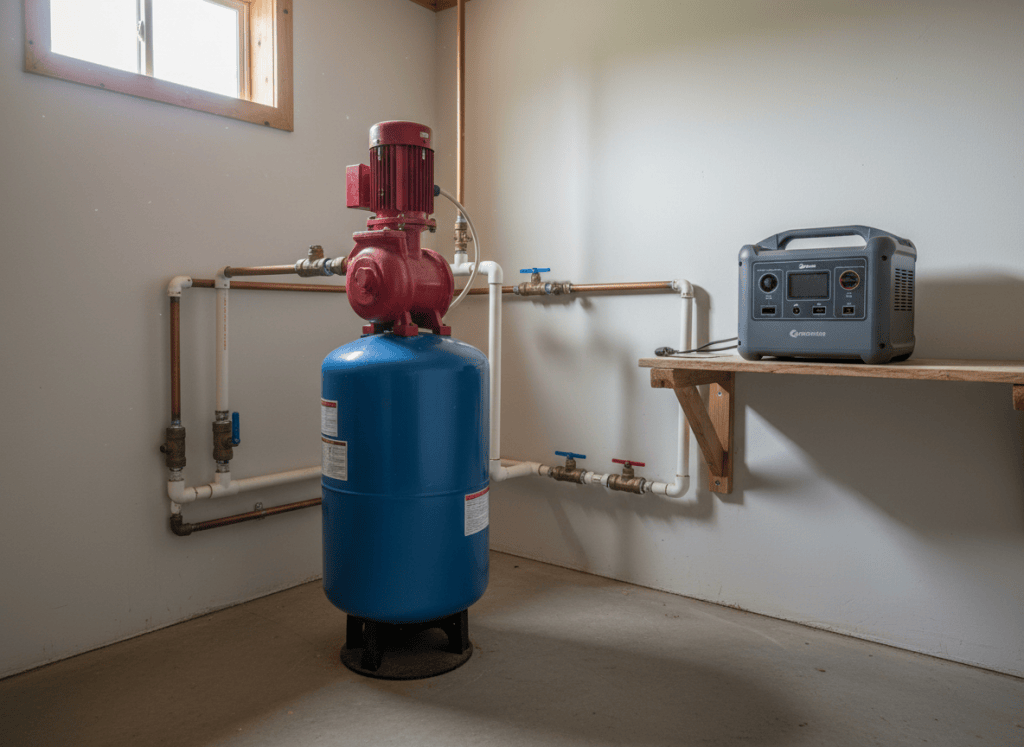
Quick answer: only if your well pump runs on 120 V. Many shallow well jet pumps can, but many deep well submersible pumps run on 240 V, which the portable power stations in this guide don’t supply. A 1/2 HP jet pump like the Red Lion RJS-50-PREM is rated at 11.8 A at 115 V (up to about 1,360 W), so you need a station with at least 1,800 W of continuous output and plenty of surge. A 2 kWh station then delivers roughly 700–800 gallons of water, or about 3–4 days of careful use.
How we wrote this: pump ratings come from Red Lion’s product page and distributors’ spec sheets; power station ratings from each maker’s official pages. Water and runtime figures are our estimates, with the math shown. We haven’t tested pumps on these units ourselves. See How We Test.
Step 1: Check your pump’s voltage
This decides everything. Look at the motor’s nameplate or the manual. Many jet pumps are dual voltage (115/230 V) and come from the factory set to 230 V; the setting on your pump is what matters, and an electrician can tell you which one it uses. Most well pumps are also hardwired to a pressure switch rather than plugged into an outlet.
| Pump | Type | Horsepower | Amps at 115 V | Approx. running watts at 115 V |
|---|---|---|---|---|
| Red Lion PWJET50 | Shallow well jet | 1/2 HP | 6.6 A | Up to ~760 W |
| Red Lion RL-SWJ50 | Shallow well jet | 1/2 HP | 8.4 A | Up to ~970 W |
| Red Lion RJS-50-PREM | Shallow well jet | 1/2 HP | 11.8 A | Up to ~1,360 W |
| Typical deep well submersible | Submersible | 1/2–1 HP and up | Often 240 V only | Not possible on a 120 V station |
Notice the spread: three 1/2 HP pumps from the same brand range from 6.6 A to 11.8 A. Always read your own pump’s label.
Step 2: Match it to a power station
| Power station | Continuous / peak | 120 V pump at ~760 W | 120 V pump at ~1,360 W |
|---|---|---|---|
| EcoFlow RIVER 3 Plus (286 Wh) | 600 W / 1,200 W | No | No |
| Jackery Explorer 1000 v2 (1,070 Wh) | 1,500 W / 3,000 W | Likely; test the start | Too close to the limit |
| EcoFlow DELTA 3 Plus (1,024 Wh) | 1,800 W / 3,600 W | Likely | Runs; test the start |
| Anker SOLIX C1000 Gen 2 (1,024 Wh) | 2,000 W / 3,000 W | Likely | Runs; test the start |
| Anker SOLIX C2000 Gen 2 (2,048 Wh) | 2,400 W / 4,000 W | Yes | Likely |
| EcoFlow DELTA 3 Max Plus (2,048 Wh) | 3,000 W / 6,000 W | Yes | Yes, most margin |
Step 3: Connect it safely
Because most well pumps are hardwired, you usually can’t just plug them into a power station. The safe options are a transfer switch or power inlet for the pump circuit, installed by a licensed electrician, or having an electrician add a plug-in connection to a 120 V pump. Never backfeed power through a wall outlet with a double-ended cord: it can energize the utility lines and seriously injure line workers, and start fires.
How much water will you get? The math
A well pump only runs when the pressure tank needs refilling, so the useful question is how many gallons a charge delivers. There’s a second cost that people forget: the station’s inverter has to stay on all day so the pump can start whenever you open a tap. At about 10 W, that’s around 240 Wh a day.
Wh per gallon = pump watts ÷ (gallons per minute × 60)
Daily Wh = gallons used × Wh per gallon + 240 Wh (inverter on all day)
Days = (battery Wh × 0.85) ÷ daily Wh
- Pump watts: RJS-50-PREM, 11.8 A × 115 V ≈ 1,357 W.
- Flow: about 10 gallons per minute at 40 psi (from its published pump curve at 5 ft of lift).
- Wh per gallon: 1,357 ÷ 600 ≈ 2.3 Wh.
- A careful outage day of 100 gallons: 100 × 2.3 = 226 Wh, plus 240 Wh of inverter time = about 466 Wh.
- Divide: a 2 kWh station has about 1,741 Wh usable, so 1,741 ÷ 466 ≈ 3.7 days.
| Water used per day | Daily energy | 1 kWh (1,024 Wh) | 2 kWh (2,048 Wh) | 3 kWh (3,072 Wh) |
|---|---|---|---|---|
| 50 gallons (very careful) | ~353 Wh | ~2.5 days | ~4.9 days | ~7.4 days |
| 100 gallons (careful) | ~466 Wh | ~1.9 days | ~3.7 days | ~5.6 days |
| 150 gallons | ~579 Wh | ~1.5 days | ~3 days | ~4.5 days |
| Pump only, inverter off between uses | ~2.3 Wh per gallon | ~385 gallons | ~770 gallons | ~1,150 gallons |
How to stretch it
- Fill containers in one session: run the pump once to fill jugs, a bathtub for flushing and a pot for cooking, then switch the station’s AC off.
- Turn the AC output off between uses to save the 240 Wh a day the inverter would burn.
- Don’t run the fridge and pump starts together on a 1,800–2,000 W unit.
- Recharge with solar during the day; 400 W of panels makes about 1,200 Wh on a 4-sun-hour day, enough for a careful day of water plus some extra. See how many solar panels you need.
- Test before an outage, with the electrician present if they installed the connection.
Three real-world scenarios
1. Rural home, 120 V shallow well pump, 2 kWh station
With a transfer switch on the pump circuit, a 2 kWh unit with 3,000 W or more of output runs the pump for about 3–4 careful days on its own. Add an average fridge (about 1,500 Wh a day) and the total jumps to nearly 2,000 Wh a day, so the same battery lasts less than a day. For both, you need solar recharging or a bigger system. Filling containers in batches and turning the inverter off between sessions stretches the water side further.
2. Deep well with a 240 V submersible
The 120 V power stations in this guide can’t run it. Your options are a generator or home battery system that supplies 240 V, installed with a transfer switch, or storing water before an expected outage. Compare installed options in home battery backup vs portable power station and solar generator vs gas generator.
3. Weekend cabin with a small jet pump
A 6.6 A pump like the PWJET50 draws up to about 760 W, well within a 1,800 W station. Using about 1.3 Wh per gallon (at 10 gpm), 60 gallons over a weekend takes under 100 Wh of pumping; the bigger cost is leaving the inverter on, so switch it off when nobody needs water.
Common mistakes
- Assuming the pump is 120 V. Dual-voltage pumps often ship set to 230 V, and many submersibles are 240 V only.
- Backfeeding through an outlet. Dangerous and illegal in many places; use a transfer switch.
- Sizing by horsepower. The same 1/2 HP rating can mean 6.6 A or 11.8 A.
- Forgetting the idle cost. Leaving the inverter on for the pump costs about 240 Wh a day.
- Never testing the start. Motors pull a surge; find out on a normal day, not during a storm.
Frequently asked questions
What size power station do I need for a well pump?
For a 120 V, 1/2 HP pump, look for at least 1,800 W continuous and a high peak rating; 2 kWh of capacity covers about 3–4 careful days of water on its own, by our estimates.
Can a portable power station run a 240 V well pump?
Not the 120 V models in this guide. You’d need a system that outputs 240 V, installed with a transfer switch by an electrician.
How many watts does a well pump use?
Check the nameplate. The 1/2 HP jet pumps in this guide range from about 760 W to 1,360 W at 115 V, plus a starting surge.
Can I just plug my well pump into the power station?
Only if it’s a 120 V pump with a cord and plug. Most are hardwired, so an electrician needs to add a safe connection or a transfer switch.
Is it the same as running a sump pump?
Similar power, different setup. Sump pumps usually plug in and run on 120 V; well pumps are often hardwired and may be 240 V. See can a portable power station run a sump pump.
The bottom line
A portable power station can keep water flowing from a 120 V shallow well pump for a few days if you pick a unit with enough output, connect it through a proper transfer switch and use water in batches. For 240 V pumps, look at installed backup instead. For more options, see best power stations for home backup.
Sources
- Red Lion, Shallow Well Jet Pump (PWJET50) (official product page).
- Red Lion RJS-50-PREM specifications and pump curve as published by PumpProducts; RL-SWJ50 amps as listed on Amazon.
- EcoFlow, DELTA 3 Plus specifications; Anker SOLIX, C2000 Gen 2 specifications. Other models: see our linked reviews and their sources.

