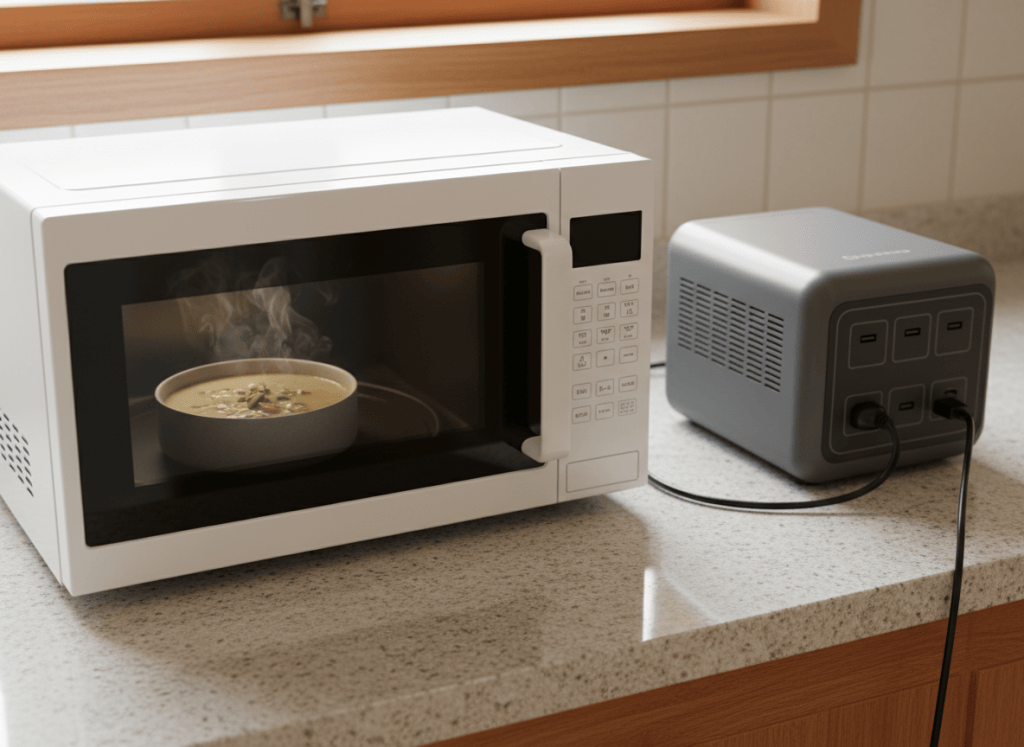
Quick answer: yes, most 1 kWh and larger power stations can run a countertop microwave, if their continuous output is higher than the microwave’s input watts. That’s the catch: the “1,000 W” on the box is cooking power. A Hamilton Beach 1,000 W model is listed at 1,500 W input, and a 1,200 W Panasonic inverter model at about 1,480 W. Energy is rarely the problem: a 2-minute reheat uses about 50 Wh, so a 1 kWh station covers roughly 17 of them.
How we wrote this: microwave ratings come from published product listings and spec data; power station ratings from each maker’s official pages. Energy figures are our estimates, with the math shown. We haven’t run these microwaves on these units ourselves. See How We Test.
Cooking watts vs input watts
A microwave turns electricity into microwaves with some loss, so it always pulls more from the outlet than it delivers to the food. The big number in the ad is the output (cooking power). What matters for a power station is the input, usually printed on the label on the back or inside the door, or listed as “power consumption” in the specs.
| Microwave | Type | Cooking (output) | Input from the outlet | Input ÷ output |
|---|---|---|---|---|
| Hamilton Beach 1.1 cu ft, 1,000 W | Conventional | 1,000 W | 1,500 W | 1.5× |
| Panasonic NN-SN686S, 1.2 cu ft | Inverter | 1,200 W | ~1,480 W | ~1.2× |
Rule of thumb when you can’t find the label: plan for about 1.5 times the cooking power. A “1,000 W” microwave then needs a station rated around 1,500 W continuous, with some margin on top.
Which power stations can run one?
| Power station | Continuous / peak | 1,500 W-input microwave alone | Microwave + fridge at the same time |
|---|---|---|---|
| EcoFlow RIVER 3 Plus (286 Wh) | 600 W / 1,200 W | No | No |
| Jackery Explorer 1000 v2 (1,070 Wh) | 1,500 W / 3,000 W | At the limit: pick a lower-input model | No: unplug the fridge first |
| EcoFlow DELTA 3 Plus (1,024 Wh) | 1,800 W / 3,600 W | Yes | Tight: only if the fridge compressor is off |
| Anker SOLIX C1000 Gen 2 (1,024 Wh) | 2,000 W / 3,000 W | Yes | Possible, small margin |
| Anker SOLIX C2000 Gen 2 (2,048 Wh) | 2,400 W / 4,000 W | Yes | Yes |
| EcoFlow DELTA 3 Max Plus (2,048 Wh) | 3,000 W / 6,000 W | Yes | Yes, most margin |
If you run past the continuous limit, the station shuts off its output to protect itself. Nothing breaks, but your food stops heating and anything else plugged in goes off too.
How much battery does it use? The math
A microwave draws a lot of power, but only for a few minutes. That’s why it’s far easier on a battery than a heater or an air conditioner.
Wh used = input watts × minutes ÷ 60
Uses per charge = (battery Wh × 0.85) ÷ Wh per use
- Input watts. Hamilton Beach 1,000 W model: 1,500 W.
- Time. Reheating a plate for 2 minutes: 1,500 × 2 ÷ 60 = 50 Wh.
- Usable energy. 1,024 Wh × 0.85 ≈ 870 Wh.
- Divide. 870 ÷ 50 ≈ 17 two-minute reheats.
| Task (1,500 W input) | Energy | 1 kWh (1,024 Wh) | 2 kWh (2,048 Wh) | 3 kWh (3,072 Wh) |
|---|---|---|---|---|
| Reheat a drink, 1 min | 25 Wh | ~35 times | ~70 times | ~104 times |
| Reheat a plate, 2 min | 50 Wh | ~17 times | ~35 times | ~52 times |
| Bag of popcorn, 3 min | 75 Wh | ~11 times | ~23 times | ~35 times |
| Frozen meal, 5 min | 125 Wh | ~7 times | ~14 times | ~21 times |
| Nonstop cooking | 1,500 W | ~35 minutes | ~70 minutes | ~1 h 45 min |
Does a lower power level help?
Not with the peak. A conventional microwave’s magnetron is either on or off; lower power levels just switch it off for part of the time, so each “on” moment still pulls the full input. An inverter model like the Panasonic delivers lower power continuously instead, which is gentler on a power station at low settings. Either way, the total energy depends mostly on how much you heat, not the setting.
How to use a microwave on a power station
- Read the input watts on your microwave’s label before an outage.
- Plug it straight into the station, not through a power strip or thin extension cord.
- On a 1 kWh unit, unplug other big loads first, especially the fridge, for the few minutes you cook.
- Heat only what you’ll eat, and cover it; less food and less time means fewer watt-hours.
- Batch it: reheat everyone’s food back to back, then plug the fridge back in.
- Test once at home with the station unplugged from the wall.
Three real-world scenarios
1. A day-long outage with the fridge, 2 kWh station
An average refrigerator uses about 1,500 Wh a day. Three meals at 3 minutes each on a 1,500 W-input microwave add 225 Wh, for 1,725 Wh total. A 2 kWh station has about 1,741 Wh usable, so it covers both for roughly a day, with almost nothing left over. With a 2,400 W or 3,000 W unit, you can microwave without unplugging the fridge. See how long a power station runs a refrigerator.
2. Van or campsite with a 1 kWh station
Morning coffee reheats (1 minute) and one 5-minute dinner a day use about 150 Wh. A 1 kWh unit covers about five days of that alone, before you count lights and phones. A smaller, lower-input microwave stretches it further. For the station itself, see our camping picks.
3. Home office lunch during a short outage
A laptop, monitor and router draw about 100 W. Adding a 1,500 W microwave for 3 minutes brings the total to about 1,600 W for those minutes: fine on a 1,800 W unit, too much on a 1,500 W one. Energy-wise, lunch costs about 75 Wh, less than an hour of the office setup. See power station vs UPS for a home office.
Common mistakes
- Sizing by the cooking watts on the box. Use the input watts, often about 1.5 times higher.
- Running the fridge and microwave together on a 1 kWh unit. The fridge’s startup can push the total over the limit.
- Buying a small power station for cooking. Units around 300 Wh can’t power a full-size microwave at all.
- Expecting low power to avoid shutoffs. On conventional models, each “on” moment still pulls full input.
- Using the microwave as a heater or dryer. Minutes are cheap; long runs empty the battery fast.
Frequently asked questions
What size power station do I need for a microwave?
Continuous output comfortably above your microwave’s input watts, typically 1,800 W or more for a 1,000 W-cooking model. For capacity, even 1 kWh covers many short reheats; choose 2 kWh if the fridge also has to run for a day.
Can a 1,000 W power station run a 1,000 W microwave?
Usually not. A 1,000 W microwave is 1,000 W of cooking power; it can draw about 1,500 W from the outlet, which is more than a 1,000 W station can supply.
How many watts does a microwave use?
Check the input rating on its label. The examples in this guide draw about 1,480–1,500 W from the outlet for 1,000–1,200 W of cooking power.
Is an inverter microwave better for a power station?
At low power settings, yes: it delivers steady, reduced power instead of switching full power on and off. At full power, what matters is still its input rating.
Can solar panels power a microwave?
Indirectly. Panels refill the battery, and the battery supplies the brief 1,500 W burst. About 400 W of panels (roughly 300 W real output) replaces a 2-minute reheat in about 10 minutes of good sun. See how to charge a power station with solar panels.
Planning your morning coffee too? A kettle is another 1,500 W heater, but boiling two mugs’ worth takes only about 50 Wh. See can a power station run a coffee maker or kettle.
The bottom line
Microwaving on battery is practical: the energy is small, the power is the hurdle. Check the input watts, choose a station with at least 1,800 W continuous (2,400 W or more if the fridge runs at the same time), and keep uses short. Not sure between sizes? Read 1 kWh vs 2 kWh or list all your devices in what size power station do I need.
Sources
- Hamilton Beach 1.1 cu ft 1,000 W microwave, input and output ratings as listed at Walmart.
- Panasonic NN-SN686S, power consumption from distributor product data; inverter description from a Panasonic product listing.
- EcoFlow, DELTA 3 Plus specifications; Anker SOLIX, C2000 Gen 2 specifications. Other models: see our linked reviews and their sources.

