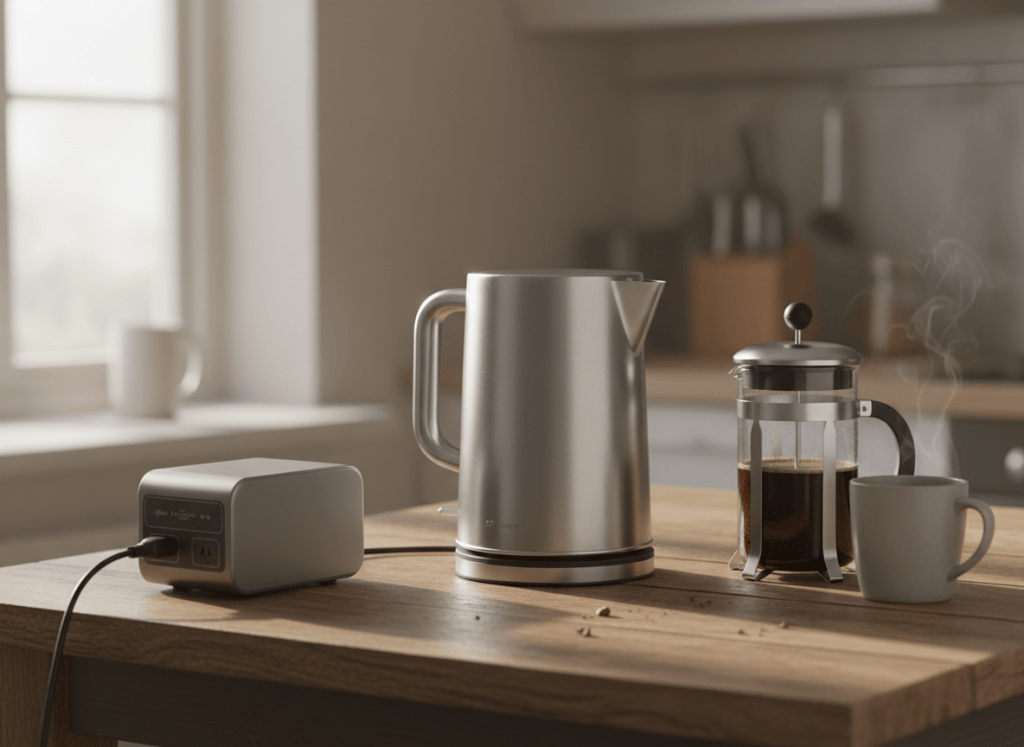
Quick answer: yes, most 1 kWh and larger power stations can run a coffee maker or an electric kettle, as long as their continuous AC output is above the appliance’s wattage: about 900 W for a typical 12-cup drip coffee maker like the Mr. Coffee Programmable, and 1,500 W for a kettle like the Cuisinart PerfecTemp. Energy is the easy part: boiling 1 liter of water takes about 100 Wh, so a 1 kWh station boils roughly 8–9 liters on a full charge.
How we wrote this: appliance wattages come from retailers’ published specifications; power station ratings from each maker’s official pages. Energy figures are our estimates, with the math shown. We haven’t run these appliances on these units ourselves. See How We Test.
How many watts do coffee makers and kettles use?
Both are heaters: they turn electricity into heat, so they draw close to their full rating the whole time they’re heating. Look for the wattage on the label under the base or in the specs.
| Appliance | Rated power | Minimum station output |
|---|---|---|
| Mr. Coffee 12-Cup Programmable (drip) | 900 W | 1,000 W or more |
| Mr. Coffee Rapid Brew 12-Cup (drip) | 1,100 W | 1,200 W or more |
| Cuisinart PerfecTemp CPK-17 (kettle, 1.7 L) | 1,500 W | 1,800 W recommended |
Unlike a fridge or a pump, a heater has no motor, so there’s no big start surge. The only thing that matters is continuous output.
Which power stations can run them?
| Power station | Continuous output | 900 W coffee maker | 1,500 W kettle |
|---|---|---|---|
| EcoFlow RIVER 3 Plus (286 Wh) | 600 W | No | No |
| Jackery Explorer 1000 v2 (1,070 Wh) | 1,500 W | Yes | At the limit; nothing else on |
| EcoFlow DELTA 3 Plus (1,024 Wh) | 1,800 W | Yes | Yes, alone |
| Anker SOLIX C1000 Gen 2 (1,024 Wh) | 2,000 W | Yes | Yes |
| Anker SOLIX C2000 Gen 2 (2,048 Wh) | 2,400 W | Yes | Yes, with the fridge on |
| EcoFlow DELTA 3 Max Plus (2,048 Wh) | 3,000 W | Yes | Yes, with the fridge on |
How much battery does a cup of coffee use? The math
For a kettle, you can calculate it from the water itself. Heating 1 liter of water from room temperature (68°F, 20°C) to boiling takes about 93 Wh in theory. Some heat escapes, so we plan on about 100 Wh per liter.
Kettle: Wh ≈ liters × 100
Coffee maker: Wh = rated watts × minutes brewing ÷ 60
Uses per charge = (battery Wh × 0.85) ÷ Wh per use
- Water for two mugs: about 0.5 liters.
- Energy: 0.5 × 100 = about 50 Wh.
- Time on a 1,500 W kettle: 50 Wh ÷ 1,500 W × 60 ≈ 2 minutes.
- Usable energy on 1 kWh: 1,024 × 0.85 ≈ 870 Wh.
- Divide: 870 ÷ 50 ≈ 17 two-mug boils.
| Task | Energy (est.) | 1 kWh (1,024 Wh) | 2 kWh (2,048 Wh) |
|---|---|---|---|
| Kettle, 0.5 L (two mugs) | ~50 Wh | ~17 times | ~35 times |
| Kettle, 1 L (French press) | ~100 Wh | ~8–9 times | ~17 times |
| Kettle, full 1.7 L | ~170 Wh | ~5 times | ~10 times |
| Drip pot, 900 W for about 10 minutes | ~150 Wh | ~5–6 pots | ~11 pots |
For perspective, a whole pot of coffee uses about the same energy as running an average refrigerator (62.5 W) for two hours. See how long a power station runs a refrigerator.
Kettle or drip coffee maker: which is better on battery?
| If you… | Use | Why |
|---|---|---|
| Have a 1,500 W or smaller station | Drip coffee maker (≈900 W) | Lower power fits more units |
| Make one or two cups | Kettle + French press or pour-over | You heat only the water you drink |
| Make a full pot for a family | Drip coffee maker, warmer off | Similar energy; pour into a thermos |
| Want tea, oatmeal or instant noodles too | Kettle | One appliance for all hot water |
How to make coffee during an outage
- Check the wattage on your coffee maker or kettle before an outage.
- Boil only what you need. The kettle’s water window makes it easy.
- Unplug other big loads for the few minutes of heating if your station is 1,500–2,000 W.
- Skip the warming plate. Pour the coffee into a thermos or insulated carafe and switch the machine off.
- Heat water once for everything: coffee, tea and oatmeal from one boil.
- Plug straight into the station, not through a power strip.
Three real-world scenarios
1. Morning coffee during an overnight outage, 1 kWh station
The fridge alone empties a 1 kWh station in about 12 hours (about 72.5 W including the inverter). Boiling 0.5 L for two mugs uses about 50 Wh, which costs the fridge roughly 40 minutes of runtime. A fair trade for most people, but a full 1.7 L kettle would cost about 2.3 hours.
2. Three-day camping trip, 1 kWh station
Two French-press mornings a day at 0.5 L each use about 100 Wh daily, or 300 Wh for the trip. That leaves about 570 Wh for lights, phones and a fan. Note that the station must handle a 1,500 W kettle; a 900 W coffee maker is easier on units like the Jackery Explorer 1000 v2. See our camping picks.
3. Working from home during an outage
A 900 W drip coffee maker plus a laptop setup (about 100 W) totals about 1,000 W, fine even on a 1,500 W station. Brewing a full pot takes about 150 Wh, less than two hours of the office setup. See power station vs UPS for a home office.
Common mistakes
- Plugging a 1,500 W kettle into a small station. Units under 1,500 W continuous shut off immediately.
- Filling the kettle to the top for one mug. You pay for every liter you heat.
- Leaving the warming plate on for hours. It keeps drawing power long after brewing.
- Running the kettle and microwave together. Two heaters can add up to 3,000 W. One at a time.
- Forgetting the fridge. On 1 kWh, every hot drink comes out of the fridge’s runtime.
Frequently asked questions
What size power station do I need for a coffee maker?
For a 900 W drip machine, at least 1,000 W of continuous output; for a 1,500 W kettle, about 1,800 W. Capacity-wise, even 1 kWh makes several pots or many kettles of water.
Can a 1,000 W power station run an electric kettle?
Not a standard 1,500 W kettle. Check the label: some small travel kettles use less, and those can fit under 1,000 W.
How many watt-hours does it take to boil water?
About 93 Wh per liter in theory from room temperature to boiling, and roughly 100 Wh in practice. Colder starting water takes a little more.
Can solar panels power my morning coffee?
Yes, indirectly. About 200 W of panels (roughly 150 W real output) replaces a 50 Wh two-mug boil in about 20 minutes of good sun. See how many solar panels you need.
Is it safe to run a kettle from a power station?
Yes, if the station’s output covers the kettle and you plug it in directly. Keep both on a dry, stable surface, since spilled water and electronics don’t mix.
The bottom line
Coffee is one of the cheapest luxuries on battery power. The hurdle is output, not capacity: 900 W for a drip machine, 1,500 W for a kettle. Heat only what you drink, skip the warming plate, and your morning cup costs less than an hour of fridge time. For other kitchen appliances, see can a power station run a microwave, and size your whole list with what size power station do I need.
Sources
- Mr. Coffee 12-Cup Programmable Coffee Maker, wattage as listed by Do it Best; Mr. Coffee Rapid Brew, wattage as listed by Kohl’s.
- Cuisinart PerfecTemp CPK-17C kettle, wattage as listed by Chef Supplies.
- Energy to heat water: our calculation using the specific heat of water (about 4.19 J per gram per °C).
- EcoFlow, DELTA 3 Plus specifications; Anker SOLIX, C2000 Gen 2 specifications. Other models: see our linked reviews and their sources.

