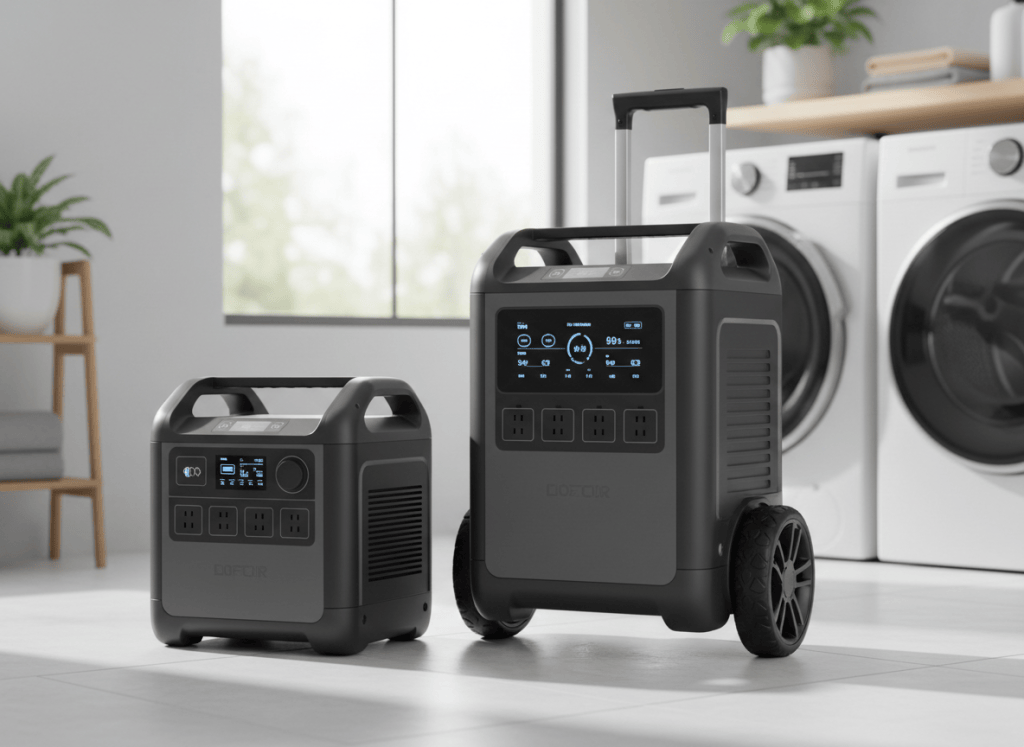
Quick answer: choose a 1 kWh power station like the EcoFlow DELTA 3 Plus if you mainly need a refrigerator overnight plus phones, Wi-Fi, lights or a CPAP, or if you want to start smaller and expand later. Choose a 2 kWh unit like the EcoFlow DELTA 3 Max Plus if you want a full day of refrigerator backup without recharging or need to run bigger appliances like a microwave alongside the fridge. The 2 kWh model doubles runtime and raises output from 1,800 W to 3,000 W, but it’s about 21 lb heavier.
| Question | 1 kWh (DELTA 3 Plus) | 2 kWh (DELTA 3 Max Plus) |
|---|---|---|
| Average fridge alone | ~12 hours | ~24 hours |
| Can it run a microwave with the fridge on? | Tight at 1,800 W | Yes, 3,000 W |
| Can one person carry it easily? | Yes, 27.6 lb | Two-hand lift, about 48.7 lb |
| Can it grow? | Yes, to 5 kWh | Check EcoFlow’s current options |
How we compared: a specification comparison using EcoFlow’s official specifications, an independent spec review and an authorized retailer listing, not a hands-on test. Runtimes are our calculated estimates. See How We Test.
Full specs side by side
| Specification | DELTA 3 Plus (1 kWh) | DELTA 3 Max Plus (2 kWh) |
|---|---|---|
| Capacity | 1,024 Wh | 2,048 Wh |
| Battery | LiFePO4, 4,000 cycles to 80% | LiFePO4 |
| AC output (surge) | 1,800 W (3,600 W) | 3,000 W (6,000 W) |
| AC outlets | 6 | 4 (20 A each) |
| USB-C | 2 × 140 W | 1 × 140 W, 2 × 45 W |
| USB-A | 2 fast-charge (36 W max) | 1 × 18 W |
| 12 V outputs | Car outlet (126 W) + 2 DC5521 | Car outlet (126 W) + Anderson port (12.6 V, 30 A, 378 W), sharing power |
| Max AC charging | 1,500 W; full in 56 min | 1,800 W; 0–80% in about 68 min |
| Max solar input | 1,000 W (2 × 500 W) | 1,000 W |
| UPS switchover | Under 10 ms | Under 10 ms |
| Charging temperature | See EcoFlow manual | 32–113°F (0–45°C) |
| Dimensions | 15.7 × 8.0 × 11.2 in | 19.4 × 9.5 × 12 in |
| Weight | 27.6 lb | About 48.7 lb |
| Expandable | Yes, up to 5 kWh | Check current options |
| Warranty | 5 years | 3 years + 2 with registration |
Runtime: the 2 kWh model doubles it
| Device | 1 kWh (DELTA 3 Plus) | 2 kWh (DELTA 3 Max Plus) |
|---|---|---|
| Average refrigerator (1.5 kWh/day) | ~12 hours | ~24 hours |
| Fridge + Wi-Fi + lamp + phones | ~9 hours | ~18 hours |
| CPAP, humidifier off | ~2.7 nights | ~5.4 nights |
| CPAP, humidifier on | ~1.7 nights | ~3.3 nights |
| Wi-Fi router and modem | ~35 hours | ~70 hours |
| Laptop (via AC) | ~14–15 hours | ~29 hours |
| 50-inch LED TV | ~8 hours | ~16 hours |
| Microwave (1,000 W) | ~50 minutes of cooking | ~1 hour 45 minutes of cooking |
| Space heater (1,500 W) | ~35 minutes | ~70 minutes |
Output: 2 kWh runs bigger appliances
At 3,000 W (6,000 W surge), the Max Plus can run a microwave, coffee maker or kettle while the refrigerator keeps going, and still start the fridge’s compressor on top. The 1,800 W DELTA 3 Plus can run a microwave on its own, but stacking it with a fridge startup leaves little headroom. High-watt appliances drain any battery fast, so keep them to short bursts; see our space heater guide for why.
Ports: more outlets on the 1 kWh, more heavy-duty DC on the 2 kWh
Surprisingly, the smaller DELTA 3 Plus has more AC outlets (six versus four) and two 140 W USB-C ports. The Max Plus trades those for higher-current 20 A outlets and a 30 A Anderson port, useful for RV setups and high-draw 12 V equipment.
The third option: 1 kWh now, expand later
Because the DELTA 3 Plus accepts EcoFlow extra batteries up to 5 kWh, you don’t have to decide everything today. Buy 1 kWh, live through a season of outages, and add a battery if you need more time. The trade-offs: the output stays at 1,800 W no matter how much capacity you add, and a base unit plus extra battery is two boxes instead of one.
| DELTA 3 Plus + extra battery | DELTA 3 Max Plus | |
|---|---|---|
| Capacity | Flexible, up to 5 kWh | 2 kWh |
| Output | Stays at 1,800 W | 3,000 W |
| Upfront cost | Lower at first; spread over time | Higher, all at once |
| Setup | Two units to store and connect | One box |
Which should you buy?
| If you… | Choose |
|---|---|
| Mainly need phones, Wi-Fi, lights or a CPAP | 1 kWh |
| Need the fridge overnight during short outages | 1 kWh |
| Are unsure how long your outages will be | 1 kWh, expandable |
| Also want it for camping or road trips | 1 kWh |
| Want a full day of fridge backup | 2 kWh |
| Want to use a microwave or kettle during outages | 2 kWh |
| Face multi-day outages | 2 kWh or more, plus solar; see our home backup picks |
Want the most output in a 1 kWh box instead? Compare the Anker SOLIX C1000 Gen 2 (2,000 W, no expansion). Still unsure? Add up your own devices with our sizing guide, or read the full DELTA 3 Plus review.
Frequently asked questions
Is 2 kWh enough to keep a refrigerator running for a day?
For an average fridge using about 1.5 kWh per day, yes, roughly 24 hours on its own. Add Wi-Fi, lights and phones and it’s closer to 18 hours. See our refrigerator runtime guide to calculate your own fridge.
How long does each take to charge with solar?
Both accept up to 1,000 W. With real-world losses, the 1 kWh unit refills in roughly 1.5 hours of strong sun and the 2 kWh unit in roughly 3 hours. See how many solar panels you need.
Is a 2 kWh unit portable?
It’s movable rather than portable. At around 48.7 lb, it’s fine to move between rooms or load into a car, but it’s not something you’ll carry to a campsite.
The bottom line
If your priority is overnight backup and light loads, or you’re unsure, 1 kWh is enough and leaves room to expand. If you want a full day on the fridge or bigger appliances from day one, go straight to 2 kWh.
Sources
- EcoFlow, DELTA 3 Plus (official product page).
- EcoFlow, DELTA 3 Max Plus specifications (official).
- StorageReview, DELTA 3 Max Plus and Ultra Plus review.
- Outbound Power, EcoFlow DELTA 3 series specification table (authorized retailer).

