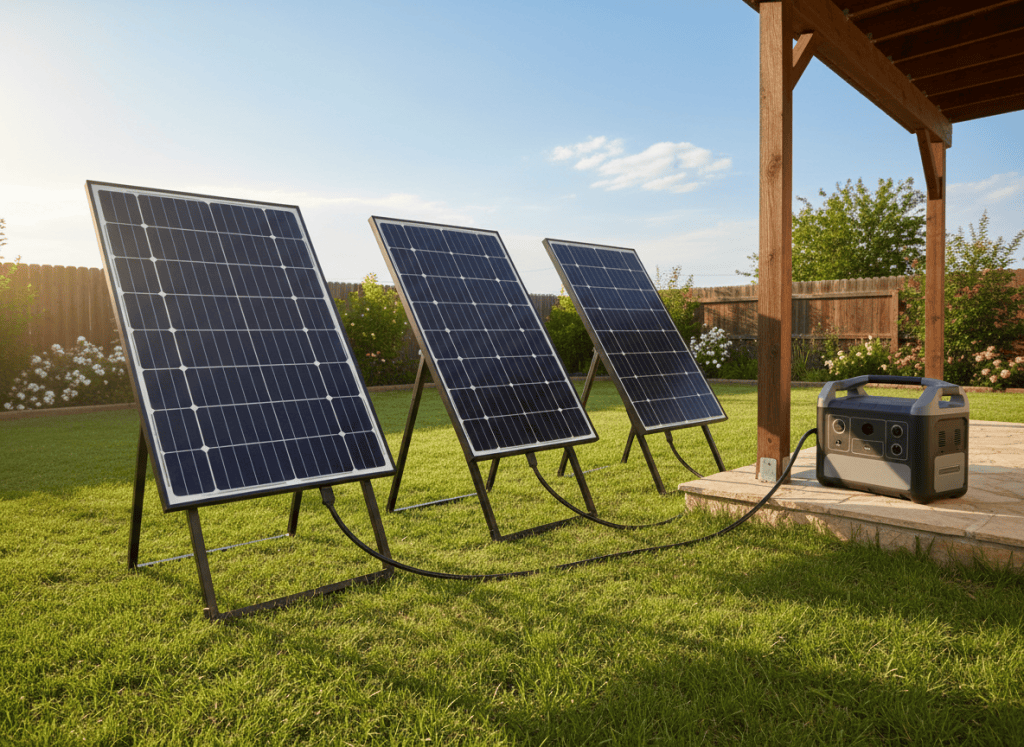
Quick answer: to fully charge a 2,000 Wh power station in one day, you need roughly 450–900 W of solar panels, which is about three to five 200 W panels. Sunny places like the Southwest sit at the low end of that range; cloudier regions and winter months need the high end. Your power station’s maximum solar input is the other limit: panels beyond it add nothing.
Figures below are calculated estimates. Peak sun hours vary with location, season and weather. See How We Test.
The formula
Solar watts needed = battery Wh ÷ (peak sun hours × 0.75)
- Peak sun hours are the equivalent hours per day of full-strength sunlight. Across the U.S. they typically range from about 3 to 6, depending on where you live and the time of year.
- 0.75 accounts for real-world losses: panel heat, imperfect angles, cables and charging efficiency. Panels rarely deliver their full rated watts outside a lab.
Example: 2,000 Wh ÷ (5 × 0.75) = about 533 W. Round up to 600 W, or three 200 W panels.
Solar panel chart by battery size
Watts of panels needed to charge from empty to full in one day:
| Battery | 3 sun hours | 4 sun hours | 5 sun hours | 6 sun hours |
|---|---|---|---|---|
| 500 Wh | ~220 W | ~170 W | ~135 W | ~110 W |
| 1,000 Wh | ~445 W | ~335 W | ~265 W | ~220 W |
| 1,500 Wh | ~665 W | ~500 W | ~400 W | ~335 W |
| 2,000 Wh | ~890 W | ~665 W | ~535 W | ~445 W |
| 3,000 Wh | ~1,335 W | ~1,000 W | ~800 W | ~665 W |
How many panels is that?
Divide the watts from the chart by your panel size and round up:
- 2,000 Wh at 5 sun hours ≈ 535 W → three 200 W panels, or two 400 W panels.
- 2,000 Wh at 4 sun hours ≈ 665 W → four 200 W panels.
- 1,000 Wh at 5 sun hours ≈ 265 W → two 200 W panels with room to spare.
Don’t forget the input limit
Your power station caps how much solar it can use. The EcoFlow DELTA 3 Plus, for example, accepts up to 1,000 W across two ports, while the Jackery Explorer 1000 v2 accepts up to 400 W. Buying 800 W of panels for a 400 W input just means half of them sit idle. Also keep the panels’ combined voltage within the input range; our solar charging guide explains how to wire them safely.
Do you really need a full charge every day?
Often not. During an outage, what matters is whether solar can replace what you use each day. If your essentials use 1,000 Wh per day, you need enough panels to put back 1,000 Wh, not to fill a 2,000 Wh battery from empty. Figure out your daily use with our sizing guide, then use the 1,000 Wh row of the chart.
Tips for getting more from fewer panels
- Re-angle the panels toward the sun every couple of hours.
- Avoid even partial shade from trees, railings or roof edges.
- Charge during the middle of the day, when sun is strongest.
- Reduce what you run during the day so more energy goes into the battery.
Frequently asked questions
Can one 100 W panel charge a 2,000 Wh power station?
Technically, but slowly. At about 75 W of real output and 5 sun hours, it adds roughly 375 Wh per day, so a full charge would take more than five sunny days.
How many sun hours do I get where I live?
As a rough guide, sunny southern and southwestern states often see 5–6 or more, much of the country falls around 4–5, and cloudier northern areas and winter months can drop to about 3 or less. Plan with your worst season, not your best.
The bottom line
For a 2,000 Wh power station, plan on about 450–900 W of panels depending on your sun, and never more than your unit can accept. If you only need to replace daily use during an outage, you may need far fewer.


Leave a comment