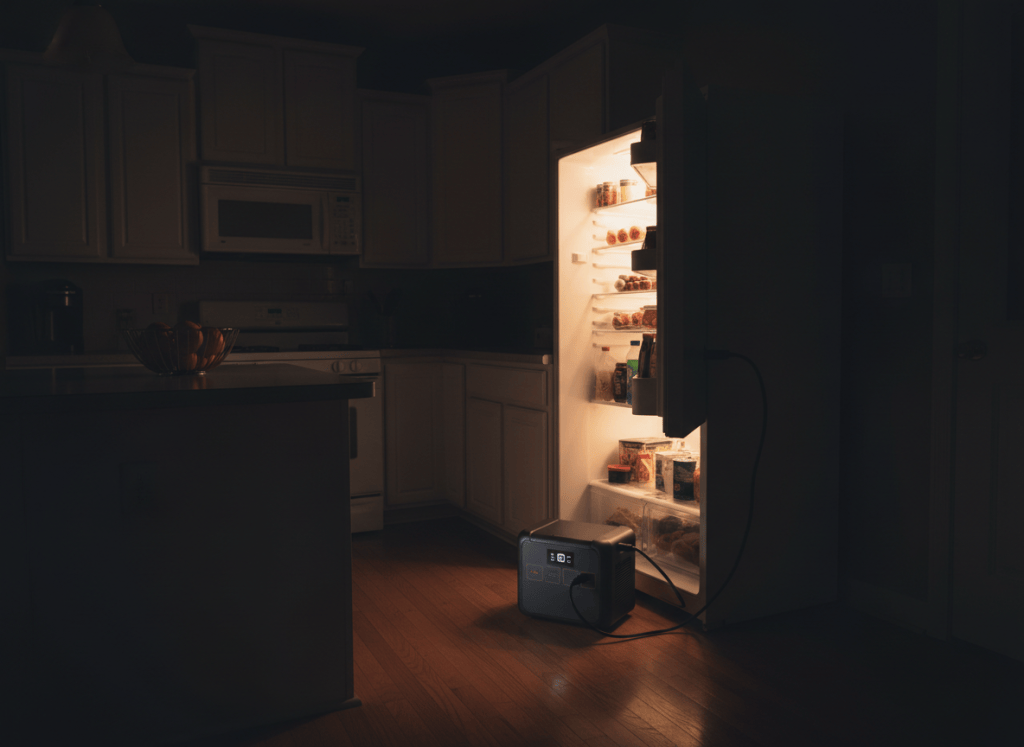
Quick answer: a 1,000 Wh portable power station will run a typical full-size refrigerator for roughly 9 to 16 hours. A 2,000 Wh unit stretches that to about 18 to 33 hours. Where your fridge lands in that range depends on one number: how many kilowatt-hours it uses per day.
Below you’ll find a runtime chart for every common battery size, the simple formula to calculate your own refrigerator in two minutes, and the food safety rules that matter when the power is out.
How we got these numbers: the runtimes in this article are calculated estimates based on typical refrigerator consumption and power station efficiency, with the math shown below. We will add measured results from our own hands-on tests as we complete them. See How We Test.
Refrigerator runtime chart by power station size
Find your power station’s capacity in the left column, then pick the column that matches your fridge. A newer ENERGY STAR full-size fridge usually uses about 1.0 kWh per day; an average fridge about 1.5 kWh; an older or large side-by-side model 2.0 kWh or more.
| Power station capacity | Efficient fridge (1.0 kWh/day) | Average fridge (1.5 kWh/day) | Older or large fridge (2.0 kWh/day) |
|---|---|---|---|
| 500 Wh | ~8 hours | ~6 hours | ~4.5 hours |
| 1,000 Wh | ~16 hours | ~12 hours | ~9 hours |
| 1,500 Wh | ~25 hours | ~18 hours | ~14 hours |
| 2,000 Wh | ~33 hours | ~23 hours | ~18 hours |
| 3,000 Wh | ~49 hours | ~35 hours | ~27 hours |
Two things jump out. First, battery size matters more than brand: doubling capacity roughly doubles runtime. Second, the fridge itself matters almost as much. The same 1,000 Wh unit can give you 16 hours or 9 hours depending on how efficient your refrigerator is.
How to calculate runtime for your own fridge
You don’t need to guess. The whole calculation takes four steps.
Step 1: Find your fridge’s daily energy use
Look for the yellow EnergyGuide label that came with your refrigerator, or search your model number online. It lists estimated energy use in kWh per year. Divide by 365 to get kWh per day.
Example: a fridge rated at 548 kWh per year uses 548 ÷ 365 = 1.5 kWh per day.
For the most accurate number, plug your fridge into an inexpensive plug-in watt meter for 24 hours. It shows exactly how many kWh it used, including the effect of your kitchen temperature and your family’s habits.
Step 2: Convert to average watts
A fridge’s compressor cycles on and off all day, so what matters for runtime is the average power draw, not the number on the compressor. Multiply kWh per day by 1,000 and divide by 24.
Example: 1.5 kWh × 1,000 ÷ 24 = 62.5 W average.
Step 3: Work out usable battery capacity
You never get 100% of the rated watt-hours out of a power station’s AC outlets. Converting battery power to household AC wastes some energy as heat. A realistic planning figure is 85% of the rated capacity.
Example: a 1,000 Wh unit gives about 1,000 × 0.85 = 850 usable Wh.
Step 4: Divide, including inverter overhead
The inverter also draws a small amount of power just by being on, even while the compressor rests. Adding about 10 W to the fridge’s average keeps the estimate honest.
Runtime (hours) = usable Wh ÷ (fridge average watts + 10 W)
Example: 850 ÷ (62.5 + 10) = about 11.7 hours.
Capacity isn’t enough: check the surge rating
Every time a refrigerator compressor kicks on, it pulls a brief spike of power, often several times its normal running watts, for a fraction of a second. If the power station’s inverter can’t handle that spike, it shuts off or refuses to start the fridge, no matter how big the battery is.
- Full-size fridges: as a rule of thumb, look for at least 1,000 W of continuous AC output and a surge rating well above that.
- Mini fridges and 12 V compressor coolers: most small power stations handle these easily.
- Waveform: use a pure sine wave inverter. Nearly all current power stations from major brands are pure sine wave, but check the spec sheet before you buy.
What size power station do you need for a fridge?
Start from how long you need to cover, not from the biggest unit you can afford.
| Your situation | Suggested capacity | Why |
|---|---|---|
| Short outages (a few hours to one night) | 1,000–1,500 Wh | Covers an average fridge overnight with room for phones and a router |
| Outages up to a full day | 2,000 Wh | About 18–33 hours for a full-size fridge alone |
| Multi-day outages (hurricanes, winter storms) | 3,000 Wh or more, plus solar panels | Solar refills the battery during the day so the fridge keeps running |
Food safety during an outage: the numbers that matter
A power station buys you time, but food safety depends on temperature, not on how many hours the fridge was plugged in. These are the U.S. public health guidelines worth knowing:
- Without power and with the doors closed, food stays safe for about 4 hours in a refrigerator, 48 hours in a full freezer and 24 hours in a half-full freezer.
- Target temperatures: keep the refrigerator at 40°F (4°C) or below and the freezer at 0°F (−18°C) or below. An inexpensive appliance thermometer in each is the only way to know for sure.
- When to throw food out: discard perishable food such as meat, poultry, seafood, eggs and leftovers that has been above 40°F for two hours or more. Never taste food to decide. When in doubt, throw it out.
- Thawed freezer food can be refrozen if it still has ice crystals or is at 40°F or below.
This is where a power station earns its price: keeping the fridge cold is far cheaper than replacing a full refrigerator of food, and it protects medicines that need refrigeration, such as insulin. If you store refrigerated medication, ask your pharmacist how long it stays safe at room temperature and plan your backup around that.
7 ways to make your power station last longer
- Charge it before the storm. A power station stored at 50% gives you half the runtime in this article.
- Keep the doors closed. Every opening lets cold air out and makes the compressor run longer.
- Fill empty space. Jugs of water or frozen gel packs hold cold, so the compressor cycles less often.
- Turn off extras. Switch off the ice maker and any door heaters or “power saver” features that add load.
- Power the fridge in cycles. Instead of running it nonstop, plug it in for an hour, unplug it for a few hours and repeat, while a thermometer confirms it stays at 40°F or below. This can stretch one charge across a much longer outage.
- Recharge with solar. Panels connected to the power station refill the battery during daylight. How fast depends on panel wattage and sunlight; we cover this in our solar charging guides.
- Unplug everything else. Phones and a Wi-Fi router add little, but a coffee maker or space heater can drain a battery in minutes.
Frequently asked questions
Can a 500 Wh power station run a refrigerator?
Sometimes. A 500 Wh unit can run an efficient full-size fridge for roughly 4 to 8 hours, but many units in this class have inverters too small to handle the compressor’s startup surge. It is a better match for a mini fridge or a 12 V compressor cooler.
Can a power station run a refrigerator overnight?
Yes, with at least 1,000 Wh for an average full-size fridge. For 10 to 12 hours of darkness, a 1,000 Wh unit is cutting it close with an older fridge; 1,500 Wh or more gives you a comfortable margin.
Can I run a fridge and a freezer at the same time?
Yes, if the power station can handle both startup surges and you add both appliances’ daily consumption in the formula. Runtime drops accordingly. Because a full freezer stays safe for about 48 hours on its own, many people prioritize the refrigerator and plug in the freezer only occasionally.
Can I charge the power station while it runs the fridge?
Most current models support pass-through charging, so they can keep powering the fridge while solar panels or a car outlet recharge them. Check the manual for your specific model.
The bottom line
For most households, a power station of 1,000 to 2,000 Wh with at least 1,000 W of AC output keeps a full-size refrigerator running through a typical outage. Check your fridge’s EnergyGuide label, run the four-step formula above and you will know your own number before you buy.
Sources
- Centers for Disease Control and Prevention, Keep Food Safe After a Disaster or Emergency.
- FoodSafety.gov, Avoid Foodborne Illness During Temporary Power Outages.


Leave a comment